"We start by locking the children in cages ..."
Before you get the wrong idea and report me for egregious and improper conduct, let me explain the game that my students and I invented for drama class.
My official title is "teacher-librarian", but if you looked at my schedule (this year and in the past), a huge chunk of my time is spent teaching drama and dance. It's a lot of fun. The students have particular activities that they really enjoy doing, and while trying to brainstorm how to do similar but different tasks, the students and I created this role play.
In the Toronto District School Board resource document called Treasures for Teaching and The Treasure Chest, there's a section that explains about role playing with young students. (I'll quote it here when I grab the book from school.) To paraphrase briefly, it encourages teachers to play pretend along with their students.
(ETA Pages 19-24 of Treasures for Teaching: Story, Drama and Dance in the Primary Classroom (3rd Edition) describes Dramatic Play as "pretend play, in which children become different characters in different times and places having different experiences." It also says "The world of dramatic play is the world of pretend, where all things are possible. In this domain of make-believe, children construct people, places, objects and events. They draw upon real-life experiences, everyday observations, and their favourite stories to shape their dramas. Children step into various roles, exploring multiple points of view, which teaches them to imagine how another thinks and feels.")
The students love playing "Toy Store", an activity I borrowed from the days when my own daughter took drama classes at The Drama Workshop on Yonge Street. In this scenario, the children are toys that come to life when the toy store owner (played by an adult) isn't watching. The students at my school go absolutely bananas when they play it. There's plenty of creative planning that goes on "between the scenes". We talk about what the toy store owner could do to try and discover why her toys are always off the shelves when she returns from a break. The students make great suggestions, and they also come up with great suggestions for how the toys can stay undetected. (For instance, after one conversation, the toy store owner installed security cameras all around the store. When the toys came to life after the toy store owner left for the day, they immediately smashed all the cameras or turned them so they'd film the wall instead of the shelves!)
There's only so many times I can play "Toy Store" before I get tired of it. (For the record, the students NEVER get tired of it!) Based on their keen interest in our school library pets, two skinny pigs named Chocolate and Vanilla, I decided to make a new variation of this type of game by inventing "Pets at the Pound".
Before we played "Pets at the Pound", we had a short talk about what a pound was for animals. We distinguished it from a pet store in several key ways, the main one being that the animals were often strays or turned in by owners who could no longer keep them. The animals in the pound were anxious to have a home. We used chairs as kennels and cages. Students chose whether to be a dog or a cat and stayed in their "cages", hoping that a visitor to the pound would choose them and adopt them.
This game has several unintended advantages.
1) "Main Stage" and "Side Stage" Role Play
Unlike "Toy Store", where all the action is focused on the toy store owner's arrival and departure, there's opportunities for many other things to be happening simultaneously. While the pound employee shows prospective pet owners some of the animals in the cages, other animals are conversing with each other (with barks and meows), while others try to escape their cages and others try very hard to get the attention of humans or other animals.
2) Shared Power Dynamics
Once we played "Pets at the Pound" a couple of times, we passed on roles like the Pound Employee and Potential Pet Owner to the students. The ECE and I went to our cages and pretended to be dogs or cats, while the students wandered around from cage to cage, with their role props (keys for the employee, balls or pretend treats for the visiting humans). They were very good at telling wandering animals to get back in their cages.
3) Common Experience AND New Experience
Most children know about dogs and cats, so even the students who don't speak English could participate, because speaking English wasn't an issue. Yet, there are still experiences they have not yet had that I didn't realize until we played this game. When we play "Pets at the Pound", it gets REALLY loud. One of the SK students said, "Does it really have to be so noisy?"
"Have you ever been to a real pound?" I asked. She hadn't. Perfect - a possible field trip for 2016!
4) Open-Ended Content
I'm always amazed by the directions the students take the role play. One pair of students, pretending to be shopping for a pet, took out a dog and then asked if they could give the dog a bath. This was completely their idea. Others took the dogs for walks, or brushed them.
5) Links to Other Subject Areas
I also teach kindergarten media literacy, and when we had a post-role-play conversation, some of the students talked about how they (as dogs and cats) wish they had been picked but weren't. Perfect moment for empathy! The ECE and I said that this might be how actual animals feel when they are passed over for adoption, and then we brainstormed what could be done to draw attention to the animals. The students said we could make signs and posters. We took a media class to "draw in role" and make posters featuring themselves as a dog or cat, with details (like age, cost, and colour) and orally, they gave reasons for why they would make a good pet for someone.
I'm thinking of writing this description up and sharing it with CODE (Council of Drama and Dance Educators), if they'll have it. It's been a lot of fun and as long as I describe it in a way that doesn't make it sound like I'm locking children up in cages for jollies, I'll be safe and we'll keep playing.
ETA: Here are some photos of one class playing "Pets at the Pound". Student faces have been covered to protect privacy.
Monday, December 14, 2015
Monday, December 7, 2015
Memes - from Twitter Inspiration to Project Finale
Inspiration can come from many sources. I noticed at my school that many classes have been displaying some new, appealing artwork by students. When I asked the teachers how they came up with these art ideas, the answer is often "Pinterest".
Although I have a Pinterest account, I know I don't use it as effectively as I could. My go-to social media site for professional ideas is still Twitter. Thanks to Twitter, I was swept up in book spine poetry creation thanks to the Toronto Public Library and Kansas City Public Library's public "friendly feud" and Fran Potvin-Schaefer's TDSB library challenge. Way back in October, I saw a link to a blog post about creating memes with students. As I tweeted, it was perfect timing because of a teacher who wanted to collaborate with me.
The students were very excited to make memes. They thought it'd be easy. What they soon learned (like I did last week with my Much Ado About Nothing Twitter play) is that comedy is complicated. Making something funny with an important message as well wasn't easy. Finding the right image and using the right combination of just a few words was more challenging than they originally thought.
We used the article Julie cited as a discussion starter in class. There was still room for improvement in student comprehension, as they came to the library to print their memes in colour. One ELL student had selected a photo of a person with a developmental delay wearing a Superman suit and a goofy facial expression as the image for her meme. She did not understand that the visual was intended to mock the man rather than make him appear heroic. The classroom teacher grabbed the teaching moment and explained why this photo was disrespectful and helped the student select a better shot.
Students also used SMART Senteo Response clickers to answer questions about what constituted a meme vs a brochure, generating some media literacy marks so students could "identify the conventions and techniques used in some familiar media forms and explain how they help convey meaning and influence or engage the audience".
I'll try and post both the hall display of the finished projects as well as the anchor chart (developed with the students) about the characteristics of a meme here on this blog so that there are examples.
ETA: Here are some of the final products!
I'm grateful I was able to partner up with this teacher for what turned out to be a very engaging and interesting project. (Our next project together? Wab Kinew's Craft Reconciliation challenge!)
Although I have a Pinterest account, I know I don't use it as effectively as I could. My go-to social media site for professional ideas is still Twitter. Thanks to Twitter, I was swept up in book spine poetry creation thanks to the Toronto Public Library and Kansas City Public Library's public "friendly feud" and Fran Potvin-Schaefer's TDSB library challenge. Way back in October, I saw a link to a blog post about creating memes with students. As I tweeted, it was perfect timing because of a teacher who wanted to collaborate with me.
. @sandypittelli @ZeliaMCT @jsm2272 This post is perfect timing! Partnering with a Grade 5/6 teacher & she wants to incorporate memes. Thx!
— Diana Maliszewski (@MzMollyTL) October 6, 2015
Julie Millan gave us another great perspective and reminded us about ethics and digital citizenship.
@MzMollyTL @sandypittelli @ZeliaMCT You might want to consider this angle too #digcit http://t.co/nZeQFBWtpR
— Julie Millan (@jsm2272) October 6, 2015
So, how did the projects fare? Quite well, actually! The original blog post that inspired my work didn't make public the bank of images that the teacher-librarian collected, so I did some digging around and found a few meme generators. Many had inappropriate content for school use but this one seemed the tamest:imgflip.com/memegeneratorAs the teacher and I planned the unit and explored using memes for social studies and social justice, we agreed that using just a meme would be insufficient to share all they learned as part of their research project. The final task was tweaked so that students would create a brochure and a meme for the NGO charity of their choice.
The students were very excited to make memes. They thought it'd be easy. What they soon learned (like I did last week with my Much Ado About Nothing Twitter play) is that comedy is complicated. Making something funny with an important message as well wasn't easy. Finding the right image and using the right combination of just a few words was more challenging than they originally thought.
We used the article Julie cited as a discussion starter in class. There was still room for improvement in student comprehension, as they came to the library to print their memes in colour. One ELL student had selected a photo of a person with a developmental delay wearing a Superman suit and a goofy facial expression as the image for her meme. She did not understand that the visual was intended to mock the man rather than make him appear heroic. The classroom teacher grabbed the teaching moment and explained why this photo was disrespectful and helped the student select a better shot.
Students also used SMART Senteo Response clickers to answer questions about what constituted a meme vs a brochure, generating some media literacy marks so students could "identify the conventions and techniques used in some familiar media forms and explain how they help convey meaning and influence or engage the audience".
I'll try and post both the hall display of the finished projects as well as the anchor chart (developed with the students) about the characteristics of a meme here on this blog so that there are examples.
ETA: Here are some of the final products!
I'm grateful I was able to partner up with this teacher for what turned out to be a very engaging and interesting project. (Our next project together? Wab Kinew's Craft Reconciliation challenge!)
ANNOUNCING #CraftReconciliation: get students talking about reconciliation & building their vision 4 it in Minecraft https://t.co/7dvwWofXgL
— Wab Kinew (@WabKinew) November 13, 2015
Monday, November 30, 2015
Back to the Virtual Stage
Just when I swore I was not going to take on another project, Danika Tipping (Barker) offered me an opportunity that I just couldn't pass up.
Several years ago - I can't believe it was way back in 2011 - Danika organized Brevity is the Soul of Twit - experiencing Hamlet via Twitter. I was Osric and I reflected a LOT on the experience. I may have gone a bit overboard on the behind-the-scenes preparation, even going so far as to create his own Goodreads account and posting my notes about Osric. I may not be Heath Ledger, but I really took the role seriously and had a fantastic and educational time doing it.
Fast forward to 2015. Danika is at it again. This time, it's not a tragedy - it's a comedy. (Much Ado About Nothing). My part is not a minor one like Osric - it's Don Pedro, the Spanish Prince, one of the main characters in the play. Another couple of big differences this time around are that a) I've never read or studied Much Ado About Nothing and b) I didn't have the same amount of time to prepare.
My colleagues have already begun to blog about their experience with doing Shakespeare via Twitter. Niall Cooke has shared how he had some trepidation about the prospect. Danika described how she approached it differently in terms of organization. I *have* to approach it differently myself this time - this is improvisational, without as much advanced preparation. I'm flying by the seat of my princely Spanish pants right now. What have I learned so far?
1) It IS possible to cram a bit and get by.
This isn't a lesson I'd recommend to my students, but it is true. I've read play summaries and character descriptions on various websites but I have a huge copy of The Complete Works of Shakespeare semi-permanently open to the act and scene we are presently portraying and I read and re-read the portions intensely. (Part of this was my fault - I thought I had an extra week to read and ponder my motivations but I didn't.)
2) Comedy is hard.
Humor depends so much on context, situation, cultural and historical references, and many many other factors. I'm told that at school I can be funny, but could I do "funny on demand"? Because the audience isn't directly in front of us, it's hard to tell if a joke or pun or image works or not. We only get feedback via a DM from one of our castmates or if our director RTs a line - but who knows the purpose of the retweet.
3) Positive interdependence is key in drama - and the show must go on.
We can't all be chained to our computers all day to respond to tweets, despite the calendar guideline. Being committed and flexible while working as a team helps. Big thanks to my dear pal Alanna (aka Beatrice) who helped out by stepping in for the Governor with a key line (because in real life he had already gone to bed when the events were unfurling - as we remarked "off stage", it was a LONG scene!) Alanna also saved my behind by helping me turn Don Pedro's press release into an image file so it could be tweeted easier. We have each other's backs (and passwords, if need be).
Here's a Storify of the action so far.
Thanks Danika for the opportunity. Follow #muchtado to catch all the action!
Several years ago - I can't believe it was way back in 2011 - Danika organized Brevity is the Soul of Twit - experiencing Hamlet via Twitter. I was Osric and I reflected a LOT on the experience. I may have gone a bit overboard on the behind-the-scenes preparation, even going so far as to create his own Goodreads account and posting my notes about Osric. I may not be Heath Ledger, but I really took the role seriously and had a fantastic and educational time doing it.
Fast forward to 2015. Danika is at it again. This time, it's not a tragedy - it's a comedy. (Much Ado About Nothing). My part is not a minor one like Osric - it's Don Pedro, the Spanish Prince, one of the main characters in the play. Another couple of big differences this time around are that a) I've never read or studied Much Ado About Nothing and b) I didn't have the same amount of time to prepare.
My colleagues have already begun to blog about their experience with doing Shakespeare via Twitter. Niall Cooke has shared how he had some trepidation about the prospect. Danika described how she approached it differently in terms of organization. I *have* to approach it differently myself this time - this is improvisational, without as much advanced preparation. I'm flying by the seat of my princely Spanish pants right now. What have I learned so far?
1) It IS possible to cram a bit and get by.
This isn't a lesson I'd recommend to my students, but it is true. I've read play summaries and character descriptions on various websites but I have a huge copy of The Complete Works of Shakespeare semi-permanently open to the act and scene we are presently portraying and I read and re-read the portions intensely. (Part of this was my fault - I thought I had an extra week to read and ponder my motivations but I didn't.)
2) Comedy is hard.
Humor depends so much on context, situation, cultural and historical references, and many many other factors. I'm told that at school I can be funny, but could I do "funny on demand"? Because the audience isn't directly in front of us, it's hard to tell if a joke or pun or image works or not. We only get feedback via a DM from one of our castmates or if our director RTs a line - but who knows the purpose of the retweet.
3) Positive interdependence is key in drama - and the show must go on.
We can't all be chained to our computers all day to respond to tweets, despite the calendar guideline. Being committed and flexible while working as a team helps. Big thanks to my dear pal Alanna (aka Beatrice) who helped out by stepping in for the Governor with a key line (because in real life he had already gone to bed when the events were unfurling - as we remarked "off stage", it was a LONG scene!) Alanna also saved my behind by helping me turn Don Pedro's press release into an image file so it could be tweeted easier. We have each other's backs (and passwords, if need be).
Here's a Storify of the action so far.
Well, #MuchTaDo is underway! Are you following the players? https://t.co/w3Yr5TNQBB
— ☻ Andrew Forgrave (@aforgrave) December 1, 2015
Thanks Danika for the opportunity. Follow #muchtado to catch all the action!
Monday, November 23, 2015
Current Events in the Elementary Social Studies Class
Twitter chats are all the rage. Some make a bigger impact than others. Recently (November 19), I participated in the #ontsshg (Ontario Social Studies History Geography) chat and the topic was on how to deal with current events in the classroom, especially considering the recent news in Paris.
#ontsshg Tweets
It was a timely chat, because I'm doing some collaborative teaching with a Grade 2-3 teacher for social studies and for the time being, we've been splitting up the two groups for some temporarily separate instruction. The classroom teacher indicated to me that she really hoped to sensitively address issues surrounding the recent anti-Muslim actions occurring in Canada recently as an aftermath of the Paris attacks.
The most recent lesson actually linked perfectly to a sensitive, student-led, age-appropriate discussion about the issues. I described it in this (edited version) of the email I sent to the classroom teacher describing the lesson.
The children insisted on sharing their continents song [the classroom teacher] taught them, so I let them sing it. (Very catchy!)
To connect it to last week's Grade 2 social studies, I asked them what continents Canada and India were in. They knew Canada right away, but we had to go look at a big map to realize that India was part of Asia.
We then took turns looking at the dot jot notes we had collected on Divali to see about what would be useful to add to our Venn diagram. We put stickers on the points we used. We did some Internet research to see what the temperature in Toronto and Mumbai was, so we could see how climate impacts the celebration (although we didn't discuss that part as much). We had to do some misconception routing because at first the students didn't believe that there were Hindu temples in Canada, only India. We connected it to mosques and churches.
We divided into two teams to see how many different holidays we could brainstorm and record in 5 minutes.
[One group] listed 17. [The other] group listed 7. ... We didn't get time to go into creating a group definition of holiday, because as we were looking at our lists, K asked the other group "What's Eid?" T chimed up right away to say it was a holiday that she celebrates. I asked T if she'd like to explain a bit more and she agreed to "be the teacher". She talked about Eid, visiting family, getting money, and praying. Then she said "but a bad thing happened before ... some boys came to a Muslim girl and said mean things to her because she was Muslim". It was a perfect segue into current events. The questions and responses that were flowing were pretty amazing, especially between E and T. I can't remember everything that was said, but here's some of it.
"How can you tell someone's a Muslim?" E asked.
"Well, you can tell by their names - my name is a Muslim name"
"But if they don't know your name, how would they know if you are Muslim"
"Sometimes what we wear ..."
(This is where I clarified for the group about hijabs)
"We speak different languages too ... N speaks Arabic and I speak Farsi..."
Others chimed in about their beliefs. J said she's a Christian. K said he doesn't have a religion (I introduce the word "agnostic").
I asked the class if T was a Muslim (yes) and a Canadian (yes) and I said that a small number of people who said they were Muslim had done some bad things in another part of the world, but that did not mean all Muslims were bad. K said "is this like #myCanada?" [a writing prompt the class teacher had given her class prior based on the Twitter conversation #notmyCanada] T said "we Muslims are supposed to do good things".
We talked a bit more about how we might like to learn about holidays that we don't know much about. Someone said "like Eid". I said, "yes, but T already knows lots about Eid" and she said "I wouldn't mind doing more about it".
Monday, November 16, 2015
Assessment can be Fun!
In the 2010 Ontario Ministry of Education document, Growing Success, seven fundamental principles of assessment and evaluation are outlined.
The Seven Fundamental PrinciplesThe purpose is to improve student learning, but what I didn't consider (and it's not listed in the document) is that assessment can be fun. Usually evaluation isn't fun for me. I agonize too much and second-guess myself. However, I had two recent assignments that I actually enjoyed marking - and the students did too.
To ensure that assessment, evaluation, and reporting are valid and reliable, and that they lead to the improvement of learning for all students, teachers use practices and procedures that:
• are fair, transparent, and equitable for all students;
• support all students, including those with special education needs, those who are learning the language of instruction (English or French), and those who are First Nation, Métis, or Inuit;
• are carefully planned to relate to the curriculum expectations and learning goals and, as much as possible, to the interests, learning styles and preferences, needs, and experiences of all students;
• are communicated clearly to students and parents at the beginning of the school year or course and at other appropriate points throughout the school year or course;
• are ongoing, varied in nature, and administered over a period of time to provide multiple opportunities for students to demonstrate the full range of their learning;
• provide ongoing descriptive feedback that is clear, specific, meaningful, and timely to support improved learning and achievement;
• develop students’ self-assessment skills to enable them to assess their own learning, set specific goals, and plan next steps for their learning.
Kindergarten Music - Singing Solo
This is my first year that I can recall teaching kindergarten music. I was very self-conscious about the prospect because I knew I was not as knowledgeable as our music/ESL teacher. (There were so many ELL students to service that there was no room in her schedule to see the three kindergarten classes for music, so they became my responsibility.) I met with the teacher and took pages of notes on what she typically does. What I realized is that I couldn't completely mimic her program. I have a different teaching style and it was okay for me not to replicate the music teacher's entire repertoire. One of the techniques I recently tried that she usually did not employ was to hear children sing individually. I thought this would backfire. I predicted that many students would refuse to sing. We had been playing a physical game for weeks based on the song "Pop Goes the Weasel" and the SKs had even rewritten the song with new lyrics (which wasn't my idea but theirs - inquiry learning takes us in unexpected directions). I borrowed the class iPad, pulled up a recording app, and first asked the seniors to sing their new verses. They did a phenomenal job. I decided to take the plunge and try it with the juniors. To my surprise and delight, 95% were able and willing to do it! For some, I had never heard them speak in English alone before, and here they were, singing in English! If I can figure out how, I'll embed some of the MP3 files we recorded here in the blog so you can hear some of their sweet, tiny voices.
Primary Drama - Face Acting Feedback
Long range planning has taken a bit of a back seat for drama and dance this year, as I try harder to integrate our drama/dance lessons with what's currently happening in the regular classroom and give students greater say in what and how we do things. (This happens to an extent - if it were up to them, we would play "Bop It" and "Toy Store" every single class!) We started with voice acting and have now moved to face acting. We had long discussions about emotions and how feelings are expressed with facial expressions. One of our final tasks will be a single photo with props that represents a specific emotion or situation, but to help prepare students to do this, our "mid-unit" evaluation consisted of selecting six emotions and showing them on our faces. We took photos and I printed them out. Growing Success describes assessment FOR learning and assessment AS learning (and notes that "terms such as diagnostic, formative, and summative, which are used to identify the nature of
assessment, have recently been supplemented with the phrases assessment for learning, assessment
as learning, and assessment of learning. ... the nature of the assessment is determined by what the information
is to be used for" [page 30]). The activity we did last week was both FOR and AS. The class members examined the photos and selected the best facial expression each student made (designated by tally marks on sticky notes). We re-discussed what made certain expressions more effective than others and then wrote detailed feedback to each other using the "two stars and a wish" structure on a larger Post-It (c) note. I used the same format when providing my own feedback and evaluated both their facial expressions and their evaluations. This matched these drama expectations:
B1.4 communicate feelings and ideas to a familiar audience (e.g., classmates), using several simple visual or technological aids to support and enhance their drama work
B2.3 identify and give examples of their strengths, interests, and areas for improvement as drama participants and audience members
I actually enjoyed looking at the photos and providing feedback. Often, my feedback mirrored that of the student evaluators, which made me feel like I was on the right track. I'll try and scan some of the examples, but unfortunately I'll have to blur the faces for privacy reasons.
I know it's not a prerequisite to make marking fun, but it definitely made the task easier and made me eager to complete it in a timely manner.
Monday, November 9, 2015
Students Solve a Decade-Old Problem
Ever have a problem that seems nearly impossible to solve?
For me in the library, it was this: "How do I allow intermediate division students to use the library freely at recess without them abusing the privilege?"
Even before it was printed in Together for Learning, I always wanted to "alter 'hours of operation' and rethink assumptions about 'acceptable activities'" (T4L page 10). Unfortunately, every time I opened up the library for teen recess use, the same thing would happen: students would flock in just because it was cold outside; they would come in the library but then leave to wander the halls or congregate in the bathrooms; I became overwhelmed with policing the visitors instead of supervising or assisting those who truly wanted my help, and it became like another yard duty. The other teachers would become upset with the student conduct and every year, I'd have to tell the intermediate students that they could come after school but not at recess.
I didn't want this to happen again, so this school year, I turned to a group for help: the students. As Leading Learning suggests, "engage students in discussion and planning: what do they need, what are their ideas for transforming the school library?" (LL page 24). I explained to the Grade 6, 7, and 8s my dilemma. I described the pitfalls I encountered every year. I tried to model some of those Individual Growth ideas from Together for Learning, like considering divergent opinions and participating in the social exchange of ideas.
The students did not disappoint me. They came up with a plan, with some additional suggestions from their classroom teachers. Some aspects of their plan might not have fit with my own vision, but so far, it's been working well. Each junior and intermediate class has about eight Popsicle sticks marked as recess passes. The students take them when they want to go. This way, the class teacher has an approximate idea of how many students are in the library, a tool the teachers requested. Students write their name, date and circle their purpose in a library visit binder. Listing a goal means that students are accountable for their library time. The students themselves monitor how often they go to the library - the agreement is that they would only visit once per day, to allow other students the opportunity to go the library as well.
An unexpected benefit of the library visit binder is that I'm gathering data on what activities the students use the library for the most. When I get my MakerSpace up and running again, it will be another opportunity for library recess visits and it'll be interesting to see if that changes the reasons for the visits.
When the weather gets colder, it will also be fascinating to see if the self-regulation continues as well as it has been. I am so pleased with the students for helping me solve this problem. I wonder what else we can solve together?
Monday, November 2, 2015
Academic & Social Lessons Learned from Halloween
Believe it or not, despite my love for dressing up, I don't "do" Halloween much in my lessons at school. (I actually searched my blog history to see if I've ever written about Halloween in the past and I hadn't.) I supply classroom teachers with Halloween-themed read-alouds from the library, but I don't use them myself. I am the semi-official photographer at the Halloween parade (for archiving and yearbook purposes), but I began the health and safety spiel in the gym on Friday by reminding the students that not everyone celebrates Halloween and that's okay (which means both observing the signs of participating houses so you don't knock on doors that aren't giving out candy, and respecting the students who do not want to dress up for whatever their reasons). Yet, observing Halloween traditions led me to some recent learning of my own.
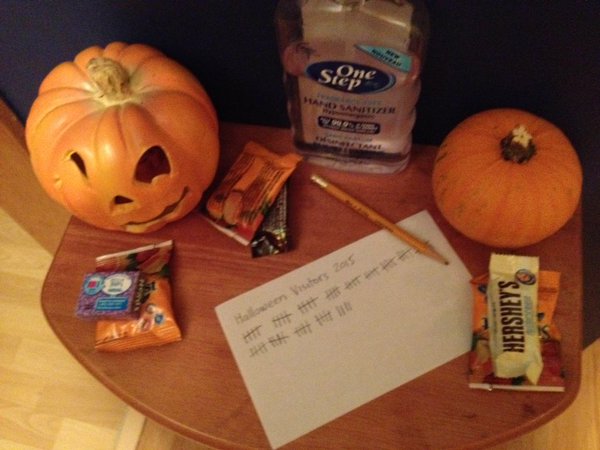
Ever since my husband told me it was easier to supervise our children as they trick-or-treated than it was to distribute candy at the door, I've been giving out candy, to prove him wrong. For some reason, I counted the visitors. In 2012, we had 135 trick-or-treaters. I lost my 2013 figures (which upset my sense of order) and in 2014 we had 98 trick-or-treaters. I liked counting because then my husband and I could estimate how much candy we would need without running out. This year, 2015, we had 121 visitors. I thought that was the limit of my mathematical leanings, but a Twitter conversation with Aviva Dunsiger made me realize that a lot more math was happening.
I don't consider myself to be a math fan, either as a teacher or student; however, Aviva's observations opened my eyes to authentic numeracy tasks, that I was *willingly* doing.
After that incident a few weeks ago with a student experiencing an anxiety attack, I've been trying to be more observant with some of my quieter students. One of the Grade 1 students I work with has been talking a lot more to me now than she did while in kindergarten. This is good, even though what she often tells me is "I'm scared". She needs a lot of praise, encouragement, and wait time. She asked me last week whether or not I liked her, and when I effusively responded positively, she seemed genuinely surprised and happy. On this chaotic Friday, I noticed that "A" was holding back even more than usual. I asked her if she was okay and she said no. After some cautious and gentle questioning, it turns out she wanted to dress up but left her costume at home. Thankfully, as part of my Library Learning Commons Play Area, I have a bin filled with costumes. I offered her the chance to wear one of the costumes. It took her a long time to decide and express her desires, but after a while, she selected a sparkly cape and we pinned it into a dress. Unfortunately, her fear came back with a vengeance when she had to return to class and I was about to take a group photo. She didn't want to go in. I didn't force her. I took the photo without her in it and quietly let the supply teacher know she was safe but in the hall and feeling a bit ill-at-ease. What was going to happen when her class went into the gym for the Halloween parade? Would she choose to sit while the rest of her class walked? I watched and when it was her class' time, one of her friends held her hand and together they marched with the rest of the group. I saw "A" in the hall by herself a short time later and talked to her. She admitted that she was scared to get up but she did it. I applauded her bravery and asked if it was okay to take a photo of her now. She agreed. (I put the blue square on the photo here to protect her privacy.)
I discussed the incident with my husband afterwards and he commented that sometimes it depends on who asks the person with anxiety to do something (i.e. a fellow student invited her to get up to walk vs the teacher demanding it). I'm glad I was able to help her. It wasn't always easy waiting as long as I had to, but she overcame that challenge and hopefully it will make other challenges in the future less scary.
Halloween Academic Lesson Learned
= Math is everywhere (and I'm not as math-phobic as I thought!)Ever since my husband told me it was easier to supervise our children as they trick-or-treated than it was to distribute candy at the door, I've been giving out candy, to prove him wrong. For some reason, I counted the visitors. In 2012, we had 135 trick-or-treaters. I lost my 2013 figures (which upset my sense of order) and in 2014 we had 98 trick-or-treaters. I liked counting because then my husband and I could estimate how much candy we would need without running out. This year, 2015, we had 121 visitors. I thought that was the limit of my mathematical leanings, but a Twitter conversation with Aviva Dunsiger made me realize that a lot more math was happening.
@MzMollyTL Love that! You're finding math in Halloween.:)My math is more probability. What are the chances that I'll last more than an hr?:)
— Aviva Dunsiger (@avivaloca) October 31, 2015
.@MzMollyTL Oh my gosh! Look at the arrays. @MrSoclassroom & @MatthewOldridge would like this set-up methinks. :)
— Aviva Dunsiger (@avivaloca) October 31, 2015
.@MzMollyTL I think there's even some proportional reasoning in here with the match-up of candies.The big one is about X2 size of the small.
— Aviva Dunsiger (@avivaloca) October 31, 2015
I don't consider myself to be a math fan, either as a teacher or student; however, Aviva's observations opened my eyes to authentic numeracy tasks, that I was *willingly* doing.
Halloween Social Lesson Learned
= Watch for unspoken needs (and know when to push and when to wait)After that incident a few weeks ago with a student experiencing an anxiety attack, I've been trying to be more observant with some of my quieter students. One of the Grade 1 students I work with has been talking a lot more to me now than she did while in kindergarten. This is good, even though what she often tells me is "I'm scared". She needs a lot of praise, encouragement, and wait time. She asked me last week whether or not I liked her, and when I effusively responded positively, she seemed genuinely surprised and happy. On this chaotic Friday, I noticed that "A" was holding back even more than usual. I asked her if she was okay and she said no. After some cautious and gentle questioning, it turns out she wanted to dress up but left her costume at home. Thankfully, as part of my Library Learning Commons Play Area, I have a bin filled with costumes. I offered her the chance to wear one of the costumes. It took her a long time to decide and express her desires, but after a while, she selected a sparkly cape and we pinned it into a dress. Unfortunately, her fear came back with a vengeance when she had to return to class and I was about to take a group photo. She didn't want to go in. I didn't force her. I took the photo without her in it and quietly let the supply teacher know she was safe but in the hall and feeling a bit ill-at-ease. What was going to happen when her class went into the gym for the Halloween parade? Would she choose to sit while the rest of her class walked? I watched and when it was her class' time, one of her friends held her hand and together they marched with the rest of the group. I saw "A" in the hall by herself a short time later and talked to her. She admitted that she was scared to get up but she did it. I applauded her bravery and asked if it was okay to take a photo of her now. She agreed. (I put the blue square on the photo here to protect her privacy.)
I discussed the incident with my husband afterwards and he commented that sometimes it depends on who asks the person with anxiety to do something (i.e. a fellow student invited her to get up to walk vs the teacher demanding it). I'm glad I was able to help her. It wasn't always easy waiting as long as I had to, but she overcame that challenge and hopefully it will make other challenges in the future less scary.
Subscribe to:
Posts (Atom)