Monday, November 14, 2022

Refocus on Planning and Partnering

 What a busy week! It began with no students in the school and lots of uncertainty as CUPE and the provincial government squared off over the use of the non-withstanding clause, and ended with the first whole-school assembly in the gym since 2019 for Remembrance Day. In between, there were also York University AQ guest speakers and my parents' 63rd wedding anniversary. 

Because of all the administrative tasks needing attention lately, I noticed that my lesson plans were almost non-existent (as in, they were in my head but not written down) and my collaborative teaching times were very last-minute, just-in-time affairs. That's fine once in a while but I want to ensure that these partner co-teaching times were valued and valuable. I have 35% of my schedule as co-teaching time, a better schedule than I've had for a long time, and I don't want to lose that because of improper or insufficient use. This is a quick overview of some of the new and renewed teaching partnerships.

Grade 6 Social Studies with Connie Chan

Connie and I work well together. Our first foray into co-teaching did not go as smoothly due to all the interruptions related to reorganization and other external factors. This time around, we vowed to make it work. We are focusing on the expectations related to expectation A3.8 in the strand "Communities in Canada: Past and Present" - "identify and describe fundamental elements of Canadian identity". We are combining it with media literacy and oral communication and our first lesson together went quite well. 


Grade 3-4 Language with Brenda Kim

Brenda and I worked on a critical thinking social studies project a few years back. Our language unit together was the most thoroughly planned of all my recent endeavors. Having said that, it's a subject that we need to keep tweaking based on the student output. I borrowed the idea Lisa Daley and I had years ago about writing the ending to an existing story rather than a complete narrative, which worked well. This past week, we actually unwrapped the back of the book to reveal what the author's original ending was like, compared to the student versions. They were very excited for the "big reveal".


Grade 7-8 Geography with Farah Wadia

I love working with Farah. There's a reason why we keep nominating her for a Prime Minister's Award for Teaching Excellence. I had a great idea related to geography concepts that I learned from my Drama AQ long ago and I used it way back in 2010. It didn't go in quite the way I had hoped. It began well and the students were very engaged. When things went south, Farah helped save the day to ensure things didn't become worse.


Grade 2-3 Social Studies

This particular teacher prefers that I abstain from mentioning her name online. She is also great to work with. Last year, due to class dynamics, our partnership involved separating into smaller groups. This year, we are more able to work in a single, cohesive team. We have expanded our resources to include videos from TVO Learn. We developed assessments to check for understanding before moving on to the next subtopic. The students were excited to explore atlases and made so many connections to their prior knowledge. A week or two before, we brought the students to the library to recreate urban and rural environments using furniture and big blocks and they keep asking when they can return to make a suburban space!


I might be missing other collaborations because I'm relying on memory rather than my notes right now. I'll take the rest of the weekend to plan the newest lessons that I deliver solo, as well as mark my university course work. Hopefully there won't be too many more out-of-the-ordinary interruptions.

Monday, November 7, 2022

Record Making and Researching (Toughest Task?)

Teachers of students in primary grades will tell you that it takes a LONG time to finish anything. This is so true. I've been keen to start my media literacy unit dealing with algorithms, but first I needed to finish our previously started tasks.

Today's blog post outlines how I proceeded with a six-week long media literacy inquiry into The Guinness Book of World Records. 

This focus on World Records was not my original intent. When Queen Elizabeth II died and we were "mandated" to teach something about her, I decided to use one of the lesson prompts I had designed for the Association for Media Literacy, about "The Queen and Breaking Records". I wanted the examination to be meaningful, so we looked at various copies of the The Guinness Book of World Records we had in our library. We created lists of superlative words (fastest, oldest, tallest). 

Based on my conversation with Sarah Wheatley and Dawn Legrow that we shared for Treasure Mountain Canada 7, I wanted to establish and practice research, citation and information literacy skills early.  The students were asked to peruse the various Guinness Book of World Records copies we had in the library and select one record that they were most interested in recalling. I asked the students to note the title and the page number of the record they liked. That was very challenging for many of our Grade 1-3 students (due to their "unfinished learning"). I had to conference individually with students to locate the page number and record it for them. Legible printing is also not a strong general skill right now, so I took their information finds and turned them into printing pages students could use for the books we are producing.


To make this learning personal, we also determined individual Class Records. This also took a long longer than I anticipated. First, we had a discussion about measurable records rather than subjective opinions (i.e. who is the "tallest" vs who is the "cutest"). Then, we started engaging in different challenges to establish some records. We threw Koosh balls, ran sprints in the hall, picked up pencils with one hand, and conducted other less-physical trials students suggested could make for intriguing records. It was my goal that everyone in the class end up with a record, which I know is contrary to the mission of The Guinness Book of World Records, but I wanted everyone to feel like they were the "top of the list" in some way. This activity really highlighted for me which students were incredibly competitive and which students actually didn't think highly of themselves. Students illustrated these personal records with a bit of exaggeration and a mixed collage of photo faces and drawn bodies. (Even just taking the student photos, colour printing them, and distributing them for making images took a long time!)

As we finally wrap up this project (which will result in 8 books), I sent home a reflection sheet for students to complete about the process. This was another difficult task because students need support with their reading and writing. I ended up creating some "circle the answer that best fits" responses, even though I would have preferred some more open-ended questions. (I used those but suggested they only answer two of the five options.) These are some of the questions below, based on Strand 4 of the current Media Literacy curriculum (Reflecting on Media Literacy Skills and Strategies).

Media Project Reflection - Guinness Book of World Records


Name: _________________________________________________


Part A: Choose two of these questions to answer on the lined paper


  1. What kind of records does the Guinness Book of World Records list?

  2. What kind of records are not in the Guinness Book of World Records?

  3. Why might people be interested in trying to be in the Guinness Book of World Records?

  4. Why do people care about records?

  5. What do records tell us about people?


Part B: Answer every question listed below. Circle the answers


  1. Do you remember the personal record you made? YES NO


  1. Do you remember the record you researched? YES NO


  1. How did looking at real records help you decide on making your personal record?

I SAW WORDS LIKE TALLEST / FASTEST / LONGEST


I SAW PICTURES THAT GAVE ME IDEAS


I GOT IDEAS FROM PEOPLE IN MY CLASS OR THOUGHT ABOUT MY SKILLS


OTHER: _______________________________________


  1. What skills did you use when making your personal record?


SPEED/STRENGTH - I HAD TO MOVE FAST OR THROW FAR


BALANCE - I HAD TO KEEP THINGS FROM FALLING


LUCK - MY RECORD WAS PART OF MY LIFE


OTHER: __________________________________________


  1. What skills did you use when researching an existing record?

READING - I READ THE WORDS TO PICK MY FAVOURITE


ORAL - I TALKED WITH THE TEACHER OR FRIENDS TO PICK 


VISUAL - I LOOKED AT THE PICTURES TO PICK MY FAVOURITE


OTHER: _______________________________________________


 I am relieved that this project is almost complete. I think there was a lot of rich learning that occurred but the amount of time it took to get through made me wonder how this could have been achieved in a much more efficient way. Maybe I just need to be more patient. After all, creating those What Is Media videos took nearly three months of work in the past, and they were definitely worthwhile. 

Monday, October 31, 2022

New Approaches to Old Favourites

Happy Halloween to all of those who partake!

This is a short blog post this week, created and posted on the same day.

In Grade 2 Social Studies, one of the expectations is "compare ways in which some traditions have been celebrated over multiple generations in their family and identify some of the main reasons for changes in these traditions". Lately, this expectation has gotten easier to teach, as COVID has forced many changes.

In our school, we used to gather in the gym for a loud and admittedly chaotic circle-share assembly. We haven't had an assembly yet this year so the students are unfamiliar with the routines. Sometimes it's hard to find the "right time" to try something different, but this was an ideal time. How might we mark this moment with the school community in a positive way? We discussed it at a staff meeting, surveyed everyone using a Google Form, and decided to try a different format this year - two school parades from room to room (with space for exemptions) - one for the kindergarteners and one for the rest of the school. We'll discuss what people thought about the new version.

I also took a new approach to carving our home jack-o-lanterns. This year, not only did I try out carving just parts of the pumpkin, I even painted the pumpkin! My Michaelangelo TMNT creation was inspired by something I saw online. We even bought special carving tools to do the job. I was really pleased with the results.


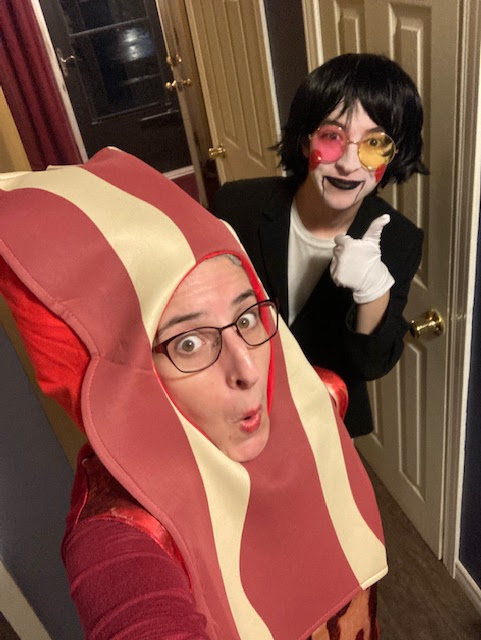
I know that Doug Peterson will be keeping an eye on this blog around this time of year because he knows how much I love costumes and dressing up. Doug, you wouldn't be disappointed. In the morning I was bacon (and my friend was an egg). In the afternoon, I was Tom Nook from the video game Animal Crossing. In the evening at the gym, I was a French maid. My daughter was Spamton from Delta Rune. (I changed back into my bacon costume to take pictures with my cosplaying-specialist eldest.)


There were more trick-or-treaters this year than last but the numbers are still lower than they were in the past. Enjoy your evenings, everyone (except for the people behind the terrible decision to rely on heavy-handed legislative moves instead of good faith negotiations with our CUPE education worker colleagues. Boo to you!)

Monday, October 24, 2022

BCTLA & TMC7

 Happy Media Literacy Week and Canadian School Library Day!

Last week and this week are busy ones, indeed. Today I'm going to reflect on the 2022 British Columbia Teacher Librarians Association Conference and Treasure Mountain Canada 7. I was only able to attend virtually this year but it still gifted me with lots of learning.


Friday, October 21, 2022 (9:00 am PDT, 12:00 pm EDT)

Opening Keynote: David A Robertson

3 Key Points

1) The ways we learn about ourselves often comes via popular culture and school

2) An absence of representation has a negative impact (note King's overview of the 3 common stereotypes of Indigenous people [savage/noble/dead]) and shapes the perception of the self. It also manifests violently with MMIWG.

3) We have made progress in terms of learning about residential schools and reconciliation (nowadays if you don't know it's because you don't want to know) but we need to continue to give books about Indigenous issues (first by Indigenous writers, then by non-Indigenous writers who have done the work properly) to kids so they can be the better leaders we need in our society because they can handle it.

So what? Now what? = I took so many notes. My next steps come directly from David's words: "teacher-librarians, dig in your heels, we need policies, be determined and fight! We can let book removals happen." My other next step is to read some more books by David. He was a captivating speaker.

Media Artifacts


Friday, October 21, 2022 (10:10 am PDT, 1:10 pm EDT)

A Peculiar Path to Library Leadership by Diana Maliszewski

Summary

Are you interested in making your mark in the field of school librarianship? What lasting legacy can you contribute? You might be surprised at the roundabout routes and curious circumstances that come into play. Chat with Diana Maliszewski, one of the writers of Ontario's pivotal Together for Learning vision document and a former recipient of Canada's Teacher-Librarian of the Year Award, to learn about how she got involved in different exciting projects and how she is now helping form new teacher-librarians at two universities. 

3 Key Points

1) The path to leadership isn't always linear or traditional - sometimes it's tangential to your work organization. 

2) If you volunteer, you might end up in the right place at the right time (and while you are there, lift others up - nominate them for awards, for instance).

3) Three key words: Network, Assist, Share

So what? Now what? = 82 people registered for my talk, although I didn't take attendance to see how many showed up. The tech was really well organized, with my special Zoom account, passwords, codes to access passwords, and links all in one convenient place. It's really hard to tell if people are enjoying your session, since cameras are off and it's mostly through the chat feature that we communicate. 

Media Artifacts


Friday, October 21, 2022 (1:00 pm PDT, 4:00 pm EDT)

Books to Build On: Indigenous Literatures for Learning by Erin Spring, Maureen Plante

Summary

This session focuses on 'Books to Build On: Indigenous Literatures for Learning,' an interactive web resource designed to assist educators with weaving Indigenous ways of knowing, being and doing into teaching and learning, all while starting with story. Responding to the Calls to Action from the Truth and Reconciliation Commission of Canada and the BC Professional Standard 9 for education, this resource helps teachers build foundational knowledge and competencies in Indigenous education.

3 Key Points

1) Alberta Education funded a grant to respond to the TRC and Calls to Action, encouraging people to integrate Indigenous knowledge into teaching.

2) The group created a website for all people, although it is mapped to the Alberta curriculum - see http://werklund.ucalgary.ca/teaching-learning/indigenous-literatures-learning 

3) Another good site is http://indigenousstorybooks.ca 

So what? Now what? = I plan on sharing these websites with my staff after the panic of report cards is through.


Friday, October 21, 2022 (2:05 pm PDT, 5:05 pm EDT)

Closing Keynote: Ivan Coyote

3 Key Points

1) Queer, non-binary folks have to leave their small towns to travel to bigger cities so they can be more anonymous and understand about how to be themselves, even though being part of a small town is part of their identities. 

2) What if we celebrated tenderness rather than toughness? Often, people who are "marginalized" (a term Coyote doesn't like) are praised for their resilience and character, but why do they have to be resilient in their own communities? (Story of Indigenous and queer youth asking small town council for a rainbow crosswalk and being turned down, the councils wondering why people don't want to get involved.)

3) Places need to ask "Who are you already missing? Who has left the room?" Choose education over fear. (Story of Michael Marshall creating a great policy on supporting surgeries but who will benefit if people move?)

So what? Now what? = Once again, the speaker told us what to do. Ivan said, "They're coming for us via the school boards. ... It is enshrined in the Human Rights Act that people cannot discriminate based on gender identity. ... Build a community where people don't have to learn to recover from their differences." My other next step is to read some of Ivan's books. 

Media Artifacts


Saturday, October 22, 2022 (1:45 pm PDT, 4:45 pm EDT)

Afternoon Table Talks
a) Larkspur LLC End Year Reports 2020-2022 by Beth Lyons

Summary (taken from TMC site)

The 2020-2022 school years were marked with a great deal of change, upheaval and constant re-imagining of the system for all of the community members involved in education. COVID restrictions, online learning, closed classrooms and re-adjusting to a return to in-person learning for the majority of our students and staff took precedence over everything. As we worked to re-imagine what the Larkspur LLC might be in this “new normal” we constantly looked to ensure that we were centring the needs of students and their families. We reflected on our collection curation, choice of books for read alouds and maker materials to provide “mirrors, windows and doors” (Sims Bishop) for both students and educators as they interacted within the library space, both in-person and virtually. It is my hope that the Larkspur LLC and the library programming provided an opportunity for growth, for reconnection and most of all, joy.

3 Key Points

1) Collect data and examples throughout the year.

2) There are many tools you can use to make your end-of-year report beautiful.

3) These reports are important advocacy and history documents. 

So what? Now what? = Beth's reports have inspired me to "up my game" and I've made changes to how I've created my annual reports based on her experience. I'll continue to 

Media Artifacts

Thanks to @CdnSchoolLibrar for inviting me to #TMC2022 to talk about my LLC year end report in a virtual table talk. #ONSchoolLibraries https://t.co/LPys2otYcO #onted

— MrsLyonsLibrary (@mrslyonslibrary) October 22, 2022


Afternoon Table Talks
b) Riffing on OSLIP: A Conversation by Diana Maliszewski, Dawn Legrow, Sarah Wheatley

Summary (taken from TMC site) 

How can elementary and secondary teacher-librarians “combine forces” to better serve their students? Impressed by a recent Ontario Library Association study of transitions between secondary and post secondary, the writers embarked on a quest themselves. In their research and conversations, they explored the challenges facing both panels in preparing students for successful transitions. The writers invite you to share strategies and approaches you use to address this critical problem.

3 Key Points

1) Elementary and secondary TLs need to talk together more, using an asset-based approach.

2) We can help each other, once we understand each other. 

3) Schools with teacher-librarians can better prepare their students for the next stage, especially if they have access to the students and know what the upcoming goals might be. 

So what? Now what? = Dawn, Sarah and I had a good chat with the participants that chose to chat with us. Someone asked a good question about what they should be asking their secondary colleagues if they reach out and I think our answers were something like "What will you cover in Gr 9 and what skills would you like them to possibly come with before entering Gr 9?" I need to reach out to the local TL in the high schools my school feeds into. 

Media Artifacts


Monday, October 17, 2022

Volunteers Make the World Work (+ Happy 100th BCH!)

 Many places would be in big trouble without volunteers. I hosted some volunteers this week and did some of my own volunteering on Sunday. Plus, I attended a centennial anniversary celebration that I'm sure operated with volunteer labour. 

Book Fair

The Scholastic Book Fair has returned to my school. I debated with myself (and there's a lot to debate) about running it again but I knew how much enjoyment the community gets out of the event, so I acquiesced. I've been involved with book fairs for a very long time but I never saw such crowds as I did on our Curriculum Night on Thursday. We had five staff members helping out, including myself (thanks Renee, Shanu, Julie and Katrina) and we didn't have time to breathe! These were the only photos I captured, before we opened it up on Thursday night, with no one in it.


Birch Cliff Heights P.S. 100th Anniversary

I attended Birch Cliff Heights Public School as a student from 1976-1985. On Saturday, October 15, the school hosted an open house for its hundredth anniversary. It was nice to revisit my old stomping grounds. The gym at BCH used to be leased out in the evenings to the Scarborough Entertainers Baton and Dance studio, and I used to teach out of that gym for years after I left the school. The gym is smaller than I remember it being. Here are some of the photos I took at the anniversary.

This is from the time capsule.


I'm starting to think about my own school's upcoming 50th anniversary and this weekend has inspired me to start brainstorming appealing things to consider for that event. (I've got time - it's not until 2031.)

  • "panels" of certain themed gatherings in the gym (e.g. all the principals that have ever served, all the teacher-librarians that have ever served, etc.)
  • name tags so people can identify others easier (I saw someone at BCH with a button she made saying "Don't worry - I don't recognize you either!")
  • souvenirs or memorabilia of different types and costs (the 100th had t-shirts but I don't wear a lot of those kind of t-shirts anymore)
  • decade rooms (often used, and helpful gathering spots for alumni) but with colour replica of photos (there were a lot of images but many were photocopies so hard to see details in some)

Guyana Christina Charities Bazaar and Bake Sale


My aunt-who's-not-really-my-aunt (which is very common in Caribbean culture) asked me to volunteer to run the raffle table with her. I gave my Sunday afternoon to this charity. I was told that the crowds were not as large as they have been in the past, but a lot of the food sold out completely way before the scheduled end time of 4:00 pm. I bought some chhana curry dahl puri, pine tarts, black cake, mauby and sorrel. 


All of these events do have something else in common - they used to be a huge part of my mother's social calendar. 

1) My mother used to run my book fairs for me for many years and I used to hold it on Curriculum Night because she was "booked" to run the Book Fair at Birch Cliff Heights PS during Parent-Teacher Interviews (the most popular time to host a Scholastic Book Fair). 

2) Speaking of Birch Cliff Heights ... I may have left BCH in 1985 but she remained there for decades afterwards, volunteering in the library. She was a constant volunteer at BCH from my JK year (1976) until the 2010s. In fact, she served on BCH's 75th anniversary committee in 1997. Many of the artifacts I saw were part of her contributions. 

3) The reason why I was conscripted into helping at the Guyana Christian Charities sale was because my mother used to help at the raffle table for years. Her advanced dementia prevents her from participating in these things like she used to do. (She last went to the GCC Christmas lunch with me in 2019. Now, she doesn't know who I am and she works best with comfortable predictable routines, like when I take her to Mass every week.)

Before this post ends on too melancholy a note, let me thank all of those volunteers - for book fairs, for school events that happen outside school hours, and for charities and non-profit organizations, - who make it all possible.

Monday, October 10, 2022

Balance

 Today's reflections are about finding a balance between two different and potentially opposite approaches. 

Library Dragon vs Laissez-Faire

In the fall of 2020, students couldn't use the school library. When school libraries reopened in the fall of 2021, I was delighted to have students back in the space, but I had to restrict how many books they could borrow because we did not have library helpers or adult volunteers permitted to shelve and the job fell on my shoulders. This fall, 2022, our library helpers returned to "work" and in my joy, I have become quite lenient. Book limits? Who cares! Usually, this wouldn't be a problem, but combined with my Summer "Bakers Dozen" Book Borrowing Program, there are many students that have rather large numbers of books out and there are students eager to get their hands on those newly bought titles that have been commandeered by a few. (Demon Slayer, anyone?) 

To rein things in a little bit, I am returning to an old practice I had - the "oopsie stamp" (combined with the new addition of a "yippee stamp"). In the past, if students forgot to return a book, I'd use the "oopsie" stamp in their agenda to remind them to bring the book back. I won't stop them from borrowing a book (unless they have a ridiculous amount of books still at home) but sometimes just a nudge is required. Students have a lot more physical objects they need to keep track of now than were used to when they learned virtually, (jackets, indoor shoes, agendas, lunch bags, water bottles, etc.) so they are a bit out of practice. 

Speaking of keeping track of physical objects, I realized that I had no clue where my original "oopsie" stamp has gone. The original was broken and just a slim piece of rubber, so it's easy to misplace. It was time to redesign and reorder a new stamp. I turned to my own children, who are quite talented at illustrating and graphic design. They pointed out that it'd be good to have a positive reinforcement stamp as well, so that agenda communications between the library and home weren't limited to reminders of jobs that hadn't been completed. 

These are the designs they created. My son drew the visuals himself. The final products will look slightly different but the message is the same.


This will be a lot less onerous than writing individually in every single agenda (like I did on Thursday for two classes). 

Hoarder / Fully Stocked vs Minimalist / Clear Shelves


I tried to use two different terms here so I wouldn't suggest one position was better than the other. On Friday, it was a Professional Activity Day. We had a staff meeting where we organized things like the Cross Country Meet and Remembrance Day; we received training on the new Report Card program, and I cleaned the library.

Keeping the library clean and tidy is a never-ending battle. Complicating things is that we transformed a classroom into a lunchroom and a lot of the supplies from the former classroom have migrated to the library. I'm trying to get the MakerSpace in some semblance of order but it's hard when there's just so much stuff. 

Our MakerSpace leans towards low-tech options, which means having materials to build with is useful. How much is too much? What's good to keep and what should just be pitched? Some educators are notorious hoarders, which can be disastrous or resourceful. However, I've learned that sometimes having less is more. I've been following Kelsey Bogan and Jennifer Brown's work on front-facing library shelving strategies to increase visibility and circulation.

It means culling the collection a bit more so there's room to see what we have. The shelves can't be crammed with books or with materials. I'm reminded of this by Lindsay Carriere, whose paper on weeding the school library collection is up on the Treasure Mountain Canada 7 website. (Congratulations Lindsay and Francis Ngo on the publication of their papers on TMC7!)

Even the way the MakerSpace gets presented might need to change. I had my space as pretty open-ended but I think I need to shake up my approach this year and use some of the learning I obtained during my Kindergarten AQ course to set up some provocations so students can be inspired to use some of the materials. Some of these ambitious plans may need to be put on hold, as I'm holding my first book fair since 2019 this week. Wish me luck!


Monday, October 3, 2022

Beyond the Shirt

 This past week, it was both our Terry Fox walk and National Day for Truth and Reconciliation. Thing is, September 30 is also called Orange Shirt Day - which is both poignant and problematic.

The reason it is called Orange Shirt Day is because of the experience of a particular person on her first day at a residential school. Phyllis Webstad was only six years old and initially excited about going to school. She was wearing an orange shirt, a gift from her family, which was taken away immediately from her when she entered the school. That shirt is symbolic of the experience of many Indigenous people at residential schools in Canada. When the magnitude of a tragedy is so large and impacts so many people, it helps to personalize it and focus on an individual's experience so that it can be grasped and understood.

I was very fortunate to have met Phyllis Webstad at OLA SuperConference in 2020. She was so sweet, soft-spoken and gracious. I couldn't help but say how sorry I was that those horrible experiences happened to her. 


Phyllis' experience is something tangible and concrete for young children especially to comprehend. What concerns me lately is the commercialization and corporatization of this idea. When I did a Google search for Orange Shirt Day, the first things that popped up were shopping options.


This isn't what the National Day for Truth and Reconciliation is supposed to be about. Some of these vendors aren't even Indigenous. Companies are profiting from this somber event. It isn't just about wearing a t-shirt. Here are some tweets that elaborate on the problem with making it "about the orange t-shirt".


My lessons this week were an attempt to begin with the joy rather than the tragedy, like Dr. Nicole West-Burns taught her audience back in 2016 and which is also part of Dr. Gholdy Muhammad's message in her book, Cultivating Genius. Instead of reading books aloud to classes that focused on the horrors of residential schools (like I did in 2019 and I knew that the classroom teachers would do with their homeroom students this year), I actually re-read "When We Are Kind" by Monique Grey Smith. I also hit upon a way to absorb the core message for the students in my school, many of whom are from one particular culture. After they told me what they knew about Orange Shirt Day (which was mostly about phrases like "Every Child Matters" or "the school took an orange shirt away from a girl"), I asked them if they knew who [or what groups of children] were sent to residential schools. Then we talked about this question: "What does it mean to be Chinese?" (Don't worry - I didn't just focus on students of Chinese background/ethnicity.) They said things like their language, their food, their clothes, their holidays, their music ... and some even said things like "how we act" or "what's important to our family". I was able to say that these are important things in a culture or community, and that residential schools (and actions by the government and other institutions) try to take those important things away or make people feel that those things from a specific community are "bad". I hope that this was a helpful step in grasping the main idea of this particular day. It's not supposed to be all about the shirt.

Speaking about "the shirt", the same is partly true for our Terry Fox day. I have a large number of Terry Fox t-shirts I've bought over the years so I could support the Terry Fox Foundation and raising funds for cancer research. Our school has raised a lot of money over the years for the Terry Fox Foundation, but I think the years with our biggest donations came when we sold the most amount of shirts. This issue is slightly different than the Orange Shirt situation, because at least the shirt sales funds go to cancer research - or at least a good part of it. The page on Canada Helps reports that the Terry Fox Foundation gives 78 cents of every dollar raised to cancer research. It's also quite visually striking to see a large group of people, especially young people, running with matching t-shirts on to commemorate one of the few examples of a "Canadian hero". Still, it's not supposed to be all about the shirt. 

Even though it's hard, let's try to get beyond the shirt.