Tuesday, March 7, 2023

More MES - Part 2 of Global Media Education Summit Reflections

 My reflections were just too lengthy to hold in a single post (and that was just with the abstracts, 3 key points, and a few photos!) Here is the second half of my reflections from the 2023 edition of the Global Media Education Summit, held in Vancouver, British Columbia.


Global Media Education Summit (2)

Conference Reflections by Diana Maliszewski

Saturday, March 4, 2023

Opening Keynote - Artivism to Promote a South-to-South Dialogue (9:00 am PST)

Summary (taken from program): This panel, convened by Andrea Medrado and Isabella Rega, brings together academics and artivists to reflect on the topic of artivism and how artivism can support a Global South dialogue to promote global social justice and to launch the new book:
Medrado, A. and Rega, I. (2023). Media Activism, Artivism and the Fight Against Marginalisation in the Global South. Routledge. In the first part of the session two experimental animations celebrating two black female activitsts will be screened: “Portrait of Marielle”, produced in Kenya by young artivists within the AHRC eVoices project and a sister animation produced by N’gendo Mukii with Brazilian artists with support from the Goethe Institute in Salvador de Bahia, “Homage to Wangari Maathai”. After the screening, Milena Anjos, Paula Callus, A-zee Cotpel, Marina Lima and Judith Lumumba will participate in a roudtable and share their perspective and experiences as scholars and artists involved in the two projects.

3 Key Points:

1) By learning about other countries in the south (Brazil & Kenya), via an animation project that completed after a 3 or 4 day workshop, it led to powerful transformation and shared knowledge.

2) The Brazil group got to meet Wangari Maathai (Diana note: she's in the picture book "Wangari Speaks for the Trees", so I have heard of her), and the participants said how impactful that way and how she was ahead of her time and not just a benefit for Kenya but for all of humanity. (The Kenyan team did Mareille Franco, who was murdered and the crime is still unsolved.)

3) Animation is a unique medium to use because it borrows from many different practices and can bring artists from a range of practices such as photography, music, and these artists/makers can combine their skills and expertise in new ways for a collaborative process (and can be "research through/for/in art"), with no specialized software equipment required. They printed stills from footage and printed them on paper and then chose what to layer or do or add or enhance and there was lots of discussion on what those choices and the new results meant.

Media Artifacts:


CEMP Conversations 5 (10:30 am PST)
Creating Digital Media Nutrition Labels


Summary (taken from program):There are many labels in our lives. Some tell us the contents of things, some warn us of hazards, and some tip us off to better uses. Food labels have been law since 1990 and appear on almost everything but fresh food. These labels help us make informed decisions. What if we thought about our digital consumption like mental food?

Media literacy assignments should promote critical thinking and be fun, engaging, and relevant for learners. This series of lessons on creating digital media nutrition labels is designed to achieve all these goals. This activity invites crowd-sourced recommendations for digital media experiences. The students create Digital Fact Guides for platforms and apps that are similar in design and function to food Nutrition Facts labels. How might the discussions, designs and labels help users and others be mindful of their media activities? 

Evaluation is one of the higher order thinking items in Bloom’s taxonomy. The students become evaluators of their chosen digital media experience. In these lessons, the students generate and then apply their evaluation criteria. By asking them to work in groups, they collaborate and make their thinking visible. They practice negotiation, cooperation, and group skills. The students create the criteria, the assessments and the label categories, so their thinking reaches the top of Bloom’s taxonomy. There is a great deal of differentiation in content, process and product with these lessons. This Conversation, by Neil Andersen and Diana Maliszewski, unit creators and facilitators, will explain the process and results.  


3 Key Points:

1) (Bias alert! This was the session Neil Andersen and I presented.) Bloom's Taxonomy has at its top things like analyze, synthesize and create, and this project used all three. 

2) It is fascinating to compare Diana's results (Grade 5-6s in 2021) with Neil's results (adult learners in 2023) - pattern recognition both for the creators and for our audience are useful tools for analysis.

3) The choice of media platforms differed based on the student audience (e.g. Roblox was just a kid option, whereas YouTube was both) as well as the categories they chose to use within the nutrition label format.


CEMP Conversations 5 (10:30 am PST)
Media Literacy and Implementation Science


Summary (taken from program): We will conduct a CEMP Conversation, and review learning from the rising field of Implementation Science by giving a brief overview as well as an example now underway in a US School District.  We will have four three panel members:  one (Barbara J. Walkosz), a research scientist who provides programming and evaluation for media literacy; another (Tessa Jolls) who provides program design and implementation to major organizations; and third and fourth, a State of Washington professor (Marilyn Cohen) and a Chicago Public Schools executive (Heather Van Benthuysen) who have laid a foundation for  the State and a District’s media literacy programming, respectively. 

Indication of Approaches/methods/research results, significance for media education:

Implementation science, the study of methods and strategies that facilitate the uptake of evidence-based practices, is emerging as a framework to study the implementation of media literacy. Implementation science emerged in the public health field, and is just becoming known and applied in media literacy programs, and demanded in US Federal grant programs. Relying on theories of change and rigorous evaluations of programming that exemplify these theories of change,  Implementation Science provides a solid foundation for dissemination and scaling and for helping media literacy take its rightful place as a central educational offering.  We will provide an overview of Implementation Science, describing steps taken to date within the State of Washington and Chicago Public Schools to illustrate how Implementation Science works to strengthen and sustain media literacy.


3 Key Points:

1) Michael from Washington state explained that it was by having a sponsor - in their case, state senator Marko Liias - explain how to advocate to make a bill that helped their group (action4mediaeducation.org) get several bills legislated that integrated media literacy in the curriculum. They gave the senator and his staff as crash course on media literacy and they really understood and embraced the ideas. (Their first bill was in 2016, second in 2017, and third in 2019 that got $300K in grants to develop media literacy units.)

2) Heather from Chicago Public Schools said her case was a grassroots lead movement to get media literacy in the curriculum. Their offerings used an option of vertical or horizontal implementation, within disciplines or over the grades, and has been a 7 year journal and they've examined the mechanisms of power to ensure improvement was continually happening.

3) Tessa said many grants call for implementation science (scientific study of methods and strategies that facilitate uptake of evidence based practice and research into regular use by practiciners and policy makers) so many frameworks that use implementation science (such as diffusion of innovation theory) can be employed.

CEMP Conversations 5 (10:30 am PST)
Edupedagogy, Environmental Science, and Critical Media Production with Junior High Scientists: Responding to Extractivism in Southern California


Summary (taken from program): To encourage junior high science students to reflect on global citizenship within an ecopedagogy lens (e.g., Misiaszek, 2021), adolescent scientists (i.e., junior high school science students) are engaging in field learning in salt marsh/coastal sage scrub habitats in Southern California. This project, which is a school-community organization partnership, has three stages: first, students explored ethical considerations regarding human activity and associated harm within local ecologies. Specifically, the ethical questions considered revolve around the impacts of oil drilling in the Los Cerritos Wetlands, a practice that began over 100 years ago in the city of Long Beach. 

This CEMP conversation will offer one vision for critical environmental science media production at the junior high level. To voice their concerns about continuing oil drilling, the students are writing letters to their future selves in which they will think about the predicted impacts of extractivist human relationships with the wetlands. Secondly, the junior high school scientists are helping the wetlands by collaborating with community partners Tidal Influence, planting native plants, and learning about the health of the environment. Finally, students are engaging in critical media production to explore their take(s) on the ethical issues and consequences of human actions on the wetlands. Student-produced media to be shared includes podcasts, children’s books, and Public Service Announcements (PSAs) as the junior high scientists share their vision(s) for their local ecology. 

Misiaszek, G. W. (2021). De-distancing ‘us’ from the rest of Earth: Ecopedagogical analysis and approaches. International Studies in Sociology of Education, 30(1-2), 1-12.


3 Key Points:

1) Criticality has been coopted and is now an identity position in a post-truth era that encourages people not to accept the "dominant narrative", so we need to reground critical literacy where you need to go beyond texts to "look in the world" and at evidence.

2) The "both side-ism" pushes disinformation, especially in schools without libraries, so eco-pedagogy (influenced by Freire linked to environment) can be brought to STEM education so (in this specific case in southern California) junior high school students doing empiracle investigations on tides and wetlands in conjunction with the Sunrise Movement (a group working to end urban oil drilling), had students reground the way of looking at their local ecosystem being harmed and then making PSAs, videos and other media texts to share the message.

3) The pre-teens and teens drew on the texts they loved to make meaning from it - Noah Golden, the presenter, talked about how some teen boys discussed the environmental issues while recording their video game play. Noah showed an absolutely bang-on parody talk show that spoofed the current Wednesday Addams Netflix TV show that was hilarious and effective.

Media Artifacts:


CEMP Conversations 6 (11:45 am PST)
When Methodology Meets Pedagogy: Games Based Research


Summary (taken from program): At MediaSmarts, Canada's centre for digital media literacy, we position youth as experts in their own lives and design research studies that create safe spaces for them to share their experiences and strategies related to the internet and digital technology. Recent qualitative projects, in particular, have allowed us to meaningfully engage with young people regarding their attitudes, behaviours, and concerns about privacy online through creative and interactive focus groups. These findings inform recommendations that we mobilize to various policy- and decision-makers and serve as the foundation for the educational resources we create and share with schools, homes, and communities across the country.  


In this session, we will speak about our project, Algorithmic Awareness, in which we facilitated a scaffolded learning experience that blended gameplay with in-depth discussions to gain insight into how young Canadians understand the relationship between artificial intelligence, algorithms, privacy, and data protection. In the second half of the session, we will showcase our new educational resource, #ForYou: A Game About Algorithms, that we finalized after piloting in the research study. #ForYou is a card-based pattern-matching game that helps players understand the role of recommendation algorithms and the value of personal information to companies that use those algorithms. The game is designed to be delivered either in school or in community spaces such as homework or coding clubs.

We will discuss the benefits of merging methodology with pedagogy and share best practices in designing and facilitating game-based digital media education.  


3 Key Points:

1) Media Smarts (who did a lot of self-promotion during this session) employs mixed method researchers with three educators for their research to resource process. They begin with a needs assessment based on surveys, then they develop, then pilot test resources in some classrooms, then do more resource development.

2) Their latest project is called #ForYou and is a card game that is meant to increase algorithmic awareness in youth ages 13-17 years old. They used Role 20, a gaming platform, to talk with their focus groups during the development stage. They said they noticed a lack of transparency in how algorithms work amongst the teens. They said that youth came to the focus groups that considered algorithms to be their friends and their attitudes shifted. (I wondered about this fear-based change, and another person in the audience whom I respect tremendously asked a question about it; they answered that they felt the new attitude was more expansive an understanding of algorithms and that their organization was approaching it from a privacy perspective.)

3) We played the first phase of this game. Each phase has two rounds: the experimental round, a discussion of what was used in the experimental round, then a second round, followed by a debrief between phases. The phases are popularity, monetization, and machine learning. Game "play" is loosely based on the game Mastermind.


CEMP Conversations 6 (11:45 am PST)
Creating Professional Learning Communities for Media Literacy Education


Summary (taken from program):With the growing awareness of the need for media education comes also an increased demand for professional development for educators. While many approaches to professional development exist around the world, media literacy education often includes perspectives that reflect its interdisciplinary nature, at the intersection of education and communication. Accordingly, the content, format, structure, delivery and target audiences may vary. Effective professional development is situational and contextual, reflecting the institutional structures of both primary education and higher education.   

In this panel discussion, we gather a group of experts from Europe and the United States to explore these questions: Why is a community of learners important for media education? How is a community of learners cultivated through PD efforts? What kinds of content, format, and delivery models are most effective? What insights have emerged from navigating the institutional structures of primary and higher education to advance learning communities for media literacy education? What are the most significant challenges still to be overcome in fostering a community of learners? 


3 Key Points:

1) Yonty is a co-directory of the Media Education Lab and he says professional development is the big push, because in Illinois, where they've recently added legislation insisting on media literacy in the curriculum, there is a single sentence that insists of PD but no funding allocated to it.

2) Their group experimented with different models, such as hybrid, in-person for a full week, and varied ways to work online.

3) The interesting thing is that teachers said they preferred face to face training but when it was offered, they would complain they had no time to attend. 

Media Artifacts:


Keynote - Media Literacy in a World of AI: Here, Now, Next (2:00 pm PST)


Summary (taken from program):What does it look like to think critically about ‘media’ in an era of global online platforms and chatbots that can write an essay? What is at stake for the generation born into a world of social media? What chance do they have to shape the mediasphere today? Why does it matter?

3 Key Points:

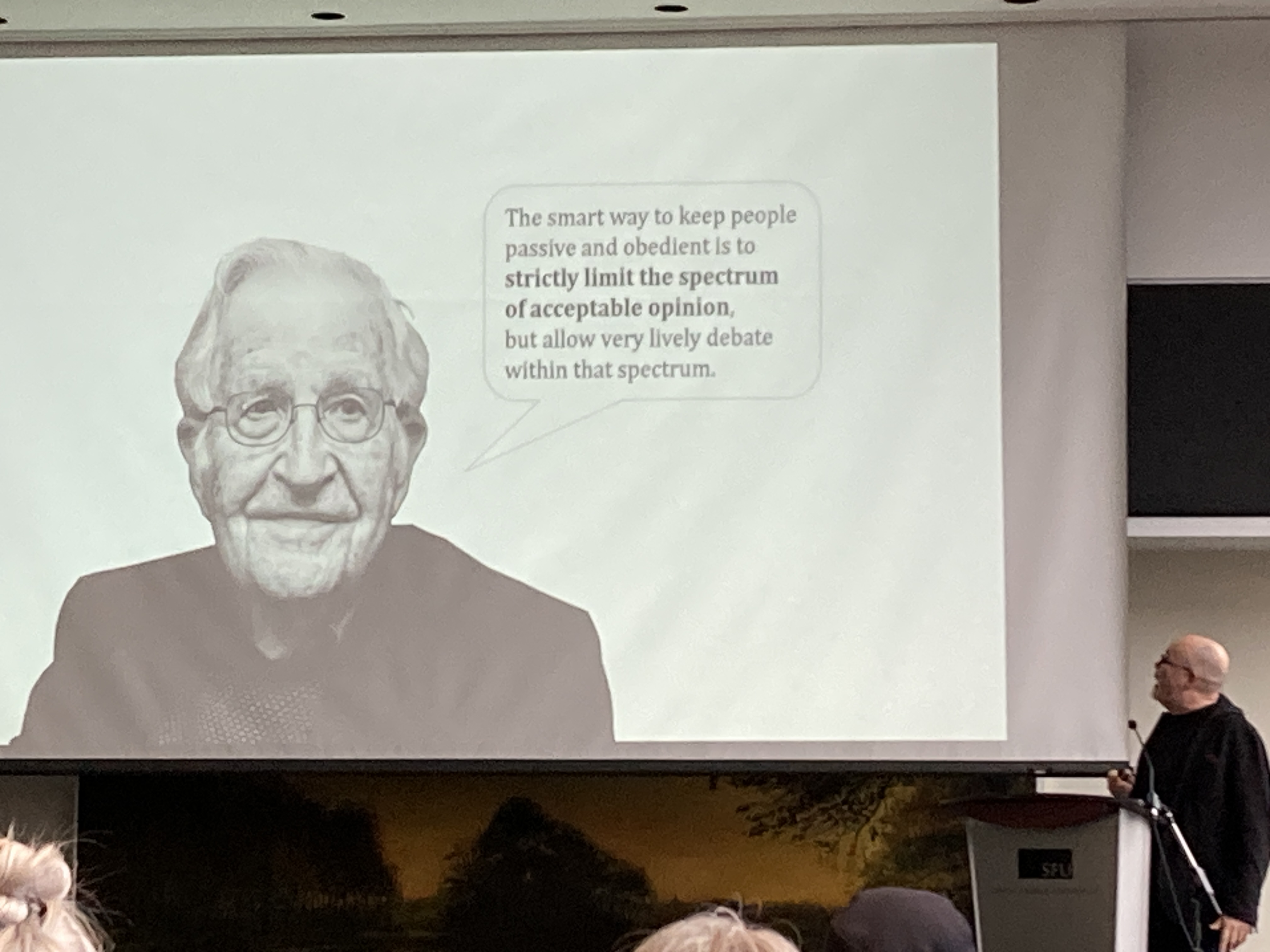
1) Mark Surman, from Mozilla, based the theme of his talk on the 30th anniversity of Noam Chomsky's Manufacturing Consent. He peppered his talk with Chomsky quotes that are still relevant. Media is about power in democracies and propaganda is the tool to democracy as the bludgeon is a tool in dictatorships.

2) We need to question the frame more often, so the focus was on the text and context (and if we want people to be engaged critically, it has to be about creating media, critical reading and production). 

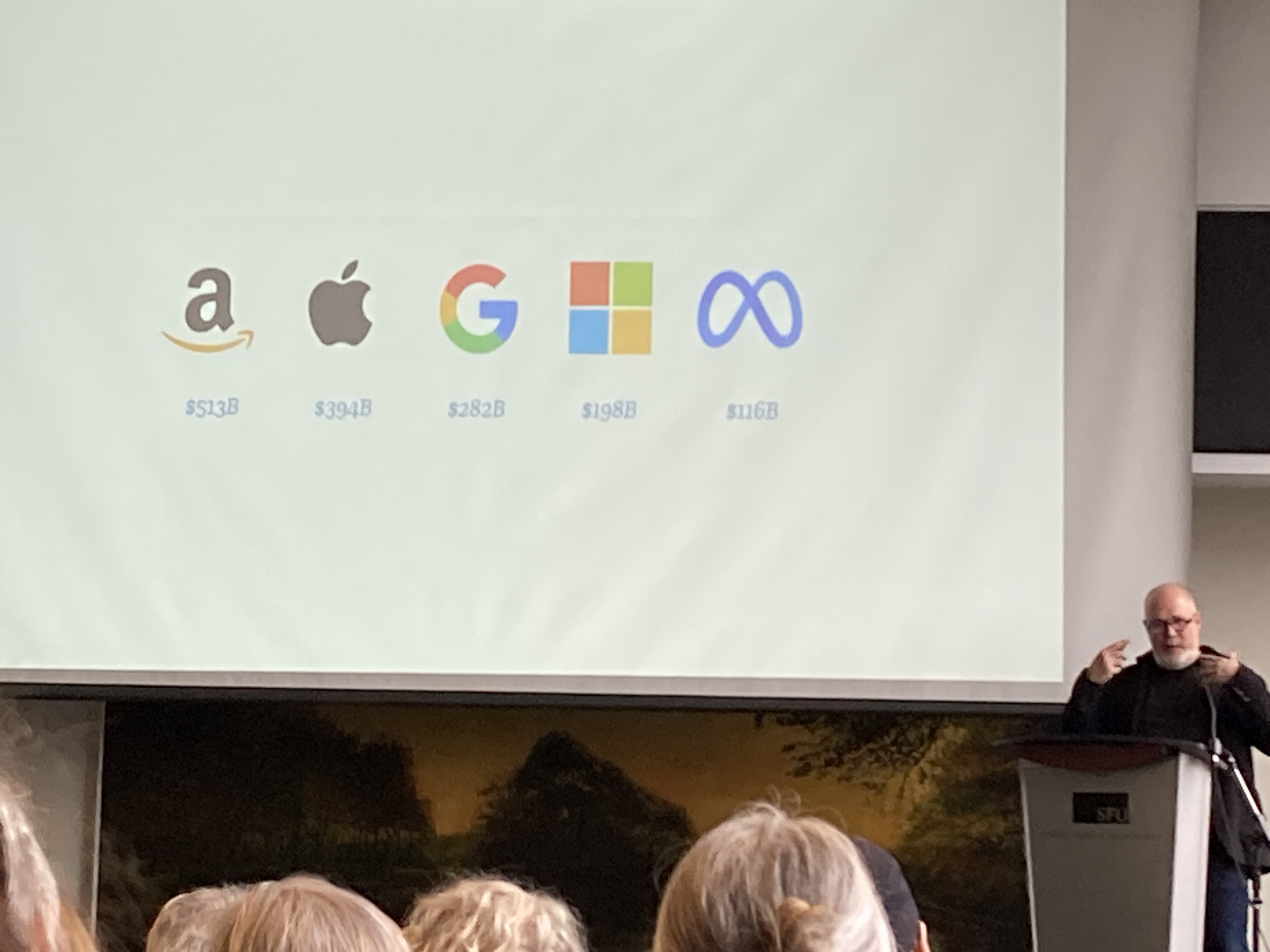
3) Mark talked about his path, via punk, activist TV, and noted that media literacy is still about power and activism is not about winning but about chipping away at power to make a balance. (He notes that 5 US companies are the richest and control the most things = Amazon, Apple, Google, Microsoft and Meta/Facebook - so these companies are the curators, bigger thant the NY Times, bigger than Exxon, bigger than Delta, and even bigger than Disney which owns so much). 

Media Artifacts:


MES Panel 13 (3:15 pm PST)
Truth and Ethics in Social Media: Youth Perception and Educational Influence of Twitter, Instagram, and YouTube


Summary (taken from program): We will report on some early findings from a large-scale, international research project based in Spain that seeks to explore the cultural and educational roles of Influencers and their fan communities within frames of digital citizenship and media education. In particular, the research explores activities of prosumers (or emirecs), particularly those who have risen to the status of social media influencer, and end users, on Instagram, YouTube and Twitter. The project seeks to uncover perceptions of media, truth and ethics from these social media sites, alongside a broader understanding of modes of interaction and communication, as well as typologies and profiles of young people in social networks and other "affinity spaces" on the Internet. The work has involved surveys, interviews, focus groups and discourse analysis. Some of our early findings include a risk of depersonalization in social networks; an awareness of the unreliability of information (and need to verify); the understanding of the potential to influence others; the general absence of ethical frameworks; and a consciousness of some educational impact. For the most part, young people agree upon some basic realities of social media: that they contain controversial information, often lacking objectivity; that they respond to economic, political, and propagandistic interests; that they are alternative to the traditional media, providing first-hand information; and that they are forums of personal and group expression. A major lynchpin is trust and how that is earned and appraised by end users, often through relationships but also through aspirational ties to figures such as Influencers.

3 Key Points:

1) Michael Hoeschsmann represented a team of four presenters and 60 researchers, mainly in Spain and Latin America, to share their investigations into online influencers and followers; he notes that North Americans try not to label stuff but the Spaniards were fine in describing some of the things they looked into as "morally reproachable".

2) Michael talked about EMIRECS as a suitable replacement portmanteau for PROSUMER (note: when I interviewed Michael for a Mediacy podcast, I was rather befuddled with this term but now I understand) and the experience of SUBSUMPTION (how influencers lose a bit of themselves within social media).

3) Even critically aware followers don't have the strategies to limit screen time, and educators surveyed underestimated their abilitity to address online influencer and follower culture. Their group is developing the COMPROMETIC model (combining media literacy and ICT within teachers' education programs). 

MES Panel 13 (3:15 pm PST)
Self-Writing as a Digital and Media Competence in a Technological and Social Environment


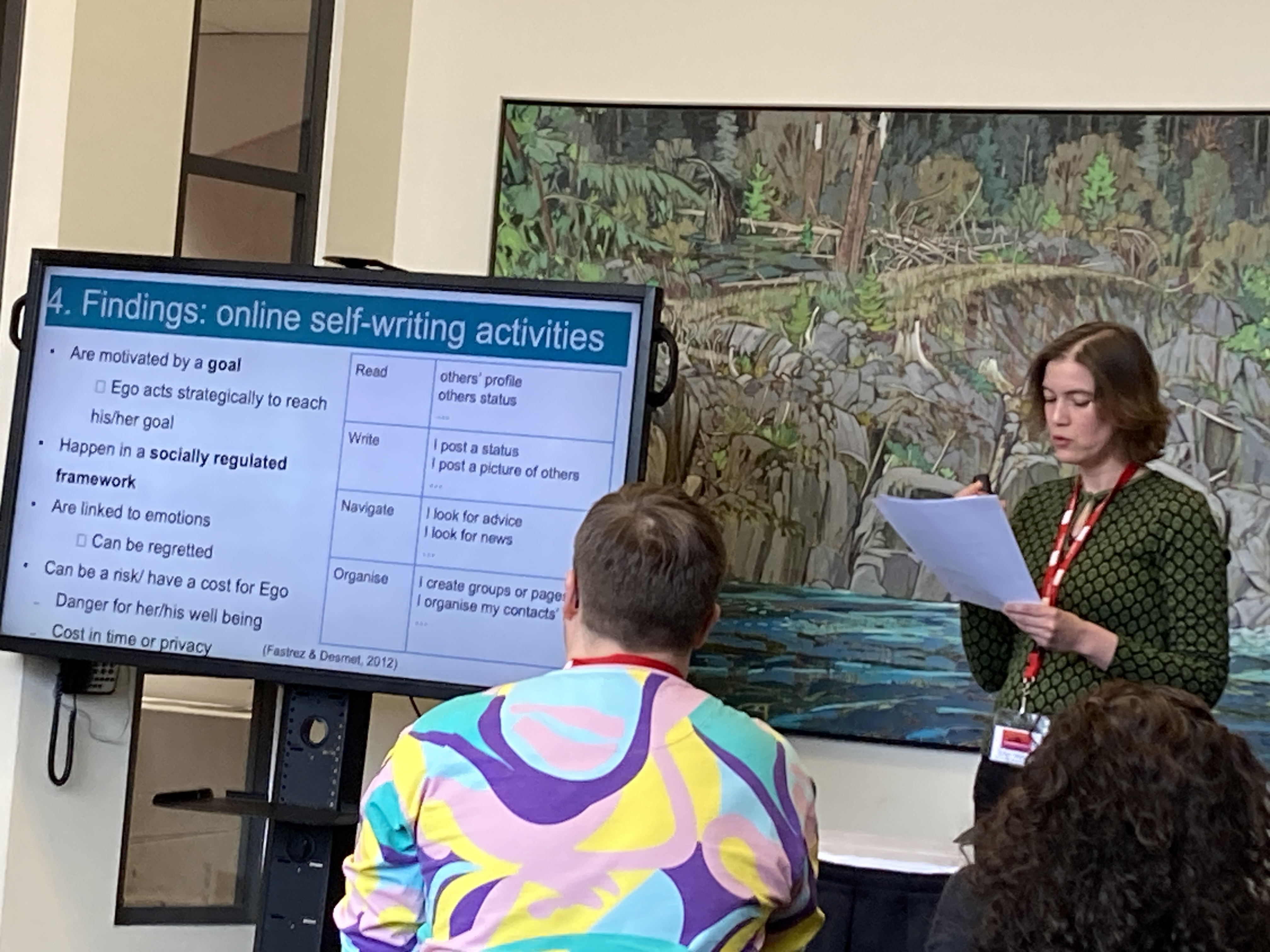
Summary (taken from program): This communication aims to present self-writing (SW) as a way to build relationships between the individual and his/her technological and social environment created by social networks. SW is intended as a set of practices designed to create and broadcast contents concerning the individual and his/her digital identity which Georges (2010) defines as tri-dimensional. It will explain how SW can be understood as a digital media competence and how this understanding modifies the definition of media literacy. The presentation will comment the results of a PhD thesis based on an inductive and comprehensive approach designed to understand how SW practices can lead to the definition of a media and digital competence, regarded as an ability “to create and spread someone’s own media productions, individually or in a group, by adopting the languages and technical processes implied by those productions using, if needed, the help of the right person” (Fastrez & De Smedt, 2012) (own translation). The analysis of 29 in-depth interviews with people (aged between 18 and 45) undergoing life changes reveals that: (1) people take into account specific social and individual norms linked to SW activities; (2) social groups play an important role in these activities; (3) the activities related to SW are specific to individuals as well as to platforms; (4) the audience influences SW (social environment) and, ultimately, (5) individuals’ digital identity. These results (which document SW activities and how digital identity evolves in social and technological environments) bring new insights to the media education framework.

Fastrez, P., & De Smedt, T. (2012). Une description matricielle des compétences en littératie médiatique. In La littératie médiatique multimodale. De nouvelles approches en lecture-écriture à l’école et hors de l’école (p. 45-60). Presses de l’Université du Québec.

Georges, F. (2010). Identités virtuelles : Les profils utilisateur du web 2.0. Questions théoriques.


3 Key Points:

1) Digital identities via online self-writing are created by ego, others, and the platforms used. This project involved iterative research that interviewed different groups of people during different phases.

2) It takes time to shape one's digital identity, because one must follow norms created by others, expose self to sanctions, and the "rules" of what to do and not do are never explicitly taught/shared. They can shape and create new norms within those structures (e.g. vloggers who choose not to show their actual faces online - this point came as a result of a question from the audience).

3) Digital identities change over time and over online platforms. Digital identity management is a challenge because there's a juggling of what you want to show, what should be shown, and the goal of not embarrassing your future self. (I asked a question about parents posting on behalf of their children and Esther and Anne-Sophie noted that fathers do a better job than mothers in moderating their posts of their children because mothers feel that since their bodies managed the pregnancy that they had rights to share more.)

MES Panel 13 (3:15 pm PST)
It is time for Media Education to address NFT Scams


Summary (taken from program): NFTs (non-fungible tokens) have been around since 2017, however only in March 2021 they became a worldwide sensation following the highly publicized sale of NFT art collage by the artist known as Beeple for $69,3mln. Following that, hundreds of thousands NFTs were traded with celebrities, artists and corporations participating in the NFT craze. The main idea behind NFTs is that they are digital collectibles that function as a proof of ownership, but not of copyright. 

While a lot of things can be sold as an NFT, its market is mostly associated with the art world. NFTs were supposed to protect digital art and support ordinary artists, while allowing them to bypass traditional gate-keeping systems such as galleries. However, in practice NFTs did not accomplish such. Instead, what NFTs are is a scam, designed to trick people into investing in cryptocurrencies and making those who are already wealthy even more rich.

The current research argues that NFTs in their current form are a scam that is largely facilitated through traditional and social media. This research discusses financial, artistic and ecological harm NFTs and cryptocurrencies bring, and appeals to include NFTs and larger cryptocurrency discourse into media education for supporting the development of digital media literacy and critical outlook. 

Overall, the research urges media education not to dismiss NFTs as just a one-time Internet trend and look behind its façade to see the scam that uses the media to spread misinformation and trick people. 


3 Key Points:

1) NFTs (non-fungible tokens) have been around since 2017. The big craze lasted for half a year but they are still present and people still trade and invest in them. (e.g. Donald Trump recently sold his NFT collection).

2) NFTs are just a market for cryptocurrencies; it does not secure ownership and can often be based on stolen art. It's a scam but because it's such an abstract concept, ponzi schemes developed. Because celebrities also talked about and promoted NFTs positively in the media, this led to an increase in crypto currency value.

3) To combat this sort of thing, we need to take a critical attitude towards media messages and ask who is sharing the story and for what purpose. There's a danger in abstraction and celebrity endorsements, especially in advertisements to children and teens, makes them possible dupes.

MES Panel 13 (3:15 pm PST)
Reconceptualizing Gather as a Social Studies Classroom Laboratory


Summary (taken from program): How might virtual students, separated physically from each other and in relative seclusion from the outside environment, understand social studies big concepts which focus on community and the significance of place? Minecraft has already proven to be a successful tool for curricular integration but has several limitations and challenges that prevent its use in certain circumstances. Difficulties related to platform agnosticism, cost, and familiarity meant that it was important to consider a different tool. Diana Maliszewski will describe how she repurposed Gather (also known as Gather Town), a web-conferencing software originally designed for remote office workers, for use with her virtual social studies students. Using McLuhan’s “through and about media” teaching approach, Maliszewski mobilized Gather to facilitate student exploration of ideas central to specific expectations and themes addressing heritage, identity, people and environments, as well as the disciplinary thinking concepts: significance, cause/consequence, continuity/change, patterns/trends, interrelationships, and perspective. The learning community addressed the “about media” portion of their learning in their reflections on possible attributes and capabilities of the “game”. 

The teacher purposefully provided scant prior information about Gather’s digital world so that students negotiated meanings of their subject content within the digital environment. They used their mental schema (both of virtual game worlds and of actual communities) to make sense of Gather’s capacity for constructing versions of reality, with social and political implications. Post-play, post-experience reflection prompts helped students make connections to, and understand, many of the overall and specific learning goals for Media Literacy and Social Studies.


3 Key Points:

1) (Bias alert! Another presentation I did. This was based on a paper I've written that will hopefully get published.) Diana's influences include Marshall McLuhan, Neil Andersen, Michael Dezuanni, and the GamingEdus (a group that included Liam O'Donnell, Denise Colby, Jen Apgar, and Andrew Forgrave). She prefers games based learning over gamification. She also prefers authentic commercial games over prescribed, didactic edu-games.

2) Because her students were already overly familiar with Minecraft (even though it is a near-perfect playing, teaching and learning environment) and because of other tech issues, she used a tool that office workers online use for virtual meetings as an unfamiliar place/space for students to explore ideas related to the social studies themes of identity and community. She had 3 case studies and her Grade 5-6 first group worked most successfully (and the Grade 3 group had the least amount of success).

3) Technically, this isn't part of my talk, but after the Q&A was done, I had a few extra questions to answer and I spent some great time talking with Allan Fox from Bournemouth University in the UK. For his PhD, he developed a "game that was not a game" (which is why he attended my talk, because I had a similar bent) for mixers to learn their craft in a less-stressful environment. He used Unity for the "game" design and the OBS (Open Broadcasts Software, which is free) to create different scenes, camera angles, and so on.

Media Artifacts:


Brain Break / Barry's Wander (4:45 pm PST)


Summary: If you are keeping track, I attended 9 sessions and presented 2 sessions on Saturday. That is a pretty intense workload / thought-load. I needed, to borrow my daughter's recently adopted phrase, to "touch grass". Originally, Joanna from Chicago and I were going to return to the Fleuvog store to look around. I couldn't find Joanna but Neil and Carol kindly accompanied me on this journey. I have to give a big shout-out to Rocco at the Vancouver store for giving me a brief history of the shoe brand AND letting me try one three different pairs of shoes. [In case a rich person with lots of money and nothing to spend it on is reading this blog post, I wore a pair of Derby Swirls (size 6.5, from the Seventh Heaven collection), a Barnett Biblio (size 7, from the Eastend "family of shoes"), and a Chakra (size 6, from the Soultalk "family")]. At first, I didn't understand the appeal of these very expensive and unusual looking shoes. However, I was fascinated with the passionate community that has developed around them and found them very comfortable to wear - even the heels, which is a minor miracle for me!

Media Artifacts:


Closing Plenary (7:00 pm PST)


Summary (taken from program): Antonio Lopez and Lissa Solip led the discussion

3 Key Points:

1) Lissa said she found this conference was like a microcosm of her career path, with media as an ecosystem and art making as a methodology that helps form knowledge; young people are the public intellectuals. We need that visceralization that was mentioned in the opening keynote, either because our senses are dulled, or contradictorily, because our senses are flooded. We can turn to the young people for the solution is there (the "youth hope industrial complex"). It is grounded in hope and based in collegial practice.

2) Antonio shared some personal stories of getting into media literacy via the punk movement, and his immune system collapsing near his "Jesus year" and a pilgrimage he took around that time ("you are walking the road but actually the road is walking you") that led him to move from journalism to teaching, and then academia. He stated that it was radical and risky to base this conference on edu-cologies, (heck, when he talked on this a few years ago, only 2 people showed up to hear him) but that it helped to think aspirationally, and he used a McLuhan tetrad to try and unpack the word edu-cologies.

3) The crowd-source definitions included (under the Improves category): transdisciplinary movemement, diversity, a regard for multiple forms of communication, co-learners, egalitarianism / (under the Retrieves category): holism, enhances collaborations, co-production of knowledge, asking youth for their opinions a sign of progress / (under the Obsoletes category): hierarchy of teachers over students, ignorance, denial (can't claim you don't know about climate change or media), anthrocentric world view / (under the Reverses category): toolified, youth hope, burden on people doing work, because too amorphous (no definition so can't be absorbed), too self-referential, eco-fascism, effort seen as doing something good instead of a step in doing so (greenwashing), words not actions (trivialization), resistance and a move back to basics because it's too messy

Media Artifacts:


Name Drop: 

These are some of the people that I met, or listened to present, or chatted with, that I really hope to continue staying in touch with after the conference. Please do not be offended if I left your name off this list - there were a LOT of people I interacted with 

Manisha Pathak-Shelat (from India)

Joe Burima (from Calgary, AB Canada) 

Scott DeJong (from Montreal QB Canada)

Karen Ambrose (from Milwaukee, WI USA)

Amanda Levido (from Australia)

Michael Dezuanni (from Australia) = Karen said I'm a "fan girl" and she's not wrong!

Hyeon-Seon Jeong (from Korea)

Joanna Marshall (from Chicago, IL USA)

Anne-Sophie Collard (from Belgium)

Noah Golden (from Long Beach, CA USA) = Noah, tell those filmmakers I loved their work!

Roxana Morduchowicz (from Argentina) = I will ask my students that question!

Carolyn Wilson (from Toronto, ON Canada)

Alan Fox (from United Kingdom)

Yonty Friesem (from Chicago, IL USA)

Paulo Granata (from Toronto, ON Canada)

Michael Hoechsmann (from Orillia, ON Canada) = I promise I'm not stalking you!

Tessa Jolls (from Malibu, CA USA)

Antonio Lopez (from Italy)

Vitor Tome (from Portugal)


... and, as always, thank you to Neil Andersen and Carol Arcus. Without you, AML would not be what it was and what it is. 


Monday, March 6, 2023

#MES23 - Global Media Education Summit (Part 1)


I escaped the big Ontario snowstorm because I was in Vancouver for the Global Media Education Summit. At one point, I said, "My brain is full". It was. In addition to presenting three times, I attended many other talks. Here is my summary of what I heard, what I learned, and the many great connections I created with some very smart people from all over the world. I am going to leave the traditional "So What, Now What?" section of my reflection to the end because some of these talks were very academic and it might be easier to explain my next steps based on the day's content, rather than individual sessions. Plus, this post is so long that it needs to be published in two parts. Here is Part 1.

Global Media Education Summit

Conference Reflections by Diana Maliszewski

Thursday, March 2, 2023

Opening Keynote - How to Sense The Future: Global Climate Change and Media Edu-cologies (5:00 pm PST)

Summary (taken from program)Global climate change has been predicted for at least a century, and yet little has been changed in response. This inaction has revealed the importance and inadequacy of knowledge: at first, many scientists and activists believed that simply educating the public would be enough, but the continuing lack of action and the debates over the existence and cause of global climate change – even after many predictions have materialised – has proven otherwise.
Although there are many reasons for this failure to act – such as concerted political efforts to sow fear, uncertainty, and doubt – our talk explores the difficulty of scale and attempts to overcome it. A fundamental difficulty is the fact that we experience weather, not climate: climate is an abstraction based on global inputs and dynamics that seem impervious to individual actions. To register the intricate and interwoven impact of climate change, we turn to arts-based interventions that deploy affectively intense hyper-local experiences. Ranging from individual VR experiences, to large scale art installations, they reveal how the senses can be deployed to create affective and effective relationships with our future world.

3 Key Points:

1) Move beyond data visualization to data visceralization - so people can feel and experience it on an emotional level.

2) Art plays an important role in understanding climate change.

3) Even with "successful" art interventions, there are criticisms with their approaches.

Media Artifacts:


Welcome to the Global Village Square (6:00 pm PST)


Summary (taken from program): Carolyn Wilson, Executive Director of the McLuhan Foundation for Digital Media Literacy, welcomes participants to the Global Village Square (GVS), a new global hub for those around the world involved in media literacy. The GVS is a place to “meet” and share research, resources, best practices, news about upcoming events, and critical perspectives on digital media and technology, recognizing that we all benefit from staying connected and knowing what is happening in the field.

3 Key Points:

1) The McLuhan Foundation can be found at https://mcluhanfoundation.org/

2) The organization wants to create a gathering space for all things media literacy.

3) They encourage people all over the world to sign up.


Friday, March 3, 2023


MES Panel 2 (9:00 am PST)
Building Critical Media Education: From Classroom to Community


Summary (taken from program): This presentation discusses a partnership between my Critical Media Literacy course and the local school district’s Racial and Educational Justice Team that extends media education from the university classroom to the local community and promotes social justice and media awareness among youths. This four-year project asks students to design Media Education Workshops themed around media representations on identity politics, such as that of gender, race and ethnicity, and (im)migration, and aimed at advancing high school students’ awareness and understanding of these issues. A panel of school teachers and equity & diversity specialists from the local school district select three best ideas and my students continue to produce, refine and present the actual workshops to local high school students at the Students Justice Conference hosted by the partnering school district. In this practice-oriented process, my students have learned to apply classroom knowledge in media advocacy to empower themselves and minority communities, and to promote media literacy for diversity and equity. The collaboration also exemplifies a co-education model in students’ learning as the specialists and coordinators of the school district’s Racial & Educational Justice Team bring their expertise in youth education and community outreach to the classroom by providing formative feedback to students’ projects and giving guest lectures on social justice, inclusion and intersectionality. This project showcases an inspiring and empowering process where college students pass on their knowledge, passion and aspirations to the younger generations through participating in media education and public engagement.

3 Key Points: 

1) Min Tang, the speaker, was very pleased with the projects her students helped create for the high school audience, on topics from Disney princess images to race/gender in video games, to whitewashing in Hollywood.

2) The structure gave adequate time for her 200 level college students to prepare (as in the fall they pitch their ideas, in the winter, they research the topic, and in the spring they present their research workshops to the high school students if they wished).

3) Min said some of her major takeways was to they benefited from the expertise of their partners (the local school board, the high school's student justice conference), learned to engage with the local community, and how the university students transitioned from learner to teacher

MES Panel 2 (9:00 am PST)
Confirmation Bias, Analytical Thinking, and Emotional Intensity in Evaluating News Headlines Online


Summary (taken from program): This study examines the role of prior beliefs, analytic thinking, and emotional intensity of content in believing that information is truthful or not. Participants (N=169 Facebook users) were presented with news headlines previously categorised into three specific subgroups – for or against vaccination, true or false, and high or low in emotional intensity. Each participant first answered questions about their attitude and behaviour towards vaccination against COVID-19 based on the theory of planned behaviour (TPB) and filled out a cognitive reflection test (CRT), a measure of analytic thinking, followed by an evaluation of each headline on whether it is truthful or not. The results showed strong evidence of overall confirmation bias in the group that supports vaccination; however, when considering whether the headline is real or false, the most significant differences between the groups were found in the case of trust in fake headlines against vaccination – those against vaccination to a larger extend believed in false headlines confirming their prior beliefs. In contrast, such differences between the groups were weak in case of false headlines supporting vaccination. Further analysis showed that analytic thinking described by the CRT score had a weak yet statistically significant tendency to promote one's ability to distinguish real from false information. The intensity of headlines had the most significant differences when evaluating real news headlines supporting vaccination with low emotional intensity and false news headlines against vaccination with low emotional intensity. Overall, these findings provide additional insight into the complex nature of information evaluation online and the critical role of one's prior beliefs and emotional components of the content.

3 Key Points:

1) Martins Priedols, the presenter, is a social psychologist from the University of Latvia and he said that the way Latvian society looks at media is very important, considering their "next-door neighbor" (Russia).

2) His study recruited participants via Facebook and the results were that the intensity of the headline had the most significant different when evaluating real news and there were interesting findings related to emotional intensity. One's prior beliefs play a critical role and the context matters a lot.

3) Sociocentric thinking does not equal critical thinking.

MES Panel 2 (9:00 am PST)
Gateways and Radicalization: The Rhetoric of Anti-Vaxx


Summary (taken from program): One of the most striking outcomes of the pandemic has been the spirited and public opposition to vaccinations and vaccine mandates. The communities that have coalesced to form what we might call the anti-vaxx movement include “strange bedfellows” (Gramsci) that emerge from diverse political and social groupings. We will present findings of a data scraping and visualization project, the data drawn primarily from Twitter over the first six months of 2022, a period that wraps around the events of January and February when the Canadian capital was occupied by the so-called Freedom Convoy. Our research connects a series of curated keywords that were in heavy circulation online with further data from Twitter. We seek those intersectional points where users who come into the conversation from different gateways coincide.
The anti-vaxx movement - which includes long-term, dyed in the wool skeptics of vaccinations and Western medicine, alongside a large number of right-wing malcontents and anti-state actors – is a highly polarized space of us vs them logics, increasingly drawn into conspiracy theories about a Great Reset directed by the World Economic Forum. The emergence to prominence of a kind of rigid, conspiratorial thinking poses a dramatic challenge to media education which relies on some flexibility of worldview to challenge ideas, ideologies and idiosyncrasies. 

3 Key Points:

1) The "Freedom Convoy" was called a "fringe minority with unacceptable views" but many different groups were drawn in, including an interesting intersection between the new age movement and conspiracy theories.

2) The Canadian flag image was taken over and appropriated by the Freedom Convey. The right wing as taken over the Big Protest movement and has co-opted language of critical thinking as part of their strategies (e.g. "do your own research" / "who is awake?")

3) This project involved collecting and analyzing 35 000 tweets based on "seed words" and it turns out different people come in from different entry points but if not careful can fall into 3 areas of "no return" (i.e. "they are lying" / "we are being persecuted" / "the normies won't get it").

MES Panel 2 (9:00 am PST)
Developing Children's Algorithmic Literacies Through Curatorship as Media Literacy


Summary (taken from program): The act of curating, that is organising, assembling and presenting content and considering audience engagement (Valtonen et al., 2019), often occurs on digital platforms by seemingly invisible algorithmic processes. Research shows the practice of curatorship can develop forms of media literacy with young people (Potter, 2012), with some research pointing to the potential of curatorship to develop an understanding of algorithms (Mihailidis & Fromm, 2014).

 So it has been established that students can learn about algorithmic processes and how they impact their media experiences through curatorship experiences. However, there are challenges using such an approach with young children, particularly in early childhood education settings. Although young children increasingly engage in practices mediated by algorithms, for example when choosing what to watch on television viewing platforms, there are few opportunities for them to engage in media literacy learning experiences that aim to develop critical perspectives of these practices.  

 This paper investigates how young children can engage in curatorship practices to begin understanding algorithms. Young children were involved in creating and collating digital artefacts responding to the prompt ‘See me use technologies to learn’. We invited children to curate these artefacts in ways that made sense to them, through narrative or thematic re-imaginings. We present findings of this process and detail the aspects of media literacy that were observed to have been developed by the children, including collating content to engage audiences with themes or narratives. We analyse the collections produced by the children to consider further opportunities to develop media literacy with young children.


3 Key Points:

1) Algorithms construct our stories for us yet are invisible and impacts our relation with media in both helpful and problematic ways.

2) Children are already exposed to algorithms so they need to understand how algorithms work; this project that involves curating and organizing helps children consider audience engagement, the invisible processes and critical perspectives.

3) This project had students take 10 Polaroid images based on the topic of "technology", then look at their photos to see what they noticed, similarities/differences; then the lead adult showed curated images and asked students to determine how she sorted her photos, had them do it to their own photos, then explain why they made the choices they did.

Media Artifacts:


All-Conference Panel - Creative Hubs, Activism, and Media Literacy in the MENA Region (10:30 am PST)


Summary (taken from program): This panel brings together three organisations active in the creative industry sector in
in the Middle East and North Africa (MENA) region to discuss the interplay between creative digital media practice, media literacy, and youth activism to fight for social justice. The three organizations, together with Roy El Khoury, Head of Youth and Civil Society for the British Council in Lebanon & Syria, will present their efforts and engage in a round-table to discuss the connection between arts, activism and media literacy in terms of capabilities and civic consequences. Khouloud Mahmoud and Leyth Ben - BOUBLI (https://linktr.ee/boubli). Boubli is a youth-led digital media founded in 2019. In Tunisian slang, boubli means a hubbub, a kerfuffle or a bangarang... in other words, a commotion often caused by conflicting views. Among young people, the term has taken quite a positive connotation which encapsulates the spirit of the project: "to make a boubli" is to disrupt norms and conventions. Amr Ajlouni - Gate of Sun (https://www.gateofsun.com/). Since August 2, 2017, Syrian filmmaker Amr and scenographer Rawan have run Gate of Sun, a social enterprise that serves as a film production house and an open space for cultural exchange in Gaziantep, Turkey. Gate of Sun aims to improve social cohesion among host and guest communities by producing audio-visual art with artists and filmmakers. Nour Melli - Shada Media Lab (https://www.instagram.com/shadamedialab/?hl=en) is a shared working space for media producers in Lebanon. It aims to provide media creators and influencers in Beirut and in North Lebanon with a safe space and platform and all the required support to drive forward their media skills.

3 Key Points:

1) It's important to disrupt the media landscape.

2) Students learn by doing, plus involvement in these programs that help them create content on social media platforms can help them find jobs and provide opportunities for community engagement.

3) The speakers agreed that their work constituted media activism and said it was important to make it as fun as possible to get engagement and train trainers to help with sustainability.

Media Artifacts:


CEMP Conversation 2 (11:45 am PST)
Fostering Primary Division Students' Critical Exploration of Algorithms


Summary (taken from program): We live in a digital world. Understanding how the world works could potentially and ideally lead to a society of informed citizens and critical thinkers. Algorithms are the invisible chaperones making the rules that govern our personal lives, provide access to our online resources, and help form our opinions. Because algorithms can be so influential, yet mysterious, it is important to realize how they operate and exert their influence on our lives. This Conversation will review one educator’s joint inquiry with her primary division students to better understand how algorithms function. She will develop different lesson plans and experiences, using the following preliminary inquiry questions to guide her action research: “What invisible things affect us?” / “What is an algorithm?” / “How can we understand and control things we cannot see, hear, or detect?”

For this inquiry and for young learners, the educator will use Trevor Mackenzie and Rebecca Bathurst-Hunt’s (2018) recommendation of employing shared research organization / collection tools with rich potential prompts (29). Because play is such an important part of childrens’ environments, we will use real-life examples that impact them from their digital play-scapes, such as board games (Maliszewski, 2022), video games (Gee, 2007) YouTube auto-play recommendations, and illustrative apps like the Most Likely Machine and Akinator. 

The educator will use analogies and metaphors to help conceptualize the phenomenon, although there may be some potential pedagogical challenges, especially considering the young age and language abilities of this group. This action research will be designed with a two-pronged purpose: to develop pedagogy for inquiry into algorithms and to support students’ media literate understanding of algorithms.


3 Key Points:

1) (Note: This was the first of my presentations, so my "key point report" may be biased). It takes time to establish an understanding of complex concepts such as algorithms, so having easy-to-remember definitions for they can use as a foundation helps.

2) Students come with many different levels of understanding; for instance, in the pre-lesson talk, some students used words like AI, where others thought that it was magic, a living entity, or some unknown general force at work.

3) Playing helps with understanding. They played with Akinator and loved it. Test results showed a good percentage of students comprehended but there were still some that were confused.

CEMP Conversation 2 (11:45 am PST)
Redefining "Feed" in an Algorithm-Driven Communication Condition


Summary (taken from program): In today’s algorithm-operated monopolistic media platforms, the unlimited expansion of neoliberalization has profoundly transformed the notion of public service into customer service, which has severely impacted the forming of human communities in the face of global issues. Confronted with the present common application of algorithmic recommendations and user profiling,  my presentation examines and rearticulates the meaning of “feed” and “feedback” to surface two essentially different and contradictory paradigms that function in platformized media communication. The first paradigm of feeding mechanism inquires into the so-called “human in the loop”, implying that the technicized and dehumanized communication model in which human beings are reduced into mere functionaries of technical apparatuses. By tracing back to Norbet Wiener’s feedback theory in his conceptualization of cybernetics, I recall Wiener’s solid belief in liberal humanism, that is, freeing human beings from any potential social and political restrictions and eliminating the injustice caused by corruption. The second paradigm is to rearticulate the ethical implication of feed/feeding to reenact human agencies in the formation of ecomedia. My argument is that instead of affirming the opposition between the machinic and the organic, it is more important to recognise the procedural and administrative function of digital profiles and algorithmic decision-making and reclaim human agency in digital media communication to formulate a morally charged media ecosystem. As a response to Antonio López’s proposal of a paradigm-shifting ecomedia literacy, my aim is to cultivate an awareness of this subtle feeding paradigm shift for media scholars, researchers, educators and practitioners.

3 Key Points:

1) Digital rhetoric is important, because we understand through metaphors.

2) It helps to unearth the etymology of the word "feed", from the sixteenth century understanding of food for animals, to the seventeenth century use as a system for providing raw materials, to the twentieth century's military connotations and boundary dissolution.

3) Qi Liu, the presenter, suggests we redefine feed to incorporate a sense of nourishment and care from the agrarian age and politicize the term.

Media Artifacts:


Keynote - Media Activism for Self-Determination: Indigenous Resistance in Defending Life and Territories (2:00 pm PST)


Summary (taken from program): Community and Indigenous organizations in Mexico produce diverse media content as part of their everyday communal life and their ongoing struggles for self-determination and autonomy. Indigenous Peoples use media and ICTs according to their needs and purposes. They use them either in the care of life and territory or in their defense.
Indigenous media production supports Indigenous activism through media practices anchored in territory and culture that serve to confront power structures from a cultural and political matrix based on everyday life. This form of media activism has both an internal and an external direction. Externally, they are spaces for the denunciation of abuses, injustices, violence, and violations of basic rights while at the same time they create and sustain networks and alliances with other Indigenous People and like-minded individuals and collectives. Inwardly, they allow self-observation and community reflection to understand geopolitics at play in their territories or to discuss practices that need to be revisited and changed such as gender biases or discrimination. Also, media products that reflect the everyday life inside the communities transmit local knowledge strengthening cultural identities and revitalizing languages. The diverse ways in which Indigenous Peoples use media are deeply intertwined with their cosmogonies and epistemologies. Therefore, instead of (only) referring to Indigenous Media, I propose to discuss Indigenous Communication. I understand Indigenous Communication as a complex system of thought, feeling and acting that resembles a spiral in which (thus far) I recognize five dimensions: (a) communication as cosmogony, (b) communication for community self-reflexivity, (c) communication as a political strategy (d) communication as a right, and (e) communication as a medium. In this talk, I discuss these five dimensions with examples from Indigenous media activist products that are part of current Indigenous struggles in defending life and territories in Mexico.

3 Key Points:

1) The term Indigenous itself is problematic because it is a reductionist political category and used in Mexico to oppress because by suggesting the population is mestizaje, it minimizes the amount of Indigenous people in the population (doubles if based on culture rather than linguistics).

2) There is a difference between caring for a territory and defending it, caring is constant, and defending is strategic and takes a different kind of energy.

3) Claudia Magallanes-Blanco, the speaker, who is not Indigenous but is an ally, talked about how she has to use her power to assist because in Oaxaca, the state with the highest Indigenous population, they have to fight for Indigenous rights (e.g. female Indigneous radio announcer training and support) - she told a story of a radio station in a school that regularly has no power and they bought a diesel generator to power the radio station for one hour a week and "you don't need to have power to do radio"

Media Artifacts:


MES Panel 7 (3:15 pm PST)
Digital Citizenship as a Public Policy in Education in Latin America


Summary (taken from program): Traditionally, digital exclusion was explained by the lack of access to the Internet. In Latin America, it is necessary to talk about unequal access to technologies. 

While access is an essential condition to promote digital citizenship, the lack of devises has been exacerbated. Today, there are new digital gaps based on skills and practices. The digitally excluded are those who do not have the capacity to respond to the new questions and challenges posed by the digital universe.

By understanding the principles that govern the digital world, citizens are able to analyse the role of technologies in society. By knowing how to critically evaluate on line content, people can use reliable information to make informed decisions. By understanding that there is nothing neutral on the web, people are able to think of their digital identity. 

Ministries of Education in Latin America agree that Digital Citizenship is an answer to the new dilemmas: fake news, big data, hate speech, digital identity, artificial intelligence. During 2020, with Microsoft´s support, UNESCO Latin America launched the Digital Citizenship Programme as Public Policy in Education.

The programme aims to strengthen the staff at teacher training institutes, pedagogical universities and Ministries of Education so they incorporate Digital Citizenship in the curriculum of the initial teacher training. 

This presentation focuses on the initiatives UNESCO launched:

  • A Latin American Conference with all Ministers of Education to present the Digital Citizenship Program 
  • A Curriculum book and online platform for teacher training 
  • Regional workshops (Southern Cone, Andean Zone, Central America) for the staff working in teacher training and curriculum 
  • Technical assistance for those countries interested in incorporating Digital Citizenship in initial teacher training

The presentation describes the results of the Digital Citizenship Program and the extent to which it has been incorporated as a Public Policy in Education.


3 Key Points:

1) Roxanna Muldochodas, from Argentina, explained the inequities exposed during the pandemic, saying that even though statistics said 55% of students in Argentina had a computer at home, in reality it was 100% of privileged/wealthy students with computers, while only 15% of students from the poorest families had computers, and 10% of students in the whole country (1 000 000 out of 11 000 000) had no access at all to computers during the lockdown (so they had to use TV or centres where they could pick up papers) so they had to address the inequalities.

2) Their three conclusions were that a) access is just the departure, not the arrival point, b) instrumental knowledge does not guarantee inclusion, and c) limited use of the Internet is the new way to exclude.

3) UNESCO Latin America launched digital citizenship as public policy and Roxanna says there's a gap between the policy and the in-the-field results, because many have it in the curriculum but nothing happens in some places, so more teacher training is needed.

MES Panel 7 (3:15 pm PST)
Digital Citizenship Education: Perceptions on the Concept and Self-Reported Competencies of Georgian school society


Summary (taken from program): This paper presents the results of an exploratory project on Digital Citizenship Education (DCE) conducted within the Georgian Education system aiming to identify core steps needed to infuse DCE in educational policy and school culture through pre-service and in-service activities. Data were collected from a total of 1954 individuals, among teachers (205), students (972), parents and guardians (777), following an exploratory sequential design (qualitative + quantitative), and data analysis exposed that school society members are aware of the DCE concept but lack proper competences to apply DCE in their everyday practice.

3 Key Points:

1) Vitor Tome presented on behalf of his Georgian colleagues, who couldn't make it. He said that there are three volumes of books produced to help with digital citizenship education - one for the framework, the second for the descriptors, and the third explains the model and how it can be used in assessment and teacher education.

2) The model is descriptive rather than prescriptive and has 10 digital domains in 3 areas.

3) Implementation can be transversal, as a subject, both, or new curriculum / under revision.


MES Panel 7 (3:15 pm PST)
Tackling Disinformation in K-12 Classrooms through In-Service Teacher Training and School Projects: Preliminary Results from the Iberian Digital Media and Fact-Checking Hub


Summary (taken from program): This paper presents the preliminary results of four in-service teacher training courses on tackling disinformation in K-12 classrooms that were developed in Portugal between October 2022 and February 2023. The trainings were the first of a course series that will be implemented in Portugal and Spain until February 2024, following the production and validation of pedagogical manuals for trainers and learners.

The trainings were led by trained journalists, certified as teacher trainers by the Portuguese Ministry of Education, during the project ‘Media Literacy and Journalism: pedagogic practices with and about media’ (2017 - …), focused on training teachers in media education. Since its arrival to the field, in partnership with the Portuguese Ministry of Education, more than 150 journalists and other media professionals have worked with 300 teachers, who have developed school projects with around 5000 preschool children and K-12 students.

Firstly, journalists helped teachers design projects adapted to their schools and communities. After the training, they continued to offer teachers regular support and monitored the developments. Therefore, some of the projects extended beyond the training course and are still ongoing.

The trainings specifically focused on tackling disinformation are being developed on behalf of the Iberian Digital Media and Fact-checking Hub (IBERIFIER), an observatory in Spain and Portugal, funded by the European Commission and linked to the European Digital Media Observatory (EDMO) and made up of twelve universities, five fact-checking organizations and news agencies, and six multidisciplinary research centers.


3 Key Points: 

1) Vitor also presented this project, which involves 14 hubs in all the European Union countries.

2) They involved journalists, organized resources, and had modules for trainees and trainers.

3) They found the trained journalists were more critical than the trained teachers in terms of evaluating (and thereby improving) the training; they've noted three challenges so far such as a) social media is not a democratic space because people are unaware how algorithms work, b) to protect or to empower - which is the focus, since both are needed, and c) trust vs truth - the danger of spreading misinformation.

Media Artifacts:


4:45 pm PST onward


Summary: I discovered through social media that my dear friend and fellow TDSB teacher-librarian Kim Davidson happened to not only be in the same city, but just a block away, presenting at a different conference. Through texts and a late Thursday night phone call, we arranged to meet each other at my conference. I skipped a book launch to make this happen but it was worth connecting. We talked at length and were joined by Joanna from Chicago on an in-depth conversation about Fleuvogs. We attempted to walk to the flagship store a few blocks away but it was closed. However, getting some fresh air and exercise helped to reinvigorate us, and we were able to attend the reception later that evening for more great conversations and networking.

Media Artifacts:


Stay tuned for Part 2 of this reflection, coming some time the week of March 6-10, 2023!