Tuesday, February 3, 2015

OLA Superconference 2015 - Photos and Tweets

I only attended one day of this year's Ontario Library Association SuperConference, which was very odd for me. Here are some of my favourite photos and tweets from the event (including the days I wasn't there).


Caroline talking about her experience with TLLP

Our presentation team: (L-R) me, Caroline, Cindy, Ray

My library mentor, Carol Koechlin, accepts OLA President's Award for her group

Joel and Sarah, OSLA SuperCon chief planners

A selfie with Shelagh Paterson, OLA director, while at Open Shelf Board meeting

Lisa, Fran, and Ruth at their session on STEM and the school library

Another selfie with my pal June from Thunder Bay

Monday, February 2, 2015

OLA Superconference 2015 - Reflections from #OLASC15

Ontario Library Association Super Conference 2015

Think It. Do It!
Conference Reflections by Diana Maliszewski

Friday, January 30, 2015 – 8:00 a.m.
Session #???:  EBSCO Breakfast

Summary =Librarians from various sectors were asked to hear about EBSCO’s latest products, in exchange for a hot breakfast and the chance at some prizes. According to the invitation, “attendees will hear about recent news and updates for eBooks on EBSCOHost, EBSCO Discovery Service, as well as Flipster, digital magazines from EBSCO and a preview of the all-new interfaces for school and public libraries”.

3 Key Points:
  • 1.       Searchasaurus, the kid-friendly EBSCO tool which has existed for 12 years, will be retired on June 30. It will be replaced by a new tool called “Explora”.
  • 2.       EBSCO found, by analyzing their search logs as well as through customer feedback, that students want topical overviews like they can find on Wikipedia, so they are providing this (and currently there are 2601 K-5 overviews but would love to hear from users what topics people want).
  • 3.       EBSCO has included more help options like auto-completes, stop-words and text-to-speech.


So what? Now what? = I entered the breakfast fully aware that this was a promotion campaign fuelled by the promise of free food. I’ll have to see if/when my board switches the icons on our school virtual library page and do some direct teaching with the kids on how to use this new product. I’d be intrigued to see what words are considered “stop words” and are blocked; would this impede work on health education research? In my grab bag, I really liked the keyboard cleaner freebie!

Friday, January 30, 2015 – 9:00 a.m.
Session #1503G: Forest of Reading Showcase

Summary = (taken from the program description) “The Forest of Reading Showcase will celebrate the 2014 Forest of Reading winners [eight authors in attendance]. The authors will share their personal reflections of being nominated, attending the Festival of Trees or Golden Oak ceremony, and their experience of being part of Canada’s largest children’s reading programs.”

So what? Now what? = I decided at the last minute that this would be enjoyable to hear but not necessarily chock-full of new learning for me. Conference visitors are permitted to change their minds and attend different workshops, so I did. I used my “extra” time to tour the Expo Hall floor and speak (as much as I could with no voice) to some colleagues I saw.

Friday, January 30, 2015 – 9:50 a.m.
Session #1502J: You Can Do That Here – Building a Maker Culture @ Your Library by Michael Laverty

Summary = (taken from program description) “By embracing the ethos of the Maker Movement, the Sioux Lookout Public Library is inviting all members of our community to help build the best possible library through active engagement (online and in person). Check out our ongoing experiment to make an innovative space for patrons to create, research, and discover”.

3 Key Points:
  • 1.       Michael’s library received two grants to transform their space and his weekly Friday conversations with his boss led to their motto philosophy “You can do that here” and their attempt to challenge and rethink how they do things at their small library and push a revolutionary mindset.
  • 2.       Who defines what a public library is? It should be like open source code, tweakable by many people, not just those who work there or even by those who visit, but by those who aren’t present. It may be impossible to understand the unique community needs of all but we should try.
  • 3.       Words are important. The space used to be called the Community Internet Access room (CIA) but they rebranded it the Community Media Room, where people can live stream events from the room, a return to public broadcasting. The people in the library are patrons, not users, because patrons give money and support and have a stake in the place.

So what? Now what? = Michael’s talk was more philosophical than I had imagined it would be. I don’t have any new insights on Maker Culture but I can always check out Vector Images for pictures to use – there were lots of little asides like that he mentioned that might be worth noting for future use.

Friday, January 30, 2015 – 10:45 a.m.
Session #1618: Teacher Learning and Leadership Program @ Your Library Learning Commons by Cindy van Wonderen, Caroline Freibauer, Ray Mercer, and Diana Maliszewski

Summary = (taken from program description) “Join us to hear about our Teacher Learning and Leadership Program [TLLP] projects for learning, research and advocacy of the Learning Commons! The TLLP is a Ministry of Education and Ontario Teachers’ Federation funded program for innovative, teacher-created learning. Learn about our proposal and what we have learned from each other in the process in showcasing the wonders of the Learning Commons for today’s students!”

3 Key Points:
  • 1.       The TLLP program benefits small boards, as many educators have never heard of it and every board regardless of size is permitted to put forward only two proposals. Caroline has done it twice (and is trying for a third).
  • 2.       There is a lot of teacher autonomy with this project, as the funds are from the Ministry and teachers are accountable to the Ministry for spending. Ray didn’t have to ask permission of his administration to come to Superconference this year because his expenses were covered by the project.
  • 3.       It helps to begin with a “problem of practice” or something that personally intrigues you. For Ray, it was how to best service all the FDK students with inquiry when they are beginning readers. For Caroline, it was how to become a more effective teacher-librarian and learn/teach/spread inquiry practices. For Diana, it was how to understand and share best practices surrounding games-based learning, especially Minecraft.

So what? Now what? = Based on the questions we heard from the small but interested audience (of about 20 people), I will be writing an article on how to fund Minecraft in the schools for GamingEdus. It was relieving to hear that people’s projects progress very slowly – I’m glad it’s not just us!

Friday, January 30, 2015 – 12:00 noon
Session #???: Open Shelf Editorial Board Lunch Meeting

Summary = OLA’s official magazine, Access, has changed its name to Open Shelf and gone purely digital. We discussed what’s working well, what needs fixing, and future plans.

So what? Now what? = I need to send Mike Ridley, Open Shelf’s editor-in-chief, the file that The Teaching Librarian magazine uses for standardized responses to writing submissions. I also volunteered to learn the back-end production information for publication, depending on release time. The team will develop an editorial calendar, share the work load (soliciting articles / editing articles / posting on the site), and look into some specialized theme editions.

Friday, January 30, 2015 – 2:15 p.m.
Session #1701R: STEM Education – What’s the School Library Got to Do with It? by Lisa Dempster, Fran Potvin-Schafer and Ruth Hall

Summary = (taken from program description) “STEM [Science, Technology, Engineering, and Mathematics] education is a growing focus in the education landscape. How does STEM relate to school library programming? Hear the perspectives of a secondary teacher-librarian, elementary teacher-librarian, and central support staff. Leave with ideas on how to implement STEM programming in your library learning commons.”

3 Key Points:
  • 1.       STEM is taking prominence now because fewer than 50% of students graduate with skills needed for STEM related careers, but (at least in the TDSB definition) it is more about an integrative, trans-disciplinary approach to learning and not focused on the subjects in the acronym.
  • 2.       Some of elementary ideas (which can work with all types of TL service models from full collaboration to prep fairy) include developing a teddy bear playground, designing an animal that can live in a certain habitat, Lego Mindstorms, Scratch programming, STEM challenges during prep classes, STEM clubs and using the Engineer in Residence program.
  • 3.       Some of the secondary ideas include 3D printing, using tools that are usually reserved for speciality programs like drafting tables and light tables, take-apart stations, challenges left on tables, steam punk artifact creation inspired by books read during a reading club, maker space in a bag, maker space on a cart, etc.

So what? Now what? = My biggest inspiration from this talk was from Lisa Dempster and two words: DUCT TAPE! Maker Spaces and STEM doesn’t have to be high-tech and involve computers. It can be paper crafts, fabric, origami, and I think duct tape has so much potential! I might want to touch base with names mentioned during this presentation like Petra at Port Royal and Michael Mendozza with his Blue Spruce linked Tinker area.

Friday, January 30, 2015 – 3:05 p.m.
Session #1702N: Inquiring Minds and Blue Spruce by Ruth Gretsinger

Summary = (taken from program description) “Looking for ways to ramp up the inquiry skills of your primary students, meet the curricular needs of your students in social studies, science and language and use Blue Spruce 2015 to its full potential in your Library Learning Commons? Come out and learn about my efforts to integrate these “buzz words” and make them meaningful with concrete strategies to enhance your Blue Spruce program”.

3 Key Points:
  • 1.       Ruth began this new approach because she noticed that often, the Blue Spruce book that won was the last book she read to the kids because they wouldn’t remember the others, so there had to be a way to keep all the books in mind. She also found that she’d teach about digital resources but when it was time for kids to research, they’d just Google things.
  • 2.       Some of the digital resources she used include True Flix and Expert Space (bought from Scholastic with Book Fair money), Pebble Go, Kids Info Bits, Book Flix, Britannica School, and Notebook 10.
  • 3.       Some of the skills she taught as part of this method was dot jot note taking, how to cite sources, how to turn I wonders into questions, highlighting text, making search terms, citing pictures, and developing criteria for judging picture books.

So what? Now what? = Ruth is one of the most generous teacher-librarians I know. She gave EVERY member of her audience a USB stick with ALL of her resources, including her SMARTboard files for immediate use. I had several people that asked me to attend this session and share what I received. My intent is that I, and anyone else that is lucky enough to get this, “pay it forward” and donate some money to the Forest Fund as a way to say thank you to Ruth for making and sharing. I’ll be using this resource this coming week with my classes! I’ll also look into buying True Flix with my extra book fair funds.

Friday, January 30, 2015 – 4:00 p.m.
Session #1800: Chief of Confusion by John Seely Brown

Summary = (taken from program description) “Part scientist, part artist and part strategist, John Seely Brown’s unofficial title has become “Chief of Confusion” focusing on helping people ask the right questions and make sense out of a constantly changing world. Brown is considered one of the leading contemporary thinkers on how technology impacts modern life…”

3 Key Points:
  • 1.       In the 21st century, there is no stability in sight, genres are fluid, topics have no boundaries, and no one agrees on anything. We need to reimagine libraries.
  • 2.       It is more important to cultivate a disposition than it is to teach content or mentor skills.
  • 3.       Blend “man who knows” with “man who makes” and “man who plays” and create three priorities: place the library as the hub of a community / make the most of digital technology and creative media / mentor, connect, guide and curate.

So what? Now what? = I was a bit critical of one part of the talk, because as a way to address the issue that learning happens outside school and we should acknowledge the “in the wild” learning, he proposed a badge system to show employees, friends, and teachers that you’ve engaged in learning. (I find badges part of gamification and that’s problematic. Who creates the badges? Who awards them? Is it for the learning or the ‘prize’?). Despite the small crowd for the closing keynote and his remote access (because he was stuck in LA), it provided some reassurance that we are on the right path, as well as food for thought .


Monday, January 26, 2015

Kindies & 3D Printing?

I was so excited by this recent set  of events that I started writing today's blog post last week! It has reinforced for me the importance of:
  • reaching out (to fellow educators and other connections)
  • using technology authentically
  • embracing inquiry
It all began with a admittedly run-of-the-mill author investigation with all three of the kindergarten classes I see for library, ICT, and media. Our focus author was Paulette Bourgeois and her Franklin the Turtle series. We read the books. We watched the TV show episodes on Learn 360. We played the games on www.treehousetv.com. I wanted the students to be active media producers and not just media consumers so each class brainstormed potential Franklin media texts that we could create. One particular class, the one fortunate enough to have Jennifer Balido-Cadavez as their ECE, decided that they wanted to make Franklin cookies. One of the many things I admire about Jen is how she integrates the themes and topics between the "regular" class and the "specialist" lessons. She and the kindergarten students continued to talk back in their regular classroom about how we might make Franklin cookies when the kindergarten teacher (Jenny Bird - there are a lot of Jennifers on our staff!) asked if it would be possible to 3D print a cookie cutter. 

I am lucky to know David Hann, a teacher at Donview Middle School who is known as "the 3D Printer Guy". He does very innovative things with his students, like building working pinball machines that he and his students shared at the recent Toronto MakerFaire. He's seriously curious and always experimenting, including his recent explorations onto the GamingEdus Professional Play Minecraft server. He's not stingy with his knowledge and resources - and neither is Lisa Dempster from Riverdale C.I.. She is constantly pushing the boundaries of what it means to work in a Library Learning Commons. She is doing pretty amazing things related to STEM in her library and she readily offered us her Google document outlining how to turn a 2D drawing into a 3D printed creation. 

Mrs. Cadavez and I read over the steps and together with the students, we explored, questioned, and experimented. We tweeted our investigations on the school Twitter account
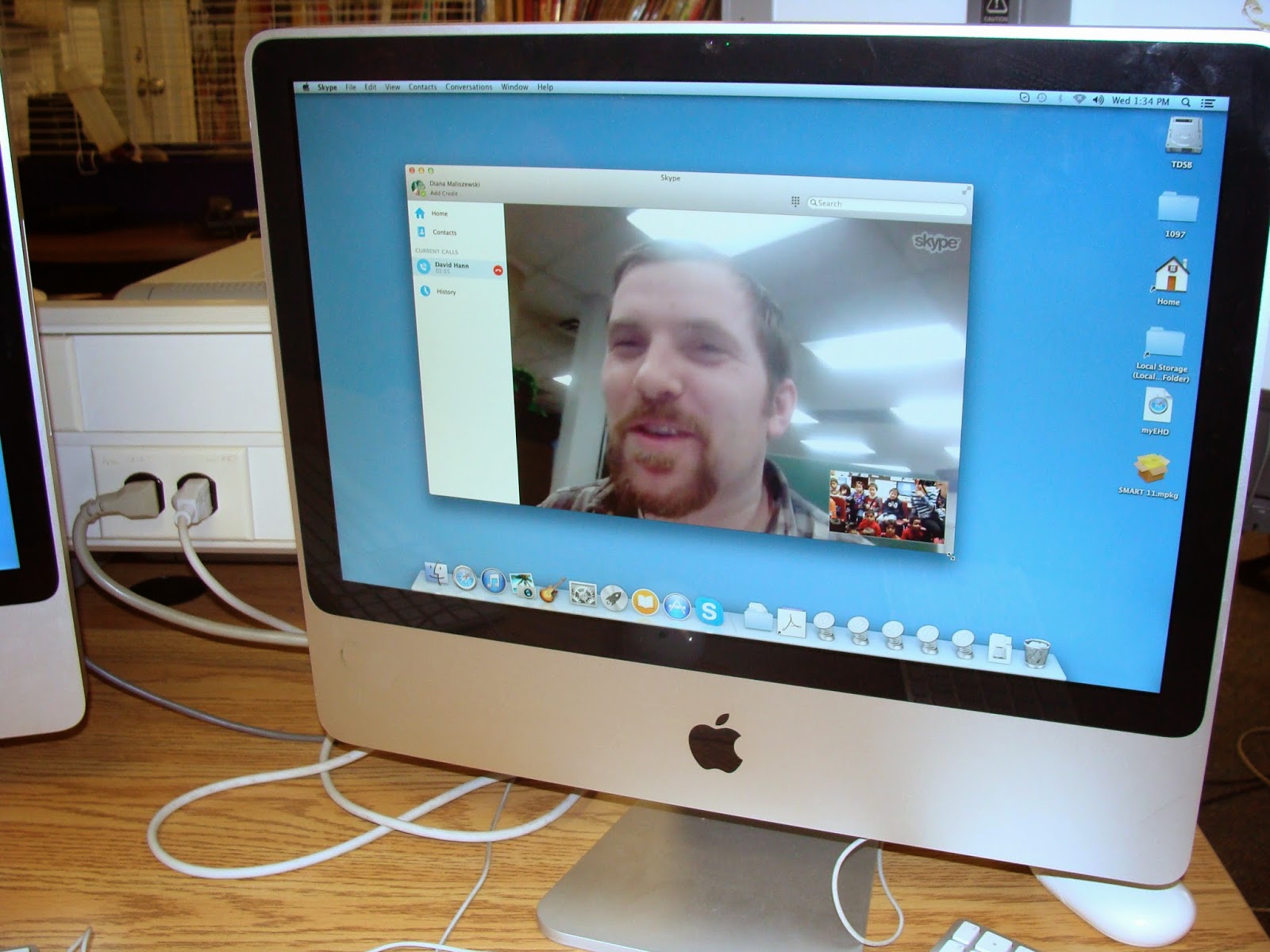
and when the possibility of a Skype chat with David Hann at Donview came up, we jumped at the opportunity.
Some would say that watching a 3D printer do its job is boring. Don't tell that to our twenty-plus 4- and 5-year-olds, who sat mesmerized as Mr. Hann warmed up his school's 3D printer, explained the process, and printed a toonie-sized object for us. We documented like crazy, taking videos, snapping photographs, and tweeting.
David explains the process to our excited kindies

Mrs. Cadavez' expression says it all: WOW!
To get an idea of what this Skype chat meant to us, let me quote a section from the email Jen and I sent to David's principal about the experience:

Mr. Hann, through the @DonviewDT Twitter account, answered some of our initial questions, and then we set up a Skype meeting to see a 3D printer in action. David was an incredible teacher - he explained the concepts in ways that our kindergarten students could understand (e.g. the 3D printer extrudes the melted plastic like when we squeeze Play-Doh through our fists). He taught us about 3D printers but also life lessons about curiosity and perseverance (e.g. he told us that it took him three tries to get his heart cookie cutter to print in the way he wanted but he learned from his mistakes and kept trying).

Other people continue to help us with our goal. The kindergarten students, under Jen's guidance, actually researched the cost of ordering our 3D cookie cutter created with food-safe materials. (We found out from our talk with Mr. Hann that our original plans for making a cookie cutter with regular plastic might not be 100% sanitary.)


I did some researching as well and found some Canadian contacts I had made at the Toronto Maker Faire. I muddled my way through transforming their drawing via TinkerCad. John Watson was willing to work with our file and project and it looks like it will become reality. Our kindergarten students may not have conducted every single step in the process, but they were involved in 3D printing in ways I didn't think were possible. Everyone involved was so enthusiastic - and we plan on showing our appreciation by baking and delivering lots of cookies!

P.S. - It's done! John Watson, from TapLabs in Ajax, made our cookie cutter for us this weekend and even took photos of the process! 


Monday, January 19, 2015

Rescued from R

I really admire the teachers that I have the pleasure of working with at my school. Today's reflection focuses on one particular teacher, Sonia Singh, her perseverance, and how invested she is in her students and their success.

It is common practice at our school that teachers notify the families of students who are doing poorly in a particular subject prior to the report card, so that there are no unhappy surprises. I submit grades for media, drama and dance for the primary grades, and after tabulating my various assessments, one student in Sonia Singh's Grade 2 class was earning "R" for media. I told Sonia about these preliminary results and this upset her greatly.

"X is not a R student. She is capable of much more than a R!", she told me.

We met and I showed her all the work samples I had for this student. I was perplexed. I thought I had provided sufficient accommodations and supports for her but it wasn't working. Sonia was shocked at the quality of work the child was producing.

"Let me work with her." she pleaded.

I explained what was expected for a couple of the tasks and agreed to give the student another chance to attempt the work with her classroom teacher. The very same day, Mrs. Singh called me into her classroom, her face beaming. Not only had the student re-done the assignments, the quality had improved tremendously! I asked her what magic she had performed to evoke this huge turnaround. Sonia said that she reexplained the work and gave the girl a very specific time for her to complete the task. The student worked at her desk right next to the teacher during recess and when Mrs. Singh checked in on her, she had completed the job. We talked about the challenges of working in the library (with many distractions present and no individual desks around) and decided on some strategies that might help the youngster stay focused (such as keeping her next to me during work time, giving her time goals to meet, and checking in on her frequently to ensure she was on task).

The road to hell is paved with good intentions and I meant to follow the recommendations the classroom teacher and I designed for her. During our dance lesson, which involved a writing task, I myself was so bombarded with other students and their desire for feedback that I forgot to keep the little girl at my side. She's a quiet child, one that can easily slip between the cracks. Yet, when I checked in on her at the end of class, she had correctly completed the task! I practically ran to Sonia's class to tell her the good news and she was so proud of what the student had accomplished (despite my lack of support).

Sonia Singh is an inspiration, because:

  • poor results were not the be-all and end-all, but reasons for investigation > Why isn't this child succeeding? What else can we do to help?
  • the unsatisfactory grade was not my problem, but OUR problem and one that she was truly interested in rectifying
  • all students have potential to improve > she possesses a growth mindset, not a fixed mindset
  • teachers help other teachers, when and how they can, even to the point of giving up their recess time to plan, discuss, reflect, and celebrate
It can be difficult to find the time to have these conversations - that's why I am so pleased that during our upcoming half-day PLC release time, the school Literacy Committee has reserved some time for us to discuss our focus students (and, if needed, the students that puzzle us for various reasons). Two heads are better than one, and if we can resolve to rescue as many of our students from the R results together as a team, then I feel optimistic about the future of education, at least in my building. Thank you Sonia for caring so much about our students.  


Monday, January 12, 2015

Tweak the Twerk

This weekend, my Mentoring AQ course was cancelled due to flooding on location so I couldn't attend. The board report card writing website was down so I couldn't do that either. Instead, I planned a media/dance lesson for my primary division students and found myself knee-deep in an ethical dilemma of my own creation.

The third section of dance expectations in the Ontario curriculum, Exploring Forms and Cultural Contexts, states that students should "demonstrate an understanding of a variety of dance forms and styles from the past and present and their social and/or community contexts". I like incorporating popular culture and student interests into my lessons and I thought it would be a fun and engaging task to examine the Taylor Swift video, "Shake It Off". If you haven't seen it before, I've embedded it below.


I really like this song and enjoyed watching both this video, as well as the "Behind the Scenes" videos on YouTube explaining the creative process. The video taught me about dance styles that I was unaware of, like the incredible Finger Tutting. The lyrics are a great inspiration for all the anti-bullying talks we are supposed to initiate with our students. But there's a problem.

Twerking.

Twerking is a dance style that, according to Wikipedia, is "a type of dancing in which an individual, usually a female, dances to music in a sexually provocative manner involving thrusting hip movements and a low squatting stance". Students in the U.S. have been suspended for twerking at dances and making twerking videos on school property. In the same article, the twerking sections of the very same Taylor Swift video I planned on showing was accused of "perpetuat[ing] stereotypes" about Black women.

What should I do? I thought of several options, but each came with its own unique set of subsequent problems.

a) Block the twerking sections

Whether I do it high-tech (download a copy and turn the screen black) or low-tech (put a paper in front of the screen as I re-film, or simply put my hand over the data projector when the section pops up), I could use the song but just remove the controversial visual parts.

BUT isn't that a form of censorship? I'm disappointed when I hear that teachers or teacher-librarians alter books because they find certain parts unacceptable. Changing an artist's creation because it doesn't match my standards is a dicey proposition. Isn't that what I would be doing by blocking specific images?

b) Play it and address the controversy

It's possible for me to play the video in its entirety and directly discuss the potential offences. Who performs each of these dances? Who doesn't? Why? It would elevate the discourse and critical thinking. I think it would make an excellent discussion, to look at dances in the past and present that were considered "bad" (such as the tango and the twist and twerking - hey, they all begin with T!)

BUT these are young students (6-8 year olds) and I'm not sure how much they could handle. I've got to confess, I don't know how much equity education happens in our classrooms. If it is uncommon for my students to have experience talking about race, gender, and class, will this be too much, too fast?

c) Play it and ignore the controversy

Maybe this is a mole hill, not a mountain. Maybe they might not even notice the twerking. After all, it lasts for a grand total of 17 seconds in the entire video. By blocking it or having a serious conversation about it, maybe I'm calling attention to it in a way that isn't needed.

BUT if I am aware of the potential for offence, then aren't I being derelict in  my teaching duty for not dealing with it? I talked with another teacher last week about the possibility of using this video, and he recommended I run it by the principal first. Do I really want to risk the wrath of upset parents or a shocked administrator?

d) Choose a different video

I could save myself the angst and trouble and just search Learn360 or any one of the school-safe video streaming options we have in my board to use a sample that doesn't have these strings attached.

BUT is avoiding the issue entirely a coward's way out? What drew me initially to this video was how, in a quick 3 minute chunk, eight different dance styles were showcased. Comparison becomes quite easy when the different dance forms are shown together like it is in the video. Read the teacher prompt included with the specific dance expectation:
"When we watched the video of Irish dancing, a few students mentioned that the dancers don't use their arms when they dance. Did anyone notice anything else? Are arms used in some of the other dance forms that we saw?"
This type of observation could be accomplished in one period (with follow-up) instead of the multiple ones needed if we were highlighting one style per class.

I'm not sure what I will do. Any advice? Option A, B, C, D, or one I have not yet considered?


Monday, January 5, 2015

Ma(r)king Major and Minor Holiday Projects

Welcome to 2015! I had a restful and yet still productive holiday - it must have been due to waking up after 10:00 am most days! I wanted to share some of the projects I worked on while I was away and how many of the non-school tasks actually helped me educationally.

Project #1 = Dad's Personalized Equalizer DVD Cover


My parents are notoriously hard to buy Christmas gifts for, but this year, my brother inspired us. We pre-ordered a Blu-Ray copy of the Denzel Washington film, The Equalizer. However, it wouldn't be ready until after December 25. I decided to use my rusty Photoshop skills and re-create the cover with my father as the star instead of Denzel. It took about an afternoon to complete and although it wasn't perfect (because I didn't add the rain effect to match the background), the reaction was pure gold.

I DISCOVERED that even though the final end-product might not be as up-to-snuff as I would like, the intended audience was extremely appreciative. (If it was a class media project, I would have given myself a B+ and I'm sure my incredible former yearbook editor would be more critical of the integration of the photo into the cover.) Having an idea to work with and shape helped a lot. If we can see the recipients of our work (like the senior citizens who got holiday cards from our students), it may help to make our work more meaningful.

Project #2 = Marking 

This took three days to complete, and technically, it's not completed. (I didn't do my kindergarten classes as I had intended.) Who would have thought that five classes of media, drama, and dance would take so long to evaluate?

I DISCOVERED that I need to devote at least half of my prep periods during the school day to marking so that it doesn't pile up. (I also need to devote half the time to keeping the library clean and half to catching up on all the media interview assessments I wanted to accomplish, but I don't think the math adds up there!) It's a goal of mine to be more timely in my assessments and feedback - I'm pleased with the mark summaries I've created to send home in student agendas. I do like examining the assessments I give to ensure that they are fair, differentiated, and evaluate what I intend. Deciding on what weight each assignment merits in the overall scheme of things is quite the challenge - I think I"ll be experimenting more with safe online tools or making my own with GAFE tools.

Project #3 = Daughter's Superhero RPG Covers


About once a month or so, we play a role-playing game with the Peer family at their house. I've written about it a lot more on my Family Gaming blog. Because it's a super-hero game, my artistic daughter had the brilliant idea to immortalize each of the RPG adventures in a pretend comic book cover recap. She pencils and I ink and then colour a scanned reproduction. I have to say that it's very relaxing to trace lines and colour pictures. These three covers took about two evenings to complete. You can see the other seven "issues" here and here.

I DISCOVERED that making something with my hands is very satisfying. I know this because of the baking I did over the holiday but this project had a much more artistic feel. This project also demonstrated positive interdependence. Each person plays a part. I can't colour if my daughter hasn't drawn the cover. We can't create any more unless Morgan leads our adventure. It becomes tricky in school, especially if someone on the team does not do their part. It also takes time and good tools to make something good. The notes on what colours go with what character help a lot too.

Project #4 = Son's Minecraft Book Trailer


My children received some nice presents for Christmas, including some Minecraft mini-figures as well as the novel Descent into Overworld  by Liam O'Donnell. This book is special to us because we had a chance to be "beta-readers" before it was published. My son and I decided to make a mini-video promoting the book using our iPad's StoMo software. It took a bit longer than usual because we accidentally filmed upside down and used Windows Movie Maker instead of iMovie to assemble the final product. It took a half-day to finish.

I DISCOVERED that in projects, some people are more committed to certain portions. My son loved the filming but was not interested in the editing, especially when we hit snags. There's always a little bit of yourself in every project you do, especially if you care about it. My husband saw the initial clip and said that the iron golem double-take looked very "Diana-esque". There are always ways to overcome technical difficulties, even thought it may take a while to figure out.

Hopefully, all of these projects will help me as I get into the final designs of the huge media restaurant project my students will be undertaking in January. We've got two teams with their restaurant names determined (Pizza Power and Sugar Shark - the Grade 1s love alliteration!) and three others who know the type of restaurant but have not voted on the name. I'm hoping that my upcoming Teacher Performance Appraisal will be an observation of one of my media lessons dealing with the restaurant, because it's been a source of reflection and learning for both me and the students.


Monday, December 29, 2014

Year Over, Years Older

This is my last post of 2014. Where did the time go? I'm still on vacation as I compose this post and my to-do list is a kilometer long. However, I made sure that on Christmas Day and Boxing Day, I relaxed and enjoyed the holiday with my family. One of my favourite presents was from my considerate husband, who ordered me a bound and printed copy of the first two years of my blog.

Thank goodness for iPhones and taking selfies!
Even though I have a pile of novels to read before January, I sat and read through the entire book, which contains my ruminations from 2009-2011. It was really neat to see how I've changed and how I've stayed the same. The biggest alterations?

My opinions about online privacy

In the past, I never used to mention people by name on the blog. I avoided using photos. I employed a pseudonym while on Twitter. Thanks to influences like Lisa Dempster and Gwyneth Jones, I started to be less afraid and more pro-active about controlling my positive digital footprint. I believe my thoughts are still evolving, as recent talks with Andrew Campbell and Peter Skillen have urged me to consider the online privacy of others as well and the digital tools I use.

My views on how blogs and Twitter work

My posts chronicle my relationship with Twitter, which mirrors many people's experiences. Beginning with "I'll just get an account to see things; I won't post" in 2009 to over 5000 tweets five years later, Twitter has become more important to me professionally and personally than I originally thought. I also used to fill my blog with "freebies", links to lesson plans and book reviews I wrote. Now, those items are still available on http://mzmollyTLsharespace.pbworks.com but my blog is more about reflecting on my teaching practices.

My pop culture and book obsessions

Boy, I used to write about Twilight a LOT back then! Thanks to the series, I have a group of wonderful adult friends from all over North America and we still keep in touch via Facebook, but I don't gush over the books I'm reading anymore.

My other observation is that I feel a lot older. It's not just the hair. (I've decided to stop colouring my hair, partly because I couldn't remember what the original hue was. Turns out it's salt and pepper, with emphasis on the salt.) I'm tired. In the past, I was involved in a lot of things, and I still am, but staying on top of everything isn't as easy as it once seemed to be. Maybe it's just my faulty memory, and the truth could be that I struggled with keeping things tidy, deadlines and completing tasks just as much back then. Still, in addition to my usual duties with school and the magazine, I'll be taking an Additional Qualification course starting in January (on Mentoring - my first official-like-on-OCT-records course since I completed my MEd in 2010, which will be exciting), running my church's Marriage Preparation program, working on the TLLP grant with the awesome Liam O'Donnell and Denise Colby, and getting closer to finishing that self-initiated research project on readers' choice programs (that I wrote about way back in the early days of my blog). I'll pace myself, monitor my energy levels, sleep when I need it, and chunk work so I can complete jobs and feel like I've accomplished something.  I may need to operate at a different speed, but if I approach 2015 with an "aging like fine wine" view instead of an "aging like an overripe banana" view, I'll be fine. Make 2015 bring you health, wealth, happiness, and all that you need.