Monday, February 29, 2016

Inquiry Begets Inquiry

"Your presentation made me not want to gouge my eyes out."

I joked that this paraphrased ringing endorsement would be included on my next ALP. On Friday, February 26, 2016 I had the great pleasure of presenting a session on Inquiry Based Learning at the West Region 10 Family of School Mentor and Mentee Professional Learning Day. I was there thanks to my friend and fellow Mentor AQ Course alumni Marianne Bartkiw, who had been asked to share her experiences with inquiry by her vice-principal. I was so grateful to be included in this experience, especially because teacher-librarians can be important resources to implementing inquiry and sometimes TLs are left out of the conversation.

This was the first time that Marianne and I had given a workshop together so we spent a lot of time beforehand planning and plotting. The preparation paid off well. What I am most proud of from our talk was how we tried to honour the expertise that already existed in the room and make it an interactive experience.

Marianne and I structured the afternoon like a 3-Part Math lesson, with Minds On, Action, and Consolidation sections. We made a conscientious effort not to talk at the audience and to provide opportunities for them to share in a variety of ways and with different groups.

Gallery Walk as part of Knowledge Building Circle

Posting the "challenges" and "challenge busters" from Snowball

Happy to see libraries listed as part of the solution
Giving workshops to fellow teachers should be a two-way learning street, and this was the case at this session. Talking with the participants during and after the presentation led me to questions I want to answer, and resources that will help me answer my new questions. I am sorry I did not write down the names of all the people I spoke to that advanced my thinking, but at the risk of forgetting to mention folks, I thank:

  • Nick, for getting me to wonder "How can we spread the news of useful documents like Together for Learning and Leading Learning beyond the teacher-librarian world, especially in places where school library professionals are non-existent or ineffective?"
  • Brian (or Ryan?) who shared the YouTube channel vsauce as a entertaining and educational way to encourage inquiry
  • Sophia (or Sonya?) who reminded me about the wonderful website that is Wonderopolis
I also need to extensively thank Marianne. She took care of the technology - and I never knew how useful the iPad was for presentation mode! Seeing the slides, notes, and timer on a separate screen was very handy for keeping us on track. She handled all the supplies, from the chart papers to the handouts. She advocated for me to attend the entire day, so that I was able to hear the morning session on Mindfulness. She captured the learning by taking photos during the workshop, giving me evidence to share. She let me be an equal part of the planning and delivering, despite the fact that I'm not part of their Family of Schools group. Thank you, Marianne! We'll both be at the TDSB Beginning Teachers Conference on March 4-5, 2016 and I hope we get the opportunity to work together again. 

Monday, February 22, 2016

TLLP Learning Summit - More Mountains Ahead!

Most people, after climbing a mountain, would probably not cheer if they realized that the peak was not the end, but the beginning of a journey up another mountain. Yet, on February 18-19, 2016, I saw and heard many individuals and groups celebrating and planning a continued climb.

Our original metaphorical mountain was the Teacher Learning and Leadership Program and all the project leads (and team members, where possible) from the 2014-15, 8th cohort gathered in Mississauga to share their discoveries. I was fortunate to be a part of the Digging into Minecraft with Inquiry project, a cross-board project headed on the TDSB front by my dear friend and colleague, Denise Colby. 

Denise & Diana sharing quantitative evidence of the project's success
We had several speakers address the large crowd, from Jim Strachan (an Education Officer with the Teaching Policy and Standards Branch of the Ontario Ministry of Education - and one of the most humble, kind, and understanding gentlemen I have the privilege of knowing) to Joanne Myers (executive staff for Professional Learning for ETFO), to Carol Campbell and Michael Fullan (both professors at OISE/University of Toronto and advisors to the Ontario Minister of Education). One of the recurring themes I noticed in the talks was that our work should be scale-able and sustainable. The learning wasn't over because the project parameters had been fulfilled. The sharing could and should continue.

Jim introduced two teams that continued their TLLP work
There are different forums and methods for continuing the work initiated through the TLLP, such as the Provincial Knowledge Exchange and participation in other conferences and organizations, such as the Action Research Network of the Americas.

I've talked about my TLLP experience frequently on this blog, from the beginning of the process, to the shift in focus based on our TDSB co-learners, from my experiences going deeper with Minecraft integration to my reflections on how TVO's Teach Ontario could solve TLLP related issues we had. The folks who regularly contribute to GamingEdus had a rather unique take to the TLLP project, because they were already doing the work prior to the financial support from the Ontario Teachers' Federation and the Ontario Ministry of Education. We will continue to write blog posts for www.gamingedus.org, make presentations about Games Based Learning (although maybe not so much about Minecraft, or maybe with a different perspective), and use Minecraft and other games as part of of instructional programming. There are more mountains ahead to climb - I'm not certain where it will lead us, but I'm curious to see where the path leads.


Monday, February 15, 2016

"I see screws everywhere!"

Partnering with the teacher-librarian looks different, depending on the classroom teacher and other circumstances. With a certain Grade 2-3 class, the home room teacher and I arranged things so that I would take the Grade 2s while she kept the Grade 3s and we would both do hands-on activities for the students with science in January and February of 2016. This is only for one double-block period (70 minutes); I am not completely responsible for the Grade 2 science unit, and I have flexibility in consultation with my teaching partner.

I've been quite pleased with how this partner time has progressed and the various forms of formative and summative assessment we've been able to incorporate. Another benefit has been the meta cognitive exercises and the amount of descriptive feedback the students have been able to receive. For instance, before giving a short quiz, we gathered in our "meeting area" (which is a group of comfortable couches by the window) and had a fascinating discussion about how to study. One of the students voiced her objections to this task initially.

"Why are we talking about this? We already know how to study!", she exclaimed.

I asked this student to bear with me. Each student was given talking time to describe what they do to prepare for a test. I took notes. Afterwards, I gave some feedback on their favoured and chosen techniques and offered a couple of strategies that no one used that might be beneficial. The students had class time to explore a new strategy before taking the quiz. Even my student with the healthy skepticism saw advantages to the activity.

The classroom teacher and I discussed what sort of culminating task would work best to conclude their study of Simple Machines. Most of the teacher resources recommended that students build a toy of some sort, but with only 70 minutes to devote to the construction, and limited materials, this task didn't look possible to complete entirely at school, and we realized that parent involvement, although welcome, could compromise and complicate the evaluation. The final projects might not indicate exactly what the students knew about simple machines.

Another concern that the classroom teacher and I had involved accurately assessing one of the Grade 2 students who is also an English Language Learner. His ESL class time occurred at the same time as the Grade 2 Science partnering time, so he only received 30 minutes of this smaller class science instruction time. Building a toy at home or school and having him describe which portions were simple machines would be extra challenging for him.

Inspiration hit as I drove to school one morning. We could still allow students to build their toys incorporating simple machines at home, but, more importantly, the students could have a much more authentic way to demonstrate that they understood what simple machines are and what they do ... with a couple of field trips!

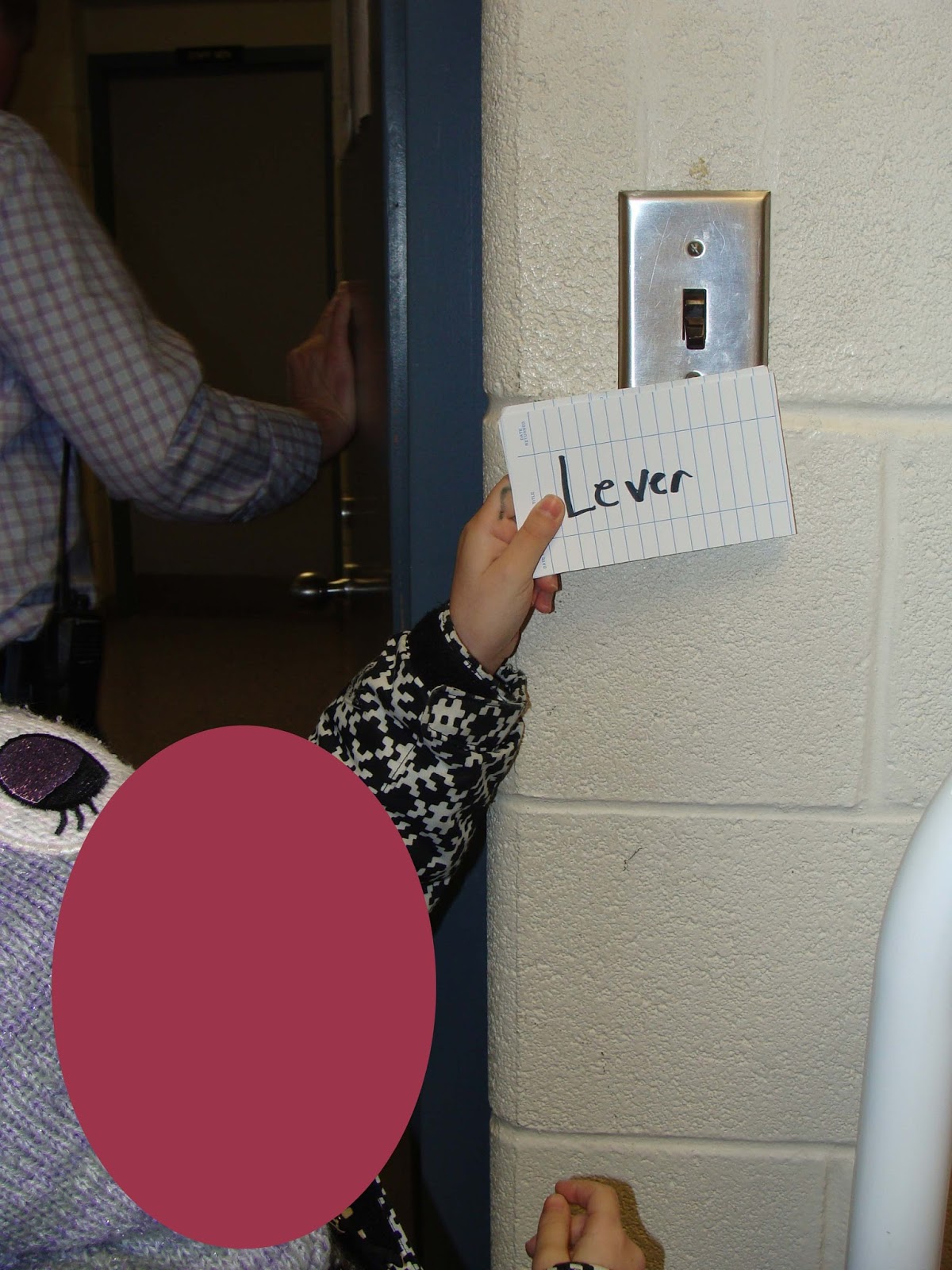
The first field trip was to the playgrounds outside. Students were given cards and had to write the six main types of simple machines on their cards. Then, we went outside and they had to locate examples of each type somewhere at the playground. I took photos of their discoveries. The students still had time to play outside, which earned them a lot of envy from the Grade 3s.

When we came inside, we flipped through the iPad and commented orally on whether or not students were correct in identifying the simple machines. Afterwards, I printed the photos in wallet size and wrote descriptive feedback on all visuals. Each student received a copy of the photos and feedback, so they'd be prepared for their  SECOND field trip.

Our second field trip was to the weight room at our local high school. The visit to the playground was diagnostic assessment for the students and for me - I noticed that certain simple machines, like pulleys, weren't commonly found around at the playground. Going to a secondary school gym meant that some of these machines would be more obvious and the students could search with greater ease for the examples they were unable to find at the playground. The Grade 2s were excited. The Grade 3s were jealous. Our trip cost nothing. We arranged a visit time with Ms. Chandhi, one of the vice principals of Albert Campbell C.I. and walked over. Mr. Fisher, the other vice principal, escorted us to the weight room and stayed with us to answer our questions. Ms. Richardson, one of the Campbell science teachers, happened to be exercising in the weight room during our visit, and both educators helped our students discover many examples of simple machines in action.

The students had a great time. One student got very excited about her discoveries.

"Mrs. Mali, I see screws EVERYWHERE! Here's a screw ... and here's another screw!"

I noticed that the number of simple machines they were able to identify increased since their last field trip and students found more examples of simple machines. My ESL student was very successful with this task. There were a couple of objects that he misidentified, but with such a small group and three adults present, I was able to explain and correct misconceptions and he was confidently telling me to take his photo as he pointed to many different simple machines.

Here are some photos of the students in action, finding and identifying simple machines. (I've blocked out their faces for privacy. I took ten times as many photos as you see here, and they will be going on display at school as part of our final task. I'm so proud of these students!)

Inclined Plane

Lever - one of many in the weight room!

Pulleys

Screws make the world ... go round? Stay together?

Wheel and axle (while another wheel is in use!)


Thanks to the administration of Albert Campbell Collegiate Institute for allowing us to visit and learn in a new environment.

Monday, February 8, 2016

A Comfort Crew

On February 4, 2016, my beloved colleague Denise Colby and I presented a webinar for TVOntario's Teach Ontario site about Minecraft. I felt that it didn't go as well as I had hoped. My opinion was the minority but I couldn't shake the disappointment I had with myself or with how things progressed. I have a hard time "letting things go" when things bother me and one of my strategies for dealing with challenges is to talk about them, a lot. I spoke about my feelings with:

  • my husband, James
  • my co-presenter, Denise
  • the TVO director of Educational Partnerships, Katina
  • my principal, Bill
  • one of the participants and a fellow TVO webinar presenter, Diana
  • my parish priest, Father Hansoo
Everyone had very reassuring things to say. Some of the advice and words of comfort included ideas such as "if learning happened, that's the important thing" / "from other people's point of view, the session was good" / "the only one who noticed that anything was 'wrong' was you, because you are your own harshest critic" / "I can totally relate to how you feel right now". 

I really want to thank my "support team" for all their help. I needed those cheerleaders because even though the message might not have penetrated my stubborn soul, the emotions were certainly clear: "I hear you" / "I'm sorry you feel this way" / "I'm here for you". 

I hope every student who faces disappointment and setbacks have a similar amount of members of a "comfort crew" to assist with feeling better. They need it, like I do.

Monday, February 1, 2016

OLA SuperConference 2016 & Treasure Mountain Canada 4

This will be the first year that I will not write an official "SuperConference Reflection", complete with summaries, key points, and action items. The reason is that although I was there at the Metro Toronto Convention Centre, I wasn't present for many workshops. I still learned a lot, but it's hard to capture the insights gleaned from an informal conversation in a way that respects the intimate nature of a small group talk. I'll try my best!

OLA SuperConference 2016

Highlights and Photos by Diana Maliszewski
(Tweets by assorted writers - see image attributions)

Thursday, January 28, 2016 - 5:30 p.m.

OSLA Awards Ceremony and AGM

I was at a TDSB Mentor Leaders meeting on Thursday afternoon, so I was only able to come to the evening event. The following awards were given. (This was originally part of a press release issued by the Ontario Library Association. I added the section about CSAE because this prize was presented at the AGM even though it is not an OLA award.)

L'Association des bibliothèques de l'Ontario-Franco (ABO-Franco) Le Prix Micheline Persaud     Joanne Plante, Conseil Des Écoles Catholiques Du Centre-Est
Canadian Society of Association Executives - Communication Awards of Excellence for Best Print / Electronic Publication
The Teaching Librarian magazine (OSLA)
Ontario Library Association Technical Services AwardLisa Radha Weaver, Library Learning Resources, Tippett Centre, Toronto District School Board


Ontario School Library Association (OSLA) Administrator of the Year AwardLynn Wisniewski, Halton District School Board
Ontario School Library Association (OSLA)Award for Special AchievementTreasure Mountain Canada
Ontario School Library Association (OSLA) Teacher Librarian of the YearDawn Telfer, Thames Valley District School Board 
James, Dawn, & Jeanne - TL of the Year Award

James, Joel, Lisa, Jeanne - Lib Tech Services Award

James, Lynn, Jeanne (sorry, forgot names!) - Admin Award

James, Diana, Jeanne - Best Print Publication

(Oops, another name lost) & Joanne - ABO-Franco Award

What did I learn?
I learned that Ontario school library professionals are the most encouraging and supportive people out there. My Twitter feed was swamped with well-wishes, even though I was only the representative for the magazine - aka the one who held the trophy and made the speech. 
I also learned that it's a good idea to hold the AGM before the awards ceremony, because about 2/3 of the attendees left immediately after the awards ended. 

I was also fortunate to go to dinner that evening after the OSLA meeting with Martha, Johanna, Alanna, and Sharon. Sharon Seslija is the head of libraries for the Greater Essex Country District School Board and she will be retiring this year. I publicly want to congratulate and thank Sharon for everything that she's done for her school board and for school libraries across Ontario.

L-R: Alanna, Johanna, Diana, Sharon, Martha

At the Multi-Vendor After-Party, I was fortunate to chat with Mary-Rose, a new OLA staff member, as well as one of my favourite board library leaders, Richard Reid from the Durham District School Board, who is also the OLA 2016 SuperConference Co-Planner. You make a difference, Richard - never forget that!

Friday, January 29, 2016 - 12:00 noon

OLA Open Shelf Editorial Board Meeting

This annual meeting brings together all the players involved with creating OLA's official magazine. 

What did I learn?
Every publication is different. I'm very familiar with how The Teaching Librarian operates, but Open Shelf is a unique creature. Kudos to Mike Ridley for his flexibility. We'll get that Terms of Reference document done by March 1, we hope!

I was tempted to squeeze in a workshop, like Monica Berra and Leona Prince's "Culturally Responsive Aboriginal Resources" or Sandra McLarnon and Sara Furnival's "Igniting your School Library with Maker and Spark Spaces". Instead, I chose to visit the Expo Hall and it was very relevant. I spoke with the Ontario Society for Prevention of Cruelty to Animals (OSPCA) about arranging a field trip and with the Centre of Equitable Library Access (CELA) about borrowing Braille and texture books for students at my school with vision impairments.

Friday, January 29, 2016 - 3:00 p.m.

OLA Closing Keynote - Wab Kinew

Wab Kinew was amusing and at the same time, he did not pull punches.

Francis, Alanna & me @ the 2016 OLA closing keynote

Wab on the big screen

Next steps for the audience

What did I learn?
I learned that I have a lot to learn. The library and school systems, not just in the past, but even today, have done wrong to FNMI communities and individuals. I was dismayed to hear the Libraries and Archives Canada made it difficult to obtain information requested by the Truth and Reconciliation Commission. Wab stated this in a room full of library professionals. Yet, it was not with resentment, but in the spirit of resilience and reconciliation. As my new friend Melanie (and new OSLA president Kate) tweeted ...


Friday, January 29, 2016 - 6:15 p.m.

Treasure Mountain Canada Opening Keynote - David Cameron

David Cameron is a researcher with People For Education. He spoke about the Measuring What Matters initiative.

What did I learn?
I learned that it's pretty difficult to listen to a speaker in a crowded, noisy restaurant. Despite the obstacles, David spoke eloquently and got participants excited about contributing to action research (past, present and future) for the areas identified by People for Education.

Saturday, January 30, 2016

Treasure Mountain Canada


Activities were fast and furious at Treasure Mountain Canada - once I was able to get Internet access and catch my breath, I started capturing my discoveries and observations as the day progressed, via Twitter. I hope the hashtag search captures some of the energy and diversity. I presented on two separate topics based on two papers I wrote for this research symposium for four "table talks". Thankfully, I'm going to take the mentoring notion of "reciprocity" seriously, so I won't be regretful or disappointed that I didn't get to hear other table talks - I only saw the whole group ones by Diane Oberg and Monica Berra.

Just because the symposium is over doesn't mean the learning stops.

This link takes you to the papers offered: https://sites.google.com/site/treasuremountaincanada4/

This link takes you to the symposium activities, TED talk, polls, and slides that we used on Saturday:
https://sites.google.com/site/tmcanada3/tmc4/saturday-jan-30-2016-program/our-work-spaces

This link is the Treasure Mountain Canada blog: http://tmcanada.blogspot.ca/

Thanks to the Treasure Mountain Canada 2016 Planning Committee: Carol Koechlin, Anita Brooks Kirkland, Liz Kerr, Jeanne Conte, Cindy van Wonderen, Jo-Anne Gibson, and David Loertscher and to everyone that contributed to this and to the OLA SuperConference. I'll be thinking about all the conversations now and in the near future.


Monday, January 25, 2016

Photos and Privacy

What is privacy?

I'm reading Danah Boyd's It's Complicated: The Social Life of Networked Teens as part of TVO's Teach Ontario online book club. We'll be discussing Chapter 2, on privacy, starting January 25. Some of the definitions of privacy, as mentioned in Boyd's book, are: the right to be left alone / a measure of access that others have to you through information, attention, and physical proximity / the claim of individuals, groups and institutions to determine when, how, and to what extent information can be communicated to others. (This is paraphrased from page 59.)

This notion of privacy is very relevant to me right now because of a discussion we're having at my son's school about the ability to take photographs at school events. I'm not going to mention the school or board or principal by name because I'd like to respect everyone's privacy - but I'm still writing about the issue online because my blog is a place for me to reflect on educational matters and gain other perspectives. It's a battle between "private space vs personal expression" (Boyd page 53). 

The administrator at my son's school has made it clear, both at the Curriculum Night Open House and Christmas Concert, that visitors are not permitted to take photographs during events such as these. This will also include school graduation ceremonies. At our recent Parent Council meeting, we were given a copy of the board's policy, which says "The recording and taking of photographic images of a person or persons, on school property, at school events, and during school activities and/or hours, is prohibited without the permission of the person or persons being photographed or the principal or designate". The principal is concerned, and justifiably so, with keeping students safe. Photos can be manipulated, distorted and distributed widely. Sensitive custody battles can be made more fraught with difficulties if adults discover the whereabouts of certain children. 

I understand the concerns of our principal but I cannot help but feel that this is very strict and by banning photographs of students entirely, some community goodwill and educational opportunities might be lost. Our Parent Council chairperson brought a FAQ document about access and privacy in the school system that states, "A school should develop a workable policy regarding the taking of photographs of its students on school property or at school events by non-board employees. Such a policy should be developed in consultation with parents/guardians and communicated to them." To be clear, this FAQ was written by a different school board and the Communications Department of the Information and Privacy Commissioner. I really hope that some consensus can be found so that everyone's needs are met.

As a teacher, I am very careful with my students' privacy and our use of photos. I use photographs as part of my assessment practices - which is very handy when evaluating work in Drama and Dance. I've attended workshops and read articles written by my union that advise using caution when dealing with recordings (but still allows photography) - e.g. posting photos online only of work or the backs of students' heads, or using school equipment to take student photographs, etc. As the school yearbook coordinator, I've touched base with parents for clarification, who have signed "no" to the board's media release forms, and all of them have agreed to allow their child's photo in the yearbook as they pose for their class shot or as part of team and club group photos. As long as the photos are used positively and responsibly, they have no problem with pictures. Online arenas are what scare people. 

As a parent, I also try to be respectful of my own children's privacy. Intensive parents that constantly and intrusively monitor their teens' online activities are considered "good parents", but going overboard with surveillance is oppressive (Boyd, page 74) and indicates a lack of trust between parent and child. Sometimes, parents don't always practice what they preach in terms of online privacy. There are many parenting blogs out there that share too much, especially regarding children that have special needs. What digital footprint or online legacy are they creating for their own sons and daughters? Privacy is not just for adults. Teens also desire privacy, but research demonstrating this is often ignored by mass media in favor of the general stereotype of teens as chronic over sharers (Boyd page 56). I try to keep references to my own son and daughter positive, and I often ask their permission before mentioning them on my blog or taking a photo of them and posting it on social media. (I avoid sharing photos on Facebook because the privacy settings change so frequently.)  Here was a photo my daughter allowed me to post on Twitter - it demonstrates her passion for reading, something neither of us mind revealing to the world.


There are many other points that I want to reflect on after reading Chapter 2 of this book, but I'll save some of that discussion for the Teach Ontario book discussion group. Go to www.teachontario.ca and use your board-designed email address to join.


Monday, January 18, 2016

That's What Friends Are For

This wasn't my original blog post scheduled for today.
I had written something on an entirely different topic, but it was a little "edgy" and I had some initial misgivings about publishing it.
I asked my husband to listen to me read it to him. He expressed some uncertainty around the intended audience and purpose, but recommended that I get a second opinion.

So it's Sunday evening. I like to ensure that I have a post ready for Monday. What do I do?

I turned to Twitter and asked a couple of teacher friends for help.


Melissa Jensen noticed my plea and offered her assistance as well.

Let me make note here that it's a weekend in mid-January. For teachers (and teacher-librarians) in Ontario, this is prime report-card-writing time as well as preparing-for-SuperConference time. Yet, three busy individuals took the time to read my draft and offer some constructive criticism. Some also recommended I get another view from someone closer to the source material. That person gave up part of her lunch hour to read it and offer her descriptive feedback. After much consultation and consideration, I decided not to publish what I wrote. The subject matter is worthy, but it needs a lot more editing and refining to make it appropriate for public consumption. That post may eventually be published, but not now, and not in its current form. I really appreciated how Denise Colby, Alanna King, and Melissa Jensen helped me out with this decision.

All three educators gave me permission to mention them here. I asked for their help in the first place because I respect their opinions; they are thoughtful, reflective, and knowledgeable.  They are aware of the impact that social media has on education. (I guess that book club discussion group on TVO's TeachOntario site must be making an impact on me - we are discussing It's Complicated: the Social Life of Networked Teens by Danah Boyd and I'm paying close attention to the chapter on how online identities are crafted.) They understand the right to be expressive and transparent in my teaching practices with the responsibility to be respectful and private with information. They understand the complicated social nuances of school politics. What I loved about their advice was they never said "Publish it" or "Don't publish it". They made comments. They described their own feelings and observations. They asked if it was possible for A or B to be re-framed or a section to be re-worked.

What are the school implications for this experience? I think that teachers should find and use "critical friends" to help them when they are struggling, be it with a challenging student, a teaching approach to a lesson or unit, or any difficulty they encounter as part of the job. It means it takes a bit longer, but getting a second (or fifth) opinion meant that I was less likely to rush ahead and possibly make a rather unfortunate faux-pas. Bringing in other points of view can help make situations clearer and decisions easier. Find someone you are comfortable with, that you can be vulnerable with, that can see you uncertain, unsure, and less-than-perfect. They don't think less of me, but they help make a better me. Thank you Melissa, Alanna, and Denise!