Monday, November 20, 2023

Sick of Sickness, Prepare to Present

 I should have known it would get me in the end.

When the kindergarten class of 15 shrunk to 11, then to 8 and by Thursday stood only at 5, I should have clued in that the illness spreading rapidly through the school population would catch me.

I don't usually get sick, (only the occasional migraine or food poisoning) but I habitually lose my voice around this time of year. It's true. I wrote about the phenomenon in 2011 (twice that year, actually) and it happened when I took my Media Part 1 AQ in 2017. I stopped writing about losing my voice because it just became a regular feature of the fall.

This time, it wasn't laryngitis. On Thursday evening, as I coordinated the translators for Parent-Teacher interviews, ringing a bell every ten minutes and walking the halls to escort speakers to their next location on time, my principal commented that I looked tired. He was right. I felt tired. I attended my Media Part 2 AQ after interviews, sipping "elixir" (a mix of honey, lemon juice, and gin) to soothe my raspy throat. The next morning, it hit me like a ton of bricks. I had chills, fever, a headache, a sore throat, exhaustion, and a cough that flipped between being so dry it stabbed me to so phlegmy it choked me. I called school around 8:00 am to say I couldn't come in, went to bed, and didn't rise until 4:00 pm. Thankfully, it was the second half of our interview day, so I didn't need to make supply plans. It has taken me all of Friday plus the entire weekend to slowly recover. Hubby has been insisting I rest a lot and drink lots of fluids. 

Patience is not always one of my strengths. I whined that I had much bigger plans for these three days. I wanted to clean the library (it's an absolute mess) and get other things done. Sleep was necessary but reluctantly taken. It's only now that I'm getting to the end of this period that I realize how privileged I am. I know, I know - that sounds very weird. However, I really am fortunate that:

  • I have a job that gives me weekends off, so I didn't have to negotiate sick days
  • I have a family that could keep an eye on me as I recovered and take over my (few) household responsibilities
  • I have my usual good health, with no chronic illnesses, so that getting better took just days instead of weeks (or even happened at all)
  • I have a safe city and country so that, even if it got to the stage where I'd have to see a medical professional, I'd eventually be taken care of adequately
At the GTA Resource Fair last Tuesday, I touched base with my school library friends, several of whom are recovering from significant medical issues. In my own family, I've got a cousin in hospital and another loved one at home recuperating from major surgery. So, even though I'm "sick of being sick", they have much longer roads to recovery. Note to self: suck it up, buttercup!

As I slowly regain the energy to be able to sit at my computer for more than an hour, I'm getting ready to present at two big events.


I will be presenting with Chelsea Attwell, my co-vice-president at the Association for Media Literacy. I'll share more about the events as they occur.

Monday, November 13, 2023

What Makes a Good Meeting?

 When choosing my focus for my blog reflection, I often look at my calendar agenda. I noticed that this past week and this upcoming week, there are a lot of meetings. Last week we had a staff meeting (November 7), a guest lecture meeting for my TL AQ (November 8), the weekly Media AQ course meeting (November 9), and a meeting with my father's doctor (November 10). This week, there will be a lunch meeting to coordinate the booking of translators (November 13), an AML monthly meeting (November 15) and Parent-Teacher interview meetings (November 16-17). This doesn't include the upcoming TDSB TL Facilitator meeting and UNESCO MIL Alliance meeting.

At the end of our most recent staff meeting, our principal commented that it was a good meeting. It made me wonder what counts as a good meeting. I turned to a Google search and was intrigued by the auto sentence completion options it offered. The categories immediately suggested the elements that can make or break a meeting.


  • agenda
  • facilitator / chair / leader
  • room
  • minutes
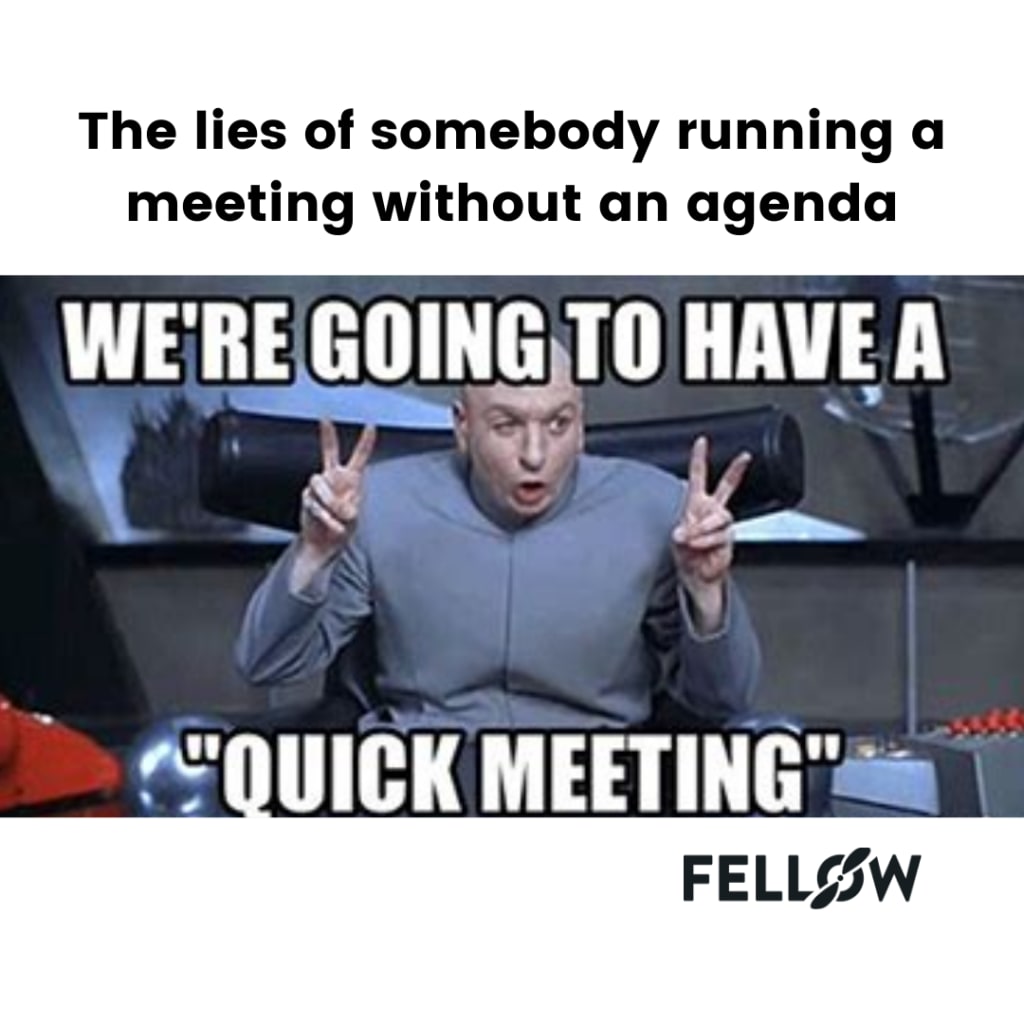
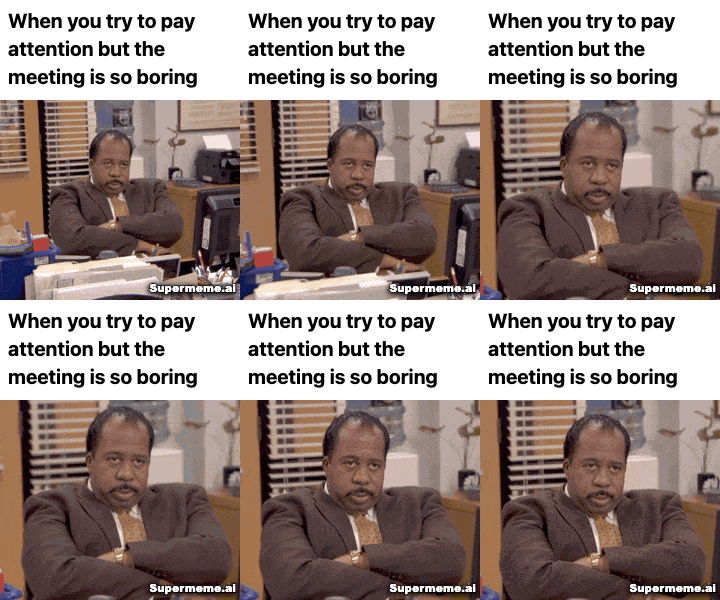
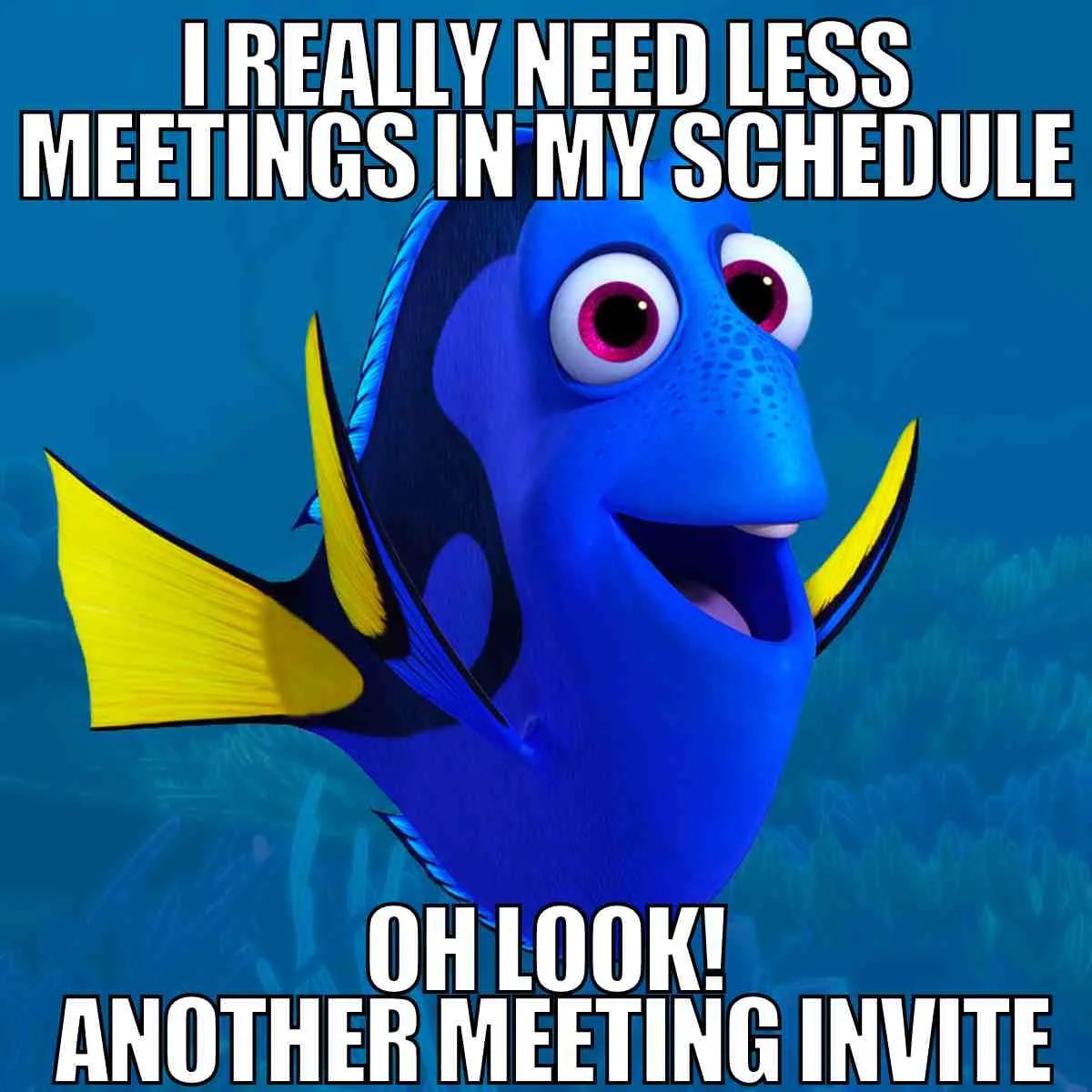
People don't usually like meetings. Take a glance at some of these "meeting memes".


I think the memes I chose to include here exemplify what the issues are with bad meetings. People want meetings to have meaningful purpose. To slide in one of the Media Literacy Key Concepts (#7, to be precise), they want the form and content to match, so if it's just information without discussion, people would often prefer an email (as the Gary Cole meme shows). Having said that, too much discussion that does not lead anywhere is just as annoying (ergo the meme with Tina Fey rolling her eyes). To help with the purpose, establishing a clear agenda and follow-up action items are vital. (That's the significance of the Toy Store and Mike Myers memes.) The way a facilitator runs the meeting is just as important. It's just like a lesson. The audience can't find it too boring or pointless. 

Our staff meeting was probably "good" because the content could not just be conveyed in a single email. There was the chance for people to ask questions and try out the new-to-us procedures. Big thanks to Farah Wadia for sharing information she learned from a recent workshop to help the rest of the staff with the K-8 portfolios. We didn't dawdle too long on any particular subject. Thank you Connie Chan for summarizing key ideas so succinctly and for taking notes. We also mixed it up a bit with short interactive pieces (i.e. a 1-minute sticky note "pop quiz") and multi-media, multimodal ways to present knowledge (i.e. a 10-minute video). If we walk away from a meeting feeling a bit smarter or more "in-the-know" than we did before, that makes a meeting a positive experience.

Monday, November 6, 2023

The Library Rabbit

 For the past few weeks, we've had a regular visitor to the library.


He or she sits just outside one of the windows by the library. The students were the ones that first spotted the rabbit, and they were very excited to discover him/her. After seeing the bunny for several days in a row, I worried that there might be something wrong. I did some research and based on the websites Bunny As a PetBackyard Caring, and My Backyard Life, there are many logical reasons. The consensus seems to be that it is relaxed and comfortable in this sheltered space.

As you can imagine, the presence of this animal has caused quite a commotion in the library.

The students are accustomed to animals in the library. After all, the library is regularly home to skinny pigs. Our current residents are Alvin and Simon.


Students love to feed Alvin and Simon, which is why I have a school vacuum permanently located in the library to clean up all the timothy hay dropped on the ground. The skinny pigs featured prominently in our Family Feud audition tape.

However, there's a different energy with the appearance of the rabbit. He/she is a wild animal, and so cannot be regularly counted on to appear. Sometimes the students are too loud, even with the closed window between them, and the rabbit will scamper away. The kindergarten students have named the rabbit "Brownie" and will routinely ask if Brownie is around if they are in the library. A student (and a teacher) has smuggled food outside for Brownie to eat. 

Brownie could provide a wide variety of inquiry questions for the students to investigate. However, we have not been able to take full advantage of the opportunity, because our social studies lessons have been directed on addressing knowledge gaps that the students still have. I will try to include Brownie in these plans, if I can. 

It will be interesting to see if Brownie continues to visit, especially when fall turns to winter and the bushes providing coverage thin out as their leaves drop. Either way, it's been a charming, delightful series of encounters.


Monday, October 30, 2023

How Did You "Celebrate" Media Literacy Week?


Last week was Media Literacy Week in Canada. (Thanks to Media Smarts for this attractive logo, which was part of their promotional kit available for free.)

I have to make a confession. Even though I am the co-vice-president of the Association for Media Literacy, and the Canadian representative for UNESCO's Media and Information Literacy Alliance, North America and Europe Chapter, I didn't do anything special to commemorate the occasion at my school. 

Before you arrange to have my membership revoked, it's not like I did absolutely nothing. I participated in a special Media Literacy Week edition of the Mediacy podcast on VoicEd Radio. I reported to the UNESCO MIL Alliance Regional meeting about all the neat things that Media Smarts and AML have been doing to promote the event in Canada. I'm currently enrolled in the Media Part 2 AQ course. I've been following Jennifer Casa Todd's daily Media Literacy Week suggestion posts on social media - she was ahead of the game this year and posted this all the way in August! I even had the pleasure of listening to Kim Davidson conduct a guest lecture for my York University Teacher Librarianship Additional Qualification course students, and much of her talk focused on media literacy and critical thinking.


So why didn't I do anything specific at school? If I'm being honest with myself, it's because I ran out of time to do something meaningful (even though Media Smarts made it easy to mark the days, with pre-made images that were easy to share). If I wanted to justify the lack of action, I could argue that I celebrate media literacy week every week with the kinds of activities and question prompts I include as part of my programming. Here are a few photos from last week and some hints about how I make them "more media literate".


Dance & Drama = Shadow Puppets

What we did: To address the problem solving and innovation strand in kindergarten, I asked students to consider what they might use as an object to cast a shadow that would make a good spout to go with their spider shadow puppet for their mini-performances of "The Itsy Bitsy Spider".

How I infused more media into it: We took photos of the audience as well as behind the scenes to show what was going on. We talked about how it didn't have to be an actual pipe or spout but the shadow had to make it look like one from behind. (Key Concept #2 - Media constructs versions of reality.)

How I could have infused even more media into it: We could talk more about why the spider is going up the spout and if this is a good or bad thing. (Key Concept #5 - Media communicate value messages.)


Social Studies = Battleship

What we did: To cover the expectation in the curriculum that deals with using grids to find locations on maps, we learned how to play the "board game" Battleship.

How I infused more media into it: For the older students, I paired the set up with the picture book "Playing War" and asked them to consider how the inclusion of the book changed what they thought about the game. (Key Concept #6 - Media communicate political and social messages.)

How I could have infused even more media into it: We could have talked directly about what I was alluding to with the book prompt. How is the experience of sinking a battleship in this game similar or different to being on an actual battleship? Would people in Gaza right now consider this game fun? How do the number of slots in the boats match with the type of ship and its power? (Key Concepts #1, 3 & 5)


Drama = Puppet Plays

What we did: While I worked with individuals on their face acting (see further below), I asked students to form groups and "make up" a puppet play with their team to share. We watched some of the "first drafts" of these plays.

How I infused more media into it: One of the students commented, "That wasn't a play, that was them having a fight with their puppets". We began to talk about what made a puppet play an actual play. (Key Concept #7 - Form and content are closely related.)

How I could have infused even more media into it: Different groups set up different puppet theatre spots. We could have talked about how the setting of the theatre impacted the type of performance. We could have discussed which play they enjoyed the most and why, and how the puppet format impacts the enjoyment of the play. (Key Concept #8 - Each medium has a unique aesthetic form.)


Library = Indigenous Prompts

What we did: We own this drum at the school. I have no idea when the school obtained it. It used to just hang in the library. As part of our SIP goal to embed more indigenous content throughout the school day, I placed this drum with two questions for the Grade 4-8 students visiting the library to choose to answer if they wished.

How I infused more media into it: The types of questions I asked probed for personal reactions (Key Concept #3 - Audiences negotiate meaning) and meaning interpretation (Key Concept #5 - Media communicate values messages).

How I could have infused even more media into it: We could have had some whole-class or small-group discussions to encourage more responses. What is it? How is it used? How was it made? How much is it worth? (Key Concept #4 - Media have economic implications.)


Drama = Face Acting with Feeling

What we did: After reading "How Are You Peeling", we brainstormed nine emotion words. Students are to pick three of these words and "act them out" just with their faces. We have also had classes and practice with how we use certain parts of the face (eyebrows, eyes, and mouths) to convey emotions and what they mean.

How I infused more media into it: When we take the photos, the students can look to see if it was what they intended to convey, since a photo is just a split second of time captured. (Key Concept #3 - Audiences negotiate meaning.)

How I could have infused even more media into it: We could compare the different class choices. We could sort them into categories like positive vs negative or eyebrows up vs eyebrows down. We will be looking at the photos as a group and interpreting them. Which feelings look most believable and why? (Key Concept #1 - Media constructs reality.)


Media = Puppet Creation

What we did: Kindergarten students made two different kinds of puppets - a paper bag puppet and a marionette.

How I infused more media into it: We talked a bit about how the puppets move and what we could use to decorate them. (Key Concept #8 - Each medium has a unique aesthetic form).

How I could have infused even more media into it: We could have asked some more questions. Which is easier to make? Which is easier to use? What does your puppet say about you and what you like? (Key Concept #3, 5 & 7).


Media = The Word and the Definition

What we did: To become familiar with the word and what it means, as well as practice some reading, we've played lots of games with these letters. A favourite is for me to mix them up on the board and pairs of students come to put them in the right order. In this photo above, the Year 2 student is turning the D around  that the Year 1 student had placed backwards.

How I infused more media into it: Letters are media. So are words. (We haven't delved into this yet, but we will.) Without words, it's hard to express ideas about things. (Key Concept #1 - Media constructs reality.)

How I could have infused even more media into it: I could have asked some questions about the orientation of the letters. If the letters are in the right order but not facing the right way, is it still readable? Why might it be wise to keep the letters facing the traditional/legible way? What might having letters face the wrong way suggest? (Key Concept #6 - Media communicate political and social messages.)


So, even though I didn't "do much" for media literacy week, to paraphrase a different saying, EVERY week can be media literacy week!

Monday, October 23, 2023

SMART Goal Irony, Land Acknowledgement Loose Parts and Photos as Biased Texts

 I tried to tie in all of the things I wanted to reflect on in this blog post into a single thread that would unite all the narratives, but I had neither the time nor the creative inspiration on how to do it. I could have connected them to my Media Part 2 AQ, which I'm currently taking with the talented trio of Neil Andersen, Carol Arcus, and Michelle Solomon facilitating the course, but it doesn't quite capture all the nuances. Therefore, bear with my "3 topics in 1" approach to this glimpse at my current thought processes.


SMART Goal Irony

This year, a small percentage of my schedule is devoted to "guidance". Honestly, the true guidance lead at our school is the irreplaceable Farah Wadia, our Grade 8 classroom teacher. My role is to support and relieve her when she had to complete guidance-related tasks, particularly those related to Grade 8-9 Transition, such as course selection forms, high school applications, and so on. She recently attended a workshop where she received some training on how to implement the whole-school online portfolio requirement that must be posted twice a year on either BrightSpace (if you are K-6) or MyBlueprint (if you are 7-12). While she prepared how to disseminate this information with the staff, she asked me to conduct a lesson with her Grade 8s on what counts as a SMART goal. (SMART is an acronym that stands for Specific, Measurable, Attainable, Relevant, and Time-Bound.) We didn't spend time creating personal SMART goals yet, but we played with those adjectives to solidify our understanding of those terms by generating examples and non-examples.

A brief note in our school's general updates reminded us that our ALPs (annual learning plans) are now expected to be submitted online, and that they will be due October 31. I didn't consider this to be a big deal, since I have a digital copy of the ALP file that I modify year after year. 

I. Was. Wrong.

Only the first portion of the ALP, the background data that informs the formation of the plan, matches the old template. The new, online version is a lot more detailed. In fact, instead of a four-column list of goals, goal strategies, rationales, and action plans, each goal (minimum of one, maximum of ten) have multiple sections to complete with specific timelines and metrics to determine success. In other words, we have to write our ALPs more like SMART goals.

Well, dang! Creating a SMART goal isn't a quick endeavor. The other challenge is that some of these goals of mine are ones I've been working on for years because it's about progress, not perfection. I've always scoffed at the IEP's (Individual Education Plan's) insistence that a number be attributed to the objective. It felt artificial. Each year brings different challenges. These were the goals I had originally chosen for this school year:

1)    Participate in leadership opportunities (AML as a vice-president, The Mentoree as a mentor, York and Queen’s University as an AQ instructor); in-school leadership will focus on renewed exploration around Equity.

  (Leadership Role)

2)    Continue to focus on accommodating and modifying lessons for ELL students as well as improving my assessment practices (especially related to kindergarten) to give timely feedback to students and parents about their progress in the reportable subjects I teach. I also aim to re-examine my “tried and true” practices to see if they could be improved with revisions.(Instructional Role)

These don't qualify as SMART. They aren't specific enough. I have no quantitative measures linked to them. I don't declare at what point I will have "succeeded" with these goals. I will go back to work on my online ALP after writing this blog post, but I've deleted some of these, separated and expanded some of these so now I have five goals, and now I need to iron out all the nitty-gritty. Is it even possible for some of these education goals to fit the SMART criteria? Will I be able to say "yes, by the end of June, I will be 80% better at modifying my lessons for MLL students"? By forcing them into a SMART framework, will they become ridiculous? (For instance, I feel like I can morph my timely feedback goal into something I can "count" by saying that I'll reach out to parents via the agendas or a note or a newsletter once a month. However, I see everyone from Grades K-4 - this may be Specific and Measurable, but is it Realistic?). Hopefully, you can see my dilemma here. However, that "time bound" deadline of October 31 looms, so I'll try my best to make it work.


Land Acknowledgement Loose Parts

I've been working on our School Improvement Plan update. It also is phrased in terms of SMART goals, but for some reason it feels slightly more possible to fit these items into a SMART framework. Weeks in, we are still working on the phrasing of these goals (reinforcing the point above that you can't just whip up a goal in an hour). The board has shifted some of the focus from three goals related to Academic Success, Equity, and Well-Being to equity infusing all three goals and the new subtitles of Academic Success, Indigenous Education, and Joy/Belonging. 

Meaningful Indigenous education is a focus everywhere, including my Media Part 2 Additional Qualification course where I am a student. We watched a fantastic, inspirational 11 minute video and every participant will be required to share the way to present or address the land acknowledgement. Last week, I mentioned how I'm trying to incorporate my learning from my Kindergarten AQ I took in 2019-20, especially loose parts. I did a bit of an experiment with the junior-intermediate students during their short book exchange time in the library. I usually have STEM challenges or playful provocations set up on the table for them to use when they have finished their book exchange and if they have extra time. You can see some of the set-ups in this post. This time, I used a phrase from the video we watched in the Media AQ as a loose part prompt. "What does it mean to acknowledge the land?"

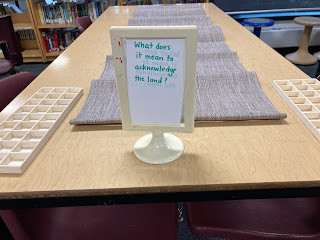

Students in Grades 4-8 were encouraged to use the loose parts to symbolically represent their thinking and potential reflection on that question. I took some video of their explanations. Here, below, are just a few of the photos I took of their work. These are just the samples from the Grade 8 class. I plan on compiling the images and commentary into a video that we can play over the announcements and at the Media AQ as a sample of an interactive way of making the daily land acknowledgement meaningful and relevant. The first image is a visual pun. (Tree-T = treaty).


Photos as Biased Texts

I enjoy taking the Media AQ, even though it takes a significant portion of my time. I like how it gets me to think and rethink. For instance, I feel like I am gaining a deeper understanding of some of McLuhan's ideas and of the Key Concepts of Media Literacy. For instance, a foundational idea behind Key Concept #2 (Media construct versions of reality) and #3 (Audiences negotiate meaning) is bias (and side note: I really wish I could commit to memory the 8 key concepts in numerical order. I have to keep looking them up. Do you think that'd be a valid SMART goal for myself?). The bias in KC#2 comes from the producer and the text itself. The bias in KC#3 comes from the audience. 

It's been said multiple times so far in the course that it is impossible to take an unbiased photograph. I whole-heartedly agree. I rely on photographs a lot as an assessment tool, but not only are they my views, they are my views at a very specific set moment in time. They don't capture what happened just before or just after the photo was taken. (This is why, back to Farah Wadia, she likes taking a "live" photo because she can then grab one of the frames of the photos in which a student isn't blinking or looking away.) 

For drama, I'm taking photos of the students doing "face acting" and portraying different emotions. I count down before I take the photo, but what if their expression was "better" in the split second before I captured the photo? I try to let the students look at the photo I took to get their approval, but when you consider I'm taking 3 photos per student (of the 9 feeling word options they generated as choices as a class) and there are about 20 students in each class and I'm doing this with 4 classes, 3x20x4 = 240. That's 240 photos I'm trying to take within a short period of time, while ensuring that the rest of the class is safely preoccupied with something else so I'm free to take the photo. (Yes, I know the students could take each other's photo, or they could do a selfie, but there are reasons why I'd like to take the photo myself, even though it would add more student agency to this task.) 

A photo is a version of reality and not reality itself. I wish I could capture what I hear or my thoughts and reactions at the time more effectively. I've had this talk with the kindergarten teachers about pedagogical documentation. It'd still be a mediated version of reality, but it might help me recall the moment better. Problem is, video take up a lot of space on devices, and I have to watch the video afterwards.


There's lots here to unpack. You can see why my mind is abuzz and I'm a bit tired. 

Monday, October 16, 2023

Applying Kindie AQ Learning: My Wonders, My Blunders and My Puppet Experiments

 I'm going to apologize in advance if this blog starts looking more like a kindergarten teacher's blog than a teacher-librarian blog. I have so much kindergarten prep coverage (13/40 periods in my schedule) and I'm preoccupied with making my early years programming work better than it did in the past. The focus-on-four-and-five-year-olds is not necessarily a bad thing - after all, my friend Beth Lyons has made the leap from teacher-librarian to full-time kindergarten teacher and her blog is still titled https://thelibrariansjourney.blogspot.com/ . In fact, she writes about the first 6 weeks of kindergarten in her latest post. Many of the things she is concerned about are things I'm concerned about and things our absolutely fabulous kindergarten team (MM, new to our staff, and JC, an educator who's been at this school longer than I have, and this will be my 20th year!) also think about regularly.

I took my Kindergarten Part 1 AQ in 2019. I'm still trying to incorporate what I learned there in my practice. Room K1 uses a lot of loose parts provocations, so I plan on sneaking in there to peruse the set up more frequently. As I mentioned in this past post about loose parts, it's helpful to get the opportunity to attempt things multiple times, so that you can learn from the errors the first time around and improve it on the second. 

I haven't been able to set up any new loose parts provocations since my initial attempt in September - book fair sort of got in the way. However, I've been relatively pleased with how the subjects are meshing into each other and how the ebb and flow of the lessons are being determined by student interest. The routine is slooooooowly being established. Big thanks to Matthew Malisani for making me signs that help me remember the process. 

Before I launch into the description of what's happening, I need to share my struggle with pedagogical documentation. We had a kindergarten reorganization and we transformed from two classes with 22 students each, complete with an Early Childhood Assistant, to a class of 15 with no ECE and a class of 29 with an ECE. It's been disruptive. The small class is challenging without an extra adult present. The large class is challenging because of the large amount of students. In both classes, it's been hard for me to properly document what I see, hear and notice students saying and doing that demonstrates their thinking and learning. Right now, it's so busy that all I've been able to do is take photographs and hope (in vain) that I'll remember what was happening at that particular time. I'm also still debating about whether it's better to keep separate student files and flip to each to record, or maintain a daily log which I can then try to link to to ensure I make notes on all the students. 

Back to what's happening in class. My general theme, at least according to my long range plan (which usually falls to the wayside in a few weeks when it comes to kindergarten) is all about imagination. In dance/drama time, we've been really interested in puppets. It's expanded into our media time and a bit into our music time. We've learned about the differences between hand- and finger-puppets and stuffed animals and how to use the puppets without getting too physical with each other. (There's a tendency for puppets to hit other puppets and people and get rammed up in faces - I know this is part of the Punch-and-Judy puppet tradition, but thankfully mini-lessons on friendly interactions have reduced the number of times I've had a puppet smack me. Eating me, on the other hand ... )


Based on comments from students, we "made" our own puppet theatres with cloth and chairs, and that's been neat to see how they set things up and put things away. 


We've also modelled some "mini-scenarios" or "tiny-stories" (such as "The Race" [like The Tortoise and the Hare] or "Are You Mommy?" [like "Are You My Mother? / Is Your Mama a Llama?"]). That helped with our "puppet plays" because at first, many of the puppet "shows" were silent. Having a narrative structure to riff on helped a lot. 


One class got really interested in sorting the puppets, so we made signs to keep us organized and we grouped them.


I own a marionette (stringed puppet) and brought it out for students to try out (gently). I was inspired, in one of those just-before-you-fall-asleep-aha-moments to try and make our own mini-marionettes, but without almost any directions or instructions. I am very cognizant of the philosophy that making in kindergarten should not result in carbon copy replicas as final products, but explorations and experimentations. (Below is a photo of Thess showing the puppet.)


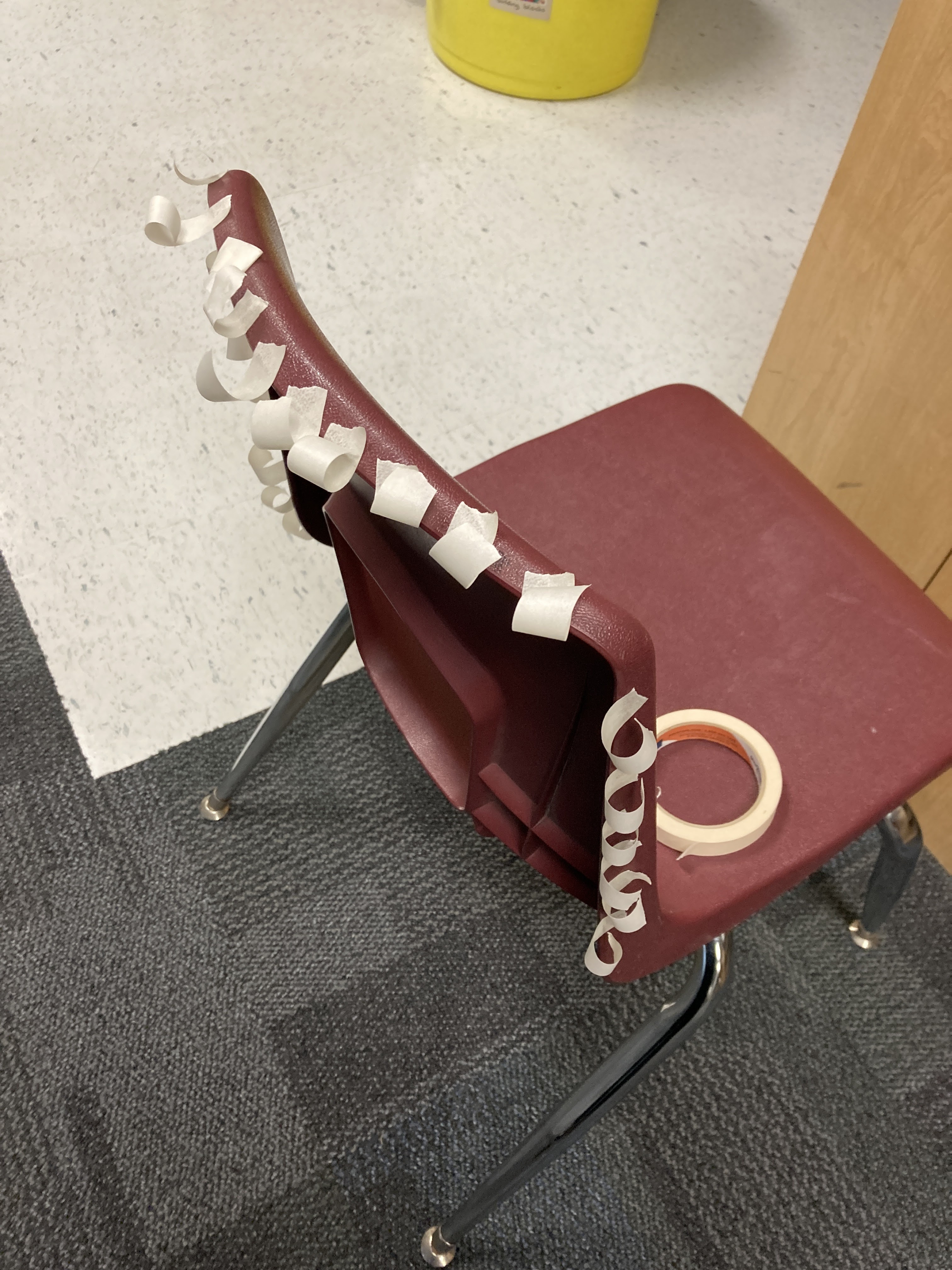
This was an example of learning from the previous class. The first time I tried this, we didn't have time to finish and it wasn't safe to just leave the projects lying out on tables in the library. I talked with Thess Isidro, the ECE, to generate ideas on how to deal with this problem. She recommended collecting the items in paper bags labelled with their names. The bonus was, we could then use the paper bags for hand puppet creations later! I also set up stations so that the students did not have to wait on me for supplies. Tape and strings were all available on chairs and the bins with scissors and potential materials to make the puppet bodies were out and reachable.


I was really pleased with how some of these mini-marionettes turned out! The products hinted at what they understood about how the marionettes worked. 


So I've made some mis-steps. We've had tears, and pick-up mix-ups, and sometimes lessons don't go according to plan. That's okay. Mistakes are part of learning, but I'll keep trying to figure out how to make this work in the school Library Learning Commons.

Monday, October 9, 2023

Go with the Flow

 For a shortened week, it was pretty jam-packed. The AQs that I lead for Queen's University and York University started this week. I hosted the annual Scholastic Book Fair in my library. Also on the calendar was our school's Curriculum Night, Terry Fox Run and the TDSB Teacher Librarian Facilitator Meeting and Planning Session. Did I mention taking my parents to get their haircuts and arranging Thanksgiving dinner? Busy, busy, busy.

Two moments this week reminded me about the importance of flow - both traffic flow and going with the flow.

Last year, the book fair resembled a packed dance club at the hottest night spot; it was so crowded that people could barely move, and even with five staff members helping out, by the end of the night we were all exhausted. This year, the admin team came by to scope out the space and make suggestions on how to improve the situation. I appreciated their interest and concern. My principal recommended a change that actually made a huge difference: create a corridor where shoppers would line up to pay that did not block people still browsing and selecting in the book fair. We moved the cashier location to a spot near my circulation desk and the door to help with this shift. I don't have any photos of the alteration, but it worked well. We only had three staff members monitoring the book fair, and those wonderful colleagues, Connie Chan and Julie Tran, sped things along even more than before by writing and calculating the purchase amounts on sticky notes that the buyers passed to me at the checkout. That meant that I could focus just on collecting the payment and making change when needed. 

I've mentioned frequently about how disruptive and dysregulating the book fair can be. I am now the primary prep provider for the kindergarten classes, and I thought I'd be clever and avoid all the distractions of the book fair by holding my music class on Wednesday in their kindergarten classroom instead of the library. The decision wasn't that smart. I couldn't log into my MusicPlayOnline subscription while in the other class. I improvised my lesson as best as I could, but the students began to get restless, and some of my usual redirection tricks relied on items left in the library. No worries - why not go to the library and use my laptop with my saved password intact? This would have been fine, if my laptop speakers had not suddenly decided to stop working. Having no sound on a music website isn't useful at all. By this time, I was getting a bit frazzled. I was saved by two things: our compassionate Educational Assistant, Joan D'Souza, who saw I was struggling and rearranged her schedule to help me out, and my handy-dandy box of instruments. Although I wasn't feeling like a very competent teacher at the time, I can be a bit creative and think fast on my feet on occasion, so we did some compare and contrast, including a repetitive song phrase I made up on the spot to match one of two instruments (bells or tambourines). It worked so well that I repeated it with the other kindergarten class I saw later that same day. (In case you are curious, the song chants were "This is a tambourine" [ta / tee tee / tee tee / ta = so, so, so, mi, mi, so] and "Bells, bells, bells bells bells" [ta / ta / tee tee / ta = so, mi, so, so, mi]).


Going with the flow isn't easy when the flow is more of a rushing river than a lazy stream. The same goes for traffic flow; managing traffic is better when it isn't like rush hour on the 401. However, life's course never runs smoothly and these tales make for entertaining stories and helpful lessons learned.