Last week, the incredible Doug Peterson, retired but active and connected educator, aka @dougpete on Twitter, launched another edition of his interview series on his blog. This time, I was the subject.
You can read the interview here.
https://dougpete.wordpress.com/2017/02/06/an-interview-with-diana-maliszewski/
I was really honoured to be featured by Doug. One of the things I tried to do (other than make it interesting to read with "exclusive content" like that old honeymoon photo) was mention as many wonderful fellow educators as I could. It wasn't name-dropping - it was an attempt to "pay it forward". Doug does a phenomenal job of profiling, promoting, and publicizing the good things happening in Ontario schools and classrooms. He shouldn't be the only one.
One of the lead-ins Doug set up was a chance to give a shout-out to the wonderful folks I know from his former board, the Greater Essex County District School Board. The pseudo-question (because he didn't actually ask anything) led to some inspiration - occasionally I should write a "Salute to my Colleagues from School Board X" on this blog. There is a fear that I'll leave someone out but if I'm methodical about organizing the post, it shouldn't be a problem (and blog posts can always be edited to add more information).
I've done something similar with my #lmmss Summer School staff, with members of the ultra-secret TTLTT PLN and with some individual teachers in my "regular" school like Kerri Commisso, Lisa Daley and Jennifer Cadavez and Thess Isidro. Everyone can use a little acknowledgement or boost now and then. Often, we are shocked and surprised that anyone would consider their work worthy of mention - I know I heard this sentiment from my colleague and friend Farah Wadia; several of us collaborated to nominate her for a major teaching award. (I really hope she wins!) Sometimes we need someone to point out the positive, especially because we can be our harshest critics.
So my advice for today's blog post is to be like Doug. Play the role of cheerleader, and highlight the amazing people you know. It may make someone's day.

Monday, February 13, 2017

Monday, February 6, 2017
OLA SuperConference 2017 - Reflections from #OLASC
Ontario Library Association Super Conference 2017
All In / Le Tout Pour Le Tout
Conference Reflections by Diana Maliszewski
Wednesday, February 1, 2017
9:00 a.m. - 12:00 p.m. MTCC 203CD
Coaching Conversations 3: Just Coach!
Summary (taken from the program description)
Every successful library leader understands that the ability to communicate effectively is a critical tool in their leadership toolbox. Conversations that begin from a place of inquiry empower your team to achieve success with strategies and solutions that they create individually or collectively.
These “coaching conversations” are only possible when leaders surrender ownership of the conversation, hold back on advice, and ask questions that empower their staff to reflect and determine next steps.
This practical, interactive and hands-on workshop will provide participants with an overview of the value and power of taking a “coach approach”. It will explain the rhythm of a coaching conversation, elements of engagement and how to create a suite of powerful questions that will achieve results. Participants will have an opportunity to test these skills through real coaching conversations with their peers, elevating this learning experience and ensuring that these concepts can be applied immediately.
So What? Now What?
The TTC was not my friend on Wednesday. I was already limited in the amount of time I could stay at this session, because I had to set up for my own session at 10:30 but my time was cut short even further because the north-south subway (Line 1) had significant delays. Instead of entering late and leaving early, I met with my convenor for my session (Melanie Mulcaster) and we went over the plan in the Speakers Lounge and took our time to set up.
Wednesday, February 1, 2017
10:30 a.m. - 12:00 p.m. MTCC 206D
See How To Help
Summary (taken from the program description)
Helping students with visual impairments involves more than just providing large print books or books in braille. Creating a culture of respect that acknowledges differences but also encourages independence takes thought and effort. An Orientation and Mobility instructor with the Vision Department with the Toronto District School Board will provide tips and techniques she uses and a Teacher-Librarian will share her learning she gained from the Vision Team that applies to all communities that wish to be inclusive.
3 Key Points
- Many accommodations that are helpful for students with vision impairments can also be helpful for other students (e.g. ELL students, pre-readers, etc.)
- There are different kinds of vision impairments so one solution does not meet the needs of all students.
- Attitudes make a big difference. Be willing to change the way you do things and the way you think so that students with vision impairments can become more independent and successful.
So What? Now What?
I have to admit, I was extremely intimidated when I realized that everyone in the audience for this talk had extensive experience in the field. People from CELA (Centre for Equitable Library Access), CNIB (Canadian National Institute for the Blind), and other organizations were in the room. Thankfully, we were able to draw on the knowledge present for some useful dialogue. Participants really liked the hands-on activities (drinking juice boxes while blindfolded, finding their specific lemons, and playing goal ball) and there were some great insights shared. Lisa has students at her high school with vision impairments; some are very open about what actions help and hinder them whereas others don't want to talk about it. Karen shared how she sensitively dealt with missteps made my place unintentionally so they could improve their level of service without making them discouraged (e.g. putting their blind support materials in a glass case where they couldn't be touched). The participants even helped me with suggestions on how to allow my student to locate braille books in the library independently and without creating a braille book section that might single her out - I can place a raised dot or a felt strip on the spine label and she can feel along the shelf for those books! I'm really looking forward to calling CELA and using their resources much more.
Hands on learning with @MzMollyTL Assisting Ss with vision impairments #olasc pic.twitter.com/G0BJOch8hf— Melanie Mulcaster (@the_mulc) February 1, 2017
Wednesday, February 1, 2017
1:00 p.m. - 2:15 p.m. ICTC Ballroom A
OLITA Spotlight Technology Session
Summary (taken from program description)
We are honoured this year to have Jessamyn West join us as the OLITA Spotlight Speaker.
Jessamyn West is a librarian and technologist living in rural Vermont. She studies and writes about the digital divide and solves technology problems for schools and libraries. Jessamyn has been speaking on the intersection of libraries, technology and politics since 2003. Check out her long running professional blog Librarian.net.
Jessamyn has given presentations, workshops, keynotes and all-day sessions on technology and library topics across North America and Australia. She has been speaking and writing on the intersection of libraries and technology for over a decade. She is the author of Without a Net: Librarians Bridging the Digital Divide, and has written the Practical Technology column for Computers in Libraries magazine since 2008. She is a Fellow at Harvard’s Library Innovation Lab for 2016-2017 (which you must admit, is pretty fancy!).
See more information about Jessamyn at: http://jessamyn.info
Jessamyn has given presentations, workshops, keynotes and all-day sessions on technology and library topics across North America and Australia. She has been speaking and writing on the intersection of libraries and technology for over a decade. She is the author of Without a Net: Librarians Bridging the Digital Divide, and has written the Practical Technology column for Computers in Libraries magazine since 2008. She is a Fellow at Harvard’s Library Innovation Lab for 2016-2017 (which you must admit, is pretty fancy!).
See more information about Jessamyn at: http://jessamyn.info
3 key points
- The digital divide still exists. The reasons vary.
- We need to get better at getting offline people HAPPILY online.
- Be careful about how you talk - you don't want people to feel stupid so feel united and you as a person need to help others
So What? Now What?
You can see Jessamyn's presentation here: http://www.librarian.net/talks/ola17/
My big takeaway from her talk was about changing the narrative away from a "computers hate me" slant to "computers are just dumb calculators that we can defeat". I've been avoiding our main computer lab at school because only 1/4 of the machines work and it usually takes an entire period to get them logged on. I will think about other options, including my current solutions with the library lab (and having them already logged on, to avoid aggravation).
My big takeaway from her talk was about changing the narrative away from a "computers hate me" slant to "computers are just dumb calculators that we can defeat". I've been avoiding our main computer lab at school because only 1/4 of the machines work and it usually takes an entire period to get them logged on. I will think about other options, including my current solutions with the library lab (and having them already logged on, to avoid aggravation).
Impressive visual record of the @jessamyn talk by @ThinkLink for the @olitassoc spotlight at #OLAsuperconference #olasc2017 #olasc pic.twitter.com/NbTB2uOSbz— Daniel Caschera (@dan_cash_man) February 4, 2017
Wednesday, February 1, 2017
2:30 p.m. - 3:45 p.m. MTCC 103Social Justice in the Library Learning Commons
Summary (taken from program description)
Libraries need to be culturally safe places for learners that provide equitable access to resources and learning. Cultural relevance, responsiveness and social justice are dynamic concepts that incorporate many elements of the Library Learning Commons. Moving beyond relevance, we will explore the importance of being culturally responsive and justice-oriented in our practice.
So What? Now What?
I was disappointed to hear that Deborah McCallum from Simcoe County DSB, who was supposed to lead this session, was sick. She withdrew her session. I hope I can hook up with Deb at a later date so she can give me an overview of what she had planned to discuss. Instead, I spent time in the Speakers Lounge having informal but informative conversations with people like Kate Johnson-McGregor, Joel Krentz, and Ruth Hall.
Wednesday, February 1, 2017
4:00 p.m. - 5:30 p.m. MTCC 105/106
Conference Opening Keynote by Sunni Brown
Summary (taken from program description)
Sunni founded and leads SB Ink and is an author, speaker, trainer, coach and expert meeting facilitator. She was named one of the “100 Most Creative People in Business” and one of the “10 Most Creative People on Twitter” by Fast Company. Her team has designed and led hundreds of group experiences in diverse industries and environments around the world. She is the best-selling author of Gamestorming and The Doodle Revolution and she leads a global campaign advocating for visual, game, design and improvisational thinking and hosts a podcast exploring wisdom for modern life called Sunni and Wise. Her TED Talk on doodling has drawn more than a million views on TED.com and her work has been featured in every major U.S. publication including The New York Times, The New York Post, The Wall Street Journal, Time Magazine, WIRED, and Entrepreneur, as well as being featured twice on the beloved CBS Sunday Morning.
3 Key Points
- Librarians are knowledge sherpas.
- Acknowledge the "learning junk" you bring with you.
- Instead of fighting the constant "voice over" in your head, befriend it. It serves a purpose.
So What? Now What?
Sunni's slides can be found here: https://www.flickr.com/photos/24462152@N03/sets/72157677803259302/
The games she had us play were challenging to some - I actually rather liked them - and I think that the self-talk exercise was one that I'd like to practice and use more often. I'm so used to ignoring the negativity, or arguing against it; listening to the protective influences behind the thoughts are insightful. It was easy to come up with an example because I was so scared after discovering how knowledgeable my audience at 10:30 that morning was.
The games she had us play were challenging to some - I actually rather liked them - and I think that the self-talk exercise was one that I'd like to practice and use more often. I'm so used to ignoring the negativity, or arguing against it; listening to the protective influences behind the thoughts are insightful. It was easy to come up with an example because I was so scared after discovering how knowledgeable my audience at 10:30 that morning was.
I loved @SunniBrown's message about being a knowledge Sherpa & our own learning junk with @ONLibraryAssoc! #OLASC #doodle #VisualThinking pic.twitter.com/BH2qNEez1P— Jennifer McCague (@McCague) February 2, 2017
Wednesday, February 1, 2017
5:30 p.m. - 7:30 p.m. MTCC 105/106All Conference Welcome Party
Summary (taken from program description)
Kick off your Super Conference at this grand event!
Mix and mingle with your colleagues, make new friends and enjoy an evening that will set the stage for your full conference experience.
This party is something you don’t want to miss.
Thank you to ProQuest for their ongoing support! So What? Now What?
It is delightful to be in a room filled with all sorts of people you know from various events and locations. I saw Elinor from the Maritimes right next to Joanne from Manitoba. I spoke with Rose, who is now in the library board sector but used to be a heavy hitter for school libraries; she introduced me to a couple of her public library colleagues that I'll have to reconnect with in the future. I saw Carm and Lori from Dufferin-Peel Catholic DSB, who were getting ready for the next day's Awards ceremony. I touched base with Peggy and Maria. I even had a chance to sit down with Kevin Brennan, who is a main player in the transition team for the new CFLA (Canadian Federation of Library Associations) - I never remember what his actual title is, although I should. I know Kevin because he was the best man at my wedding. I followed up the party with a late dinner with two very good friends of mine, Martha Martin and Jennifer Brown.
Gr8 teacher & TL talk with @MzMollyTL & @JennMacBrown @CanyonCreekEats tonight after fun @#olasc welcome party! #librarymatters #greatminds pic.twitter.com/7dz7esQPWw— Martha Martin (@mlbrackmartin) February 2, 2017
Thursday, February 2, 2017
9:00 a.m. - 10:30 a.m. MTCC 105/106Keynote Lindy West
Summary (taken from program description)
Lindy West is a Seattle-based writer, editor, and performer whose work focuses on pop culture, social justice, humor, and body image. She’s currently a culture writer for GQ magazine and a weekly columnist at The Guardian, as well as the founder and editor of I Believe You | It’s Not your Fault, an advice blog for teens. In 2015 she wrote and recorded a story for “This American Life” about confronting an Internet troll who impersonated her dead father and was half of the duo who initiated #shoutyourabortion, which landed her on the cover of The New York Times. She was named “Internet’s Most Fascinating 2015” by Cosmopolitan.com.In SHRILL, Lindy explores how to survive in a cold, judgmental world and shares how to weather hatred, loneliness, harassment, and loss and still walk away laughing. Ferociously witty and candid, Lindy is a rare and bewitching talent whose body of work has garnered a coast-to-coast audience of prominent writers, press, booksellers, and men and women alike who are not afraid to hold an honest (and mostly unflattering) mirror up to our own culture. She has a special way of discussing tough subjects that both makes you laugh and cuts right to your core.
So What? Now What?
I missed this keynote but for a good reason - I had to prioritize. My daughter was presenting with me and she was very anxious about it. Rather than rush to Lindy's keynote and then hustle to our room to prepare in a hurry, I decided to keep it relaxed and low-key. We checked out the Expo Hall, placed our names on the waiting list for the Styling Lounge, and saw Leslie and Brenda browsing.
Thursday, February 2, 2017
10:45 a.m. - 12:00 p.m. MTCC 206D
Cosplay MakerSpaces
Summary (taken from program description)
You’ve heard the term “makerspace.” Have you heard of “cosplay”? Often seen and admired at comic and anime conventions, cosplay is the practice of dressing up as a character from a movie, book, or video game. Cosplayers often make their own outfits, so why not combine cosplay and makerspaces at school? This mother-daughter team of amateur cosplayers will tell their tales of creating costumes and potential ways to incorporate it into your established or emerging makerspace.
3 Key Points
- Cosplay and makerspaces have a lot in common.
- There are many ways to integrate costume / clothing construction into the curriculum.
- Issues and challenges exist with cosplaying (e.g. expense, gender conformity, harassment, etc.) but these all have potential solutions.
So What? Now What?
I know exactly what my next steps are after this presentation. I'll be presenting it again with my daughter in Montreal at the QSLIN conference and I'll be happy to touch base with Julian from that organization to ensure that my content matches the educational situation in that province. At my own school, I'll continue to teach this unit and document all the learning as we go. We'll plan our trip to Value Village so we can see reusing in action. Mary will work on her Squirrel Girl costume and consider how to pull off her version of The Question. We had a few minor technical issues during our talk (i.e. the slides wouldn't move forward past the title screen) but we were flexible and everything worked out well. Big thanks to Melanie, Jenn, Alanna, and Jessie who took photos, handed out supplies, helped people finger knit, and helped clean up at the end.
So impressive when young adults share their learning & experiences. #olasc pic.twitter.com/BMhJd0Ggv3— Jennifer Brown (@JennMacBrown) February 2, 2017
Thanks @MzMollyTL for inspiring my first sketch note. I think the crayons were key! ❤ #olasc pic.twitter.com/1ZRJ5b6C8U— Jennifer Brown (@JennMacBrown) February 2, 2017
First sketch note attempt....Thank you @MzMollyTL for the courage to go for it during your cosplay presentation #OLASC #Oslacouncil pic.twitter.com/820C4TdgCj— Kelly Maggirias (@kellymaggirias) February 2, 2017
Thursday, February 2, 2017
2:00 p.m. - 2:40 p.m. ICTC Haliburton
Making Gone Virtual with GAFE
Summary (taken from program description)
Makerspaces encourage hands-on innovation and creation in shared environments using a mix of digital and non-digital tools. These spaces offer students opportunities to actively learn, experiment, collaborate, share, and most of all, dream of possibilities. When layered with a virtual space provided through GAFE (Google Apps for Education), the learning and exploration of a makerspace are maximized. Discover how you can continue to provide differentiated content and resources to drive student passions and inquiry.
3 Key Points
- Time and the ability to collaborate effectively are makerspace challenges that can be surmounted by a virtual presence.
- GAFE tools can be used to discover student passions/interests, organize schedules, and share/collect feedback.
- Melanie hopes everyone might be interested in helping with The Forest of Making, combining the OLA Forest of Reading books with makerspace-like tasks.
So What? Now What?
Another no-brainer - my next step is to continue to help Melanie create this Forest of Making Google site. Her presentation can be seen here:
It was a huge crowd in attendance - people were lined along the walls and sitting on the floor to hear Melanie talk. I'm honoured to know her and get to work with her.
It was packed in @the_mulc's session on virtual maker spaces with GAFE #olasc (fabulous session!) pic.twitter.com/0MaPiL05jI— Diana Maliszewski (@MzMollyTL) February 2, 2017
Thursday, February 2, 2017
3:45 p.m. - 5:00 p.m. ICTC OakvilleGrow Your Professional Learning Network: Inside the Teach Ontario Community
Summary (taken from program description)
http://www.olasuperconference.ca/event/grow-your-professional-learning-network-inside-the-teachontario-community/
TeachOntario is the space to be for professional learning across the province. Leadership in education is taking on new formats and one of those is online professional development that is self-directed. Come and hear from your colleagues how this online space, along with other free TVO educational resources, supports the communication, collaboration and knowledge exchange between Ontario educators. How might an online platform of educators promote learning and improve your professional practice? Hear about one Teacher-Librarian’s experiments with participatory culture and the OSLA’s partnership with TVO’s TeachOntario and the #BIT16Reads online book club. TeachOntario, powered by TVO, is the where the learning happens!
3 Key Points
- Teach Ontario supports partnerships from all sectors - unions and government agencies even work together!
- Book clubs are constantly striving for improvement in participation and engagement; through new strategies like #pubPD F2F encounters, they are seeing even better results.
- Professional learning can be on your time, completely self-directed (i.e. even though courses are "over", you can still go through them and get support).
So What? Now What?
I just finished running the Secret Path book club for Teach Ontario. I think I want to join one of Alanna's new clubs. I will also revisit the MakerSpace course after I'm finished my weaving project. My highlight from this session was meeting Albert, the famous face behind "Ask Albert".
— Diana Maliszewski (@MzMollyTL) February 2, 2017
Book club guru @banana29 describing @tvo discussion titles @ #olasc including very popular @zephoria book "It's Complicated" pic.twitter.com/9vCvq8lMj3— Diana Maliszewski (@MzMollyTL) February 2, 2017
Thursday, February 2, 2017
5:30 p.m. - 6:30 p.m.OSLA AGM and Awards
Summary
So What? Now What?
Congratulations go to Colin Anderson from Ottawa Carlton DSB, Carmen Condotta from the Dufferin Peel Catholic DSB, and to Teach Ontario (TVO) for their awards. Our outgoing OSLA president, Kate Johnson-McGregor, also deserves congratulations for all the work she's done with the organization. I'll continue to work for OSLA as the magazine editor, although my days are numbered because I finally have a successor lined up. (No spoilers yet for the general public!) I lost my purse and took an hour (and a devoted team of TLs) to find it. Thank you Kelly for locating it at the Intercontinental Hotel concierge! I ended my time at the conference by having dinner with my friend Joanne Gibson, who was in from Winnipeg.Thank you #OSLA for the special recognition award! The @tvo #teachontario team is humbled and honoured #olasc pic.twitter.com/S5TzVDvDac— Katina (@KatPapulkas) February 2, 2017
 |
| Johanna Lawler explains ETFO resolutions with Kate nearby |
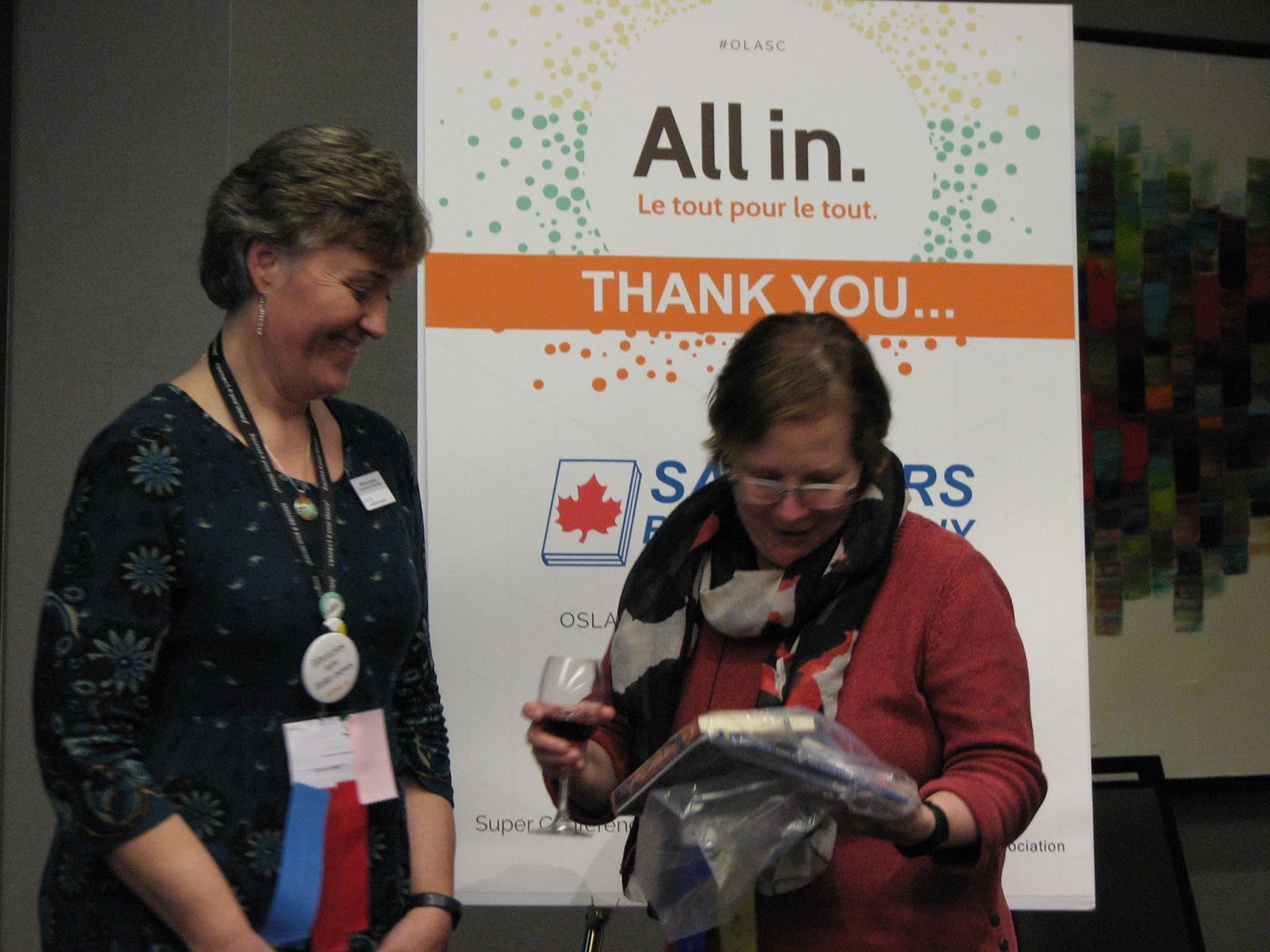 |
| OSLA 2017 president Melissa presents Lauren with a parting gift |
 |
| (L-R Carm Condotta, James Saunders, Kate Johnson-McGregor) |
 |
| (L-R Colin Anderson, James Saunders, Kate Johnson-McGregor) |
 |
| (L-R Leah, Akhina, Albert, Katina accepting the award) |
Monday, January 30, 2017
We cannot be silent
Living in Canada, next to the United States, is like sleeping next to an elephant, someone once said. (I looked it up. The person who uttered that quote was former Prime Minister Pierre Trudeau.) Even if it looks like we are not directly involved with their state of affairs, it impacts us. This past weekend, the new president of the United States signed an executive order, which he called "Protecting the nation from foreign terrorist entry into the United States", to strictly restrict immigration from seven specific countries, and to completely prevent any refugees arriving in the US from Syria. This threw airports into chaos as people with green cards were denied entry and other visitors were sent back. That this was done on Holocaust Memorial Day was especially ironic.
My friend, Jennifer Brown, was upset. She wrote about it on her blog. (I wish I was as passionately articulate as she is.)
As educators, what should we do? Should we keep politically neutral? Should we avoid controversy? I made my plans public and clear on Twitter -
My goal is not to indoctrinate, but to think critically. My aim is to examine current events and understand what's happening and why.
This is not easy for everyone. Look at Doug Robertson's dilemma (read the top tweet second; read the bottom tweet first).
This is why organizations like Teaching Kids News @TeachKidsNews on Twitter, are vital. I hope that within the next couple of days, they will have a student-friendly news article for teachers to read with their class on the topic. For instance, here is a kid-friendly news article about the inauguration and the Women's March the following day. It strives to provide facts and promote discussion.
To those of you in schools where you might be labeled an "agitator" for mentioning this issue, I have something for you. I'm working with my Grade 1-5 students on an inquiry unit on clothing. One aspect that I will need to address, because it is part of the media literacy expectations, concerns overt and implied messages. This tweet, posted by a new virtual friend of mine, is perfect for teaching overt and implied messages to my students.
The overt message is what is stated in the flyer. The implied message can be understood by the words she attaches to the photo, as well as the knowledge of recent current events. This is how I can "justify" bringing up the topic, even to younger students. We shouldn't have to justify equity education, but in case you need a reason, take mine.
Not teaching media literacy? What about math? Take a look at these statistics. Find the source. Discuss the rationale.
Whatever way you choose to address this topic, do it. Thank you to my Twitter pal @t8ish1 for bringing this article and video to my attention. We can't be silent. Silence implies consent. We cannot consent to people being tried and judged not by their actions but by their countries of origin.
My friend, Jennifer Brown, was upset. She wrote about it on her blog. (I wish I was as passionately articulate as she is.)
My virtual friend, Rusul Alrubail, whom I infer did not travel to #educon because of the current political situation, posted this practical advice for people:https://t.co/EGyIZUOG1P check out my mom's latest blog post. I was brought to tears.Every student deserves to learn from educators like her.— jenna brown (@JennaMichellex) January 29, 2017
If you're looking for actionable steps to help in the aftermath of the #MuslimBan here is a good list by @KhaledBeydoun #nomuslimban. pic.twitter.com/wrEazN1IyZ— Rusul الربيعي (@RusulAlrubail) January 29, 2017
As educators, what should we do? Should we keep politically neutral? Should we avoid controversy? I made my plans public and clear on Twitter -
My upcoming week's lessons will reflect current events & #MuslimBan Challenging with elementary kids? Maybe. Needed? Yes. #EduColor— Diana Maliszewski (@MzMollyTL) January 28, 2017
My goal is not to indoctrinate, but to think critically. My aim is to examine current events and understand what's happening and why.
This is not easy for everyone. Look at Doug Robertson's dilemma (read the top tweet second; read the bottom tweet first).
- Prefer to bring it up directly, but convos w parents after discussing Women's March have shown me I need to be sure to couch in standards.
- Trying to think of a way to bring up the #MuslimBan in class. We recently discussed the Statue of Lib. Could talk her engraving.
 Doug Robertson
 This is why organizations like Teaching Kids News @TeachKidsNews on Twitter, are vital. I hope that within the next couple of days, they will have a student-friendly news article for teachers to read with their class on the topic. For instance, here is a kid-friendly news article about the inauguration and the Women's March the following day. It strives to provide facts and promote discussion.
To those of you in schools where you might be labeled an "agitator" for mentioning this issue, I have something for you. I'm working with my Grade 1-5 students on an inquiry unit on clothing. One aspect that I will need to address, because it is part of the media literacy expectations, concerns overt and implied messages. This tweet, posted by a new virtual friend of mine, is perfect for teaching overt and implied messages to my students.
This ban I like pic.twitter.com/rxmkFkQH6R— Munazzah Shirwani (@HandsOnilm) January 28, 2017
The overt message is what is stated in the flyer. The implied message can be understood by the words she attaches to the photo, as well as the knowledge of recent current events. This is how I can "justify" bringing up the topic, even to younger students. We shouldn't have to justify equity education, but in case you need a reason, take mine.
Not teaching media literacy? What about math? Take a look at these statistics. Find the source. Discuss the rationale.
The teacher-librarian in me wishes that the source was listed. If # s are right, then we must ask why those places? https://t.co/PpMATOB0TC— Diana Maliszewski (@MzMollyTL) January 29, 2017
If you have older students, why not try what @JessLif is doing with her students. She is using the same prompts, but a new text.It's simple. Retweet this.— James Melville ❄️ (@JamesMelville) January 28, 2017
Hypocrisy must be called out.
Fascism must be stamped out.#MuslimBan pic.twitter.com/k29oXlHSA3
On Monday, I'm teaching Ss to synthesize information from videos. I'm switching the video clips I planned to use to news clips about the ban pic.twitter.com/CAROlqnFTn— Jess (@JessLif) January 29, 2017
Whatever way you choose to address this topic, do it. Thank you to my Twitter pal @t8ish1 for bringing this article and video to my attention. We can't be silent. Silence implies consent. We cannot consent to people being tried and judged not by their actions but by their countries of origin.
Brené Brown offers brilliant advice for talking to kids about hateful rhetoric https://t.co/27QoMd79Ee pic.twitter.com/5JvV1qVpVJ— Huffington Post (@HuffingtonPost) January 29, 2017
Monday, January 23, 2017
Creating Clothes Yourself
Last week was a busy one in the library and at home. I launched our new inquiry question and unit for the primary division: "how might our clothes reflect our identity" and have begun to teach students methods of clothing design and creation. I began with finger knitting. It takes a while to become accustomed to the pattern and not everyone finds it easy or relaxing. It was interesting to see which students gave up and which students kept trying. Some of the end results didn't look exactly like finger knitted strands, but for those who persevered, there was a sense of pride as they wore their creation. Others really delighted in this new skill and begged for more wool so they could continue to make new and different things at home over the weekend.
At home, I was preoccupied with working on various presentations - polishing ones that have already been booked and designing a few that are still at the proposal stage. A workshop that may do double-duty at multiple events is a session I'm constructing with my friend and fellow OSLA member Alanna King. The workshop is called "Teacher Librarians: Oiling The Gears of the MakerSpace Movement". To give it some added pizzazz, we decided to incorporate a steampunk theme to it. I am not a steampunk connoisseur, so I was a little stumped about what to wear. I did some research and initially I thought I'd borrow or rent an outfit.
My staff members even got into the act. One of our kindergarten teachers lent me his son's ski goggles, which will look great with a bowler hat I bought a while back from the dollar store, just because. (I'm not wearing it in the photo because I haven't decided if I want to do the fascinator yet instead.)
I didn't make these clothes in the same way that my students made their finger-knitted headbands / bracelets / belts / scarves / etc., but going on this hunt to compile and create the outfit for myself was a lot of fun. I need to give myself (and my students) time to be creative mor eoften!
At home, I was preoccupied with working on various presentations - polishing ones that have already been booked and designing a few that are still at the proposal stage. A workshop that may do double-duty at multiple events is a session I'm constructing with my friend and fellow OSLA member Alanna King. The workshop is called "Teacher Librarians: Oiling The Gears of the MakerSpace Movement". To give it some added pizzazz, we decided to incorporate a steampunk theme to it. I am not a steampunk connoisseur, so I was a little stumped about what to wear. I did some research and initially I thought I'd borrow or rent an outfit.
I did some investigating and sent a few email and Twitter inquiries. I felt like I wouldn't have time or knowledge to create a proper steampunk outfit for myself. Alanna and I shared photos of fabulous ensembles back and forth. Then I read an inspiring blog post by Adrienne Kress. It brought me back to another presentation I'm giving called "Cosplay MakerSpaces". Now was not the time to give up and just pay someone - now was the perfect time to rise to a new challenge, and test my cosplay mojo! I used my daughter's process for creating her costumes and I visited two different Value Village stores. My daughter accompanied me and I have to say that it was fun to hunt for the right clothes and to combine them for the effect I was attempting.PLN, know any cosplayers or places where I can rent or borrow a steam punk outfit? @lynthatye, ideas? Needed for Feb.15, 1 day only— Diana Maliszewski (@MzMollyTL) January 17, 2017
@lynthatye @banana29 @AdrienneKress Not sure which skirt I like better for steampunk. Your opinions? pic.twitter.com/ulPFLXpdnB— Diana Maliszewski (@MzMollyTL) January 19, 2017
Cosplay success! @lynthatye @banana29 @AdrienneKress found corset AND top @ Value Village. Whole steampunk outfit under $40! pic.twitter.com/w8ns5tLl0J— Diana Maliszewski (@MzMollyTL) January 22, 2017
My staff members even got into the act. One of our kindergarten teachers lent me his son's ski goggles, which will look great with a bowler hat I bought a while back from the dollar store, just because. (I'm not wearing it in the photo because I haven't decided if I want to do the fascinator yet instead.)
I didn't make these clothes in the same way that my students made their finger-knitted headbands / bracelets / belts / scarves / etc., but going on this hunt to compile and create the outfit for myself was a lot of fun. I need to give myself (and my students) time to be creative mor eoften!
Monday, January 16, 2017
Foot Care
It's January - time to put your best foot forward - figuratively and literally!
During the first week back to school, I vowed to continue my fitness regime from 2016 of walking around the community for a portion of the lunch hour. When I walked on Monday, I wore boots because of the snow. My boots aren't meant for long walks; after I was through, the bottoms of my feet had blisters from the wear. New plan: wear running shoes instead of boots, even if it's snowy out. This worked on Tuesday but on Wednesday, my feet felt funny after the extra-long trek on the icy sidewalks; I examined my feet and I had bled right through my sock on my left heel. The shoes I wore weren't the proper size (lesson learned - don't rush when buying footwear, even when you have family members impatient to leave the store - I ended up with a size 7 on the left and a size 9 on the right, and I usually wear a 7.5 - the shoes work fine as long as I'm not walking far).
We don't realize how important our feet are as teachers until they pain us. At the ETFO Presenter's Palette session, one of the guest speakers was Gwen Merrick, a Speech Language Pathologist. She spoke to us about keeping our voices healthy. I think the same is true for our feet. That's why I decided as part of my daughter's birthday present that I'd treat both of us to manicures and pedicures. I don't do pedicures often, especially in the winter. My usual justification is that no one will see my bare toes, so why bother painting them? However, I felt that proper foot care is meant for me, not others, so it was irrelevant who saw my pretty painted nails but important to get my feet taken care of. It's also important to choose the salon you use carefully; in the past, my feet were injured after a pedicure that was a bit too vigorous with the cutting and scrubbing, and made me limp for weeks. I really like the place I go to now (QS Nails, between Scarborough and Pickering).
This time of year can be very busy for teachers as they hurry to prepare and mark exams or finalize grades and write report cards. This post is just a gentle reminder to take time to take care of yourselves - your feet, your voice, and the other important parts of you.
During the first week back to school, I vowed to continue my fitness regime from 2016 of walking around the community for a portion of the lunch hour. When I walked on Monday, I wore boots because of the snow. My boots aren't meant for long walks; after I was through, the bottoms of my feet had blisters from the wear. New plan: wear running shoes instead of boots, even if it's snowy out. This worked on Tuesday but on Wednesday, my feet felt funny after the extra-long trek on the icy sidewalks; I examined my feet and I had bled right through my sock on my left heel. The shoes I wore weren't the proper size (lesson learned - don't rush when buying footwear, even when you have family members impatient to leave the store - I ended up with a size 7 on the left and a size 9 on the right, and I usually wear a 7.5 - the shoes work fine as long as I'm not walking far).
We don't realize how important our feet are as teachers until they pain us. At the ETFO Presenter's Palette session, one of the guest speakers was Gwen Merrick, a Speech Language Pathologist. She spoke to us about keeping our voices healthy. I think the same is true for our feet. That's why I decided as part of my daughter's birthday present that I'd treat both of us to manicures and pedicures. I don't do pedicures often, especially in the winter. My usual justification is that no one will see my bare toes, so why bother painting them? However, I felt that proper foot care is meant for me, not others, so it was irrelevant who saw my pretty painted nails but important to get my feet taken care of. It's also important to choose the salon you use carefully; in the past, my feet were injured after a pedicure that was a bit too vigorous with the cutting and scrubbing, and made me limp for weeks. I really like the place I go to now (QS Nails, between Scarborough and Pickering).
 |
| Daughter's pedicure (happy 17th birthday!) |
 |
| My pedicure, thanks to QS Nails. |
This time of year can be very busy for teachers as they hurry to prepare and mark exams or finalize grades and write report cards. This post is just a gentle reminder to take time to take care of yourselves - your feet, your voice, and the other important parts of you.
Monday, January 9, 2017
Twins: Treasure and Trouble
On the last day of winter vacation, I spent a few hours of my time doing what I often do on Sunday afternoons - I drive across the city to give my friend Tracey a hand.
Tracey has twins.
Her boys are about 5 1/2 months old now and I try to make a point of popping by a couple of times a month to help out where I can. Don't turn me into any kind of hero or saint for these visits - as I told Tracey today, I get to go home after my stint and get a full nine hours of sleep. She's on duty 24 hours a day, 7 days a week. She's the one that gets the medal.
Sometimes when I'm over, Tracey can sneak off for a short nap or a quick shower while Morgan (her husband) and I take the helm. Today, Morgan took their eldest son swimming so it was just Tracey, me, and the babies for a while. If one or both are sleeping, our conversations are muted but still engaging and insightful, which is surprising considering that lately Tracey has been working on about two hours of sleep a night. If that were me, cohesive words strung together as sentences would be near impossible. I asked if it was okay to write about the twins on my blog and Tracey agreed. See, a lot of what Tracey has said about the twins can apply to caring for a room full of students (minus the diaper changing).
1) You have to forgive yourself.
Fits perfectly with my #oneword2017, and I didn't even plan it that way! Tracey's doctor also has twins and he said to her that if you are giving 100%, that means that each baby's getting 50%. In other words, don't beat yourself up if one has to cry while you are dealing with the other one. Ideally, you want to give your full attention to each and every student in your room, but some may need you more than others - the one having a meltdown, or having an epic struggle understanding a concept, or the one with language processing issues, or other reasons. Don't eat yourself up with guilt for not making every single day a Hallmark card moment.
2) Do what you can, but accept help.
Morgan is a high school teacher, so for most of the day, Tracey is flying solo. She also doesn't drive, so when she has to run errands during the day, she packs up the double stroller and walks. She's become quite adept at handling two babies at once but she does not turn down aid when it's offered. When Morgan is around, he is pulled into service when required. (For instance, during the night, Tracey won't wake Morgan for help unless both babies are up and fussing. Even if that means she puts one to bed and the other wakes up right after, she will handle it because she doesn't want Morgan to be sleep-deprived at work.) When I first broached the idea of coming over to assist, Tracey accepted right away. She doesn't have me change diapers or do laundry - I'm not sure if I'm relieved or disappointed about that - but I will sweep, fix lunch, brush the dog, feed bottles or amuse a baby with toys or songs. I think this was awkward for Morgan at first (if I'm allowed to say that) because he and Tracey were impeccable hosts pre-baby and not accustomed to relying on others. Tracey says "you get over that pretty quick". This should be true for teachers too. We're lucky - help may just be a door away. If you need assistance, there is no shame in asking.
3) Count small accomplishments, day by day.
When one of the boys stayed down for four hours during the night, it was a cause of celebration. Sometimes those celebrations may be inconsistent. Emmett used to be the great napper. Now it's Owen. Instead of despairing over what isn't happening, find joy in what is. For me, getting one of the babies to smile feels huge. On the teacher side of this sage piece of wisdom, it's challenging to promote the positive, especially when it is irregular. (I'm writing report cards right now, so there's a lot of calculating the different sign posts of progress and various assessments and evaluations to try and summarize success, even though the actual results may vary depending on the day, time or mood.)
4) Allow yourself to vent. Humour helps.
Tracey is hilarious, although she says most of her good lines get wasted because the twins don't exactly understand what she's saying. When things are bumpy, she's joked about taking a walk to the orphanage. On a few rough days before Christmas, she said "I hope Santa brings them coal." I remember when my eldest was a baby during her "witching hour", we'd quip about throwing her in the toilet. It sounds cruel, but as long as we don't actually go through with it, that dark humour is a survival strategy. In a way, it's the flip side of #3. Rejoice in the sunny skies and curse the rain clouds. As long as it's done in a respectful manner and in a proper place (i.e. not in front of the students themselves, because students understand your words more than babies) teachers need a safe place to gripe too.
5) It's a hard, hard job ... but you wouldn't trade it for the world.
Taking care of one baby isn't easy. Taking care of two at the same time is extra challenging. Banning TV until they're 2? Ha! If a bit of Thomas the Tank Engine can buy time to finish a task, so be it. When babies outnumber the adults, it's difficult. However, Tracey adores her boys. She admits to getting teary eyed looking at them and realizing that they are alive, safe, healthy, and happy. Hopefully, that's the same feeling for teachers. It's tough. You put in a ton of hours and wonder if you're making a difference. You despair. You cry. Yet, teaching can be the best job ever.
Tracey has twins.
 |
| Thanks for letting me use your photos Tracey! (L-R: Owen, "Mommy", Emmett) |
Her boys are about 5 1/2 months old now and I try to make a point of popping by a couple of times a month to help out where I can. Don't turn me into any kind of hero or saint for these visits - as I told Tracey today, I get to go home after my stint and get a full nine hours of sleep. She's on duty 24 hours a day, 7 days a week. She's the one that gets the medal.
Sometimes when I'm over, Tracey can sneak off for a short nap or a quick shower while Morgan (her husband) and I take the helm. Today, Morgan took their eldest son swimming so it was just Tracey, me, and the babies for a while. If one or both are sleeping, our conversations are muted but still engaging and insightful, which is surprising considering that lately Tracey has been working on about two hours of sleep a night. If that were me, cohesive words strung together as sentences would be near impossible. I asked if it was okay to write about the twins on my blog and Tracey agreed. See, a lot of what Tracey has said about the twins can apply to caring for a room full of students (minus the diaper changing).
1) You have to forgive yourself.
Fits perfectly with my #oneword2017, and I didn't even plan it that way! Tracey's doctor also has twins and he said to her that if you are giving 100%, that means that each baby's getting 50%. In other words, don't beat yourself up if one has to cry while you are dealing with the other one. Ideally, you want to give your full attention to each and every student in your room, but some may need you more than others - the one having a meltdown, or having an epic struggle understanding a concept, or the one with language processing issues, or other reasons. Don't eat yourself up with guilt for not making every single day a Hallmark card moment.
2) Do what you can, but accept help.
Morgan is a high school teacher, so for most of the day, Tracey is flying solo. She also doesn't drive, so when she has to run errands during the day, she packs up the double stroller and walks. She's become quite adept at handling two babies at once but she does not turn down aid when it's offered. When Morgan is around, he is pulled into service when required. (For instance, during the night, Tracey won't wake Morgan for help unless both babies are up and fussing. Even if that means she puts one to bed and the other wakes up right after, she will handle it because she doesn't want Morgan to be sleep-deprived at work.) When I first broached the idea of coming over to assist, Tracey accepted right away. She doesn't have me change diapers or do laundry - I'm not sure if I'm relieved or disappointed about that - but I will sweep, fix lunch, brush the dog, feed bottles or amuse a baby with toys or songs. I think this was awkward for Morgan at first (if I'm allowed to say that) because he and Tracey were impeccable hosts pre-baby and not accustomed to relying on others. Tracey says "you get over that pretty quick". This should be true for teachers too. We're lucky - help may just be a door away. If you need assistance, there is no shame in asking.
3) Count small accomplishments, day by day.
When one of the boys stayed down for four hours during the night, it was a cause of celebration. Sometimes those celebrations may be inconsistent. Emmett used to be the great napper. Now it's Owen. Instead of despairing over what isn't happening, find joy in what is. For me, getting one of the babies to smile feels huge. On the teacher side of this sage piece of wisdom, it's challenging to promote the positive, especially when it is irregular. (I'm writing report cards right now, so there's a lot of calculating the different sign posts of progress and various assessments and evaluations to try and summarize success, even though the actual results may vary depending on the day, time or mood.)
4) Allow yourself to vent. Humour helps.
Tracey is hilarious, although she says most of her good lines get wasted because the twins don't exactly understand what she's saying. When things are bumpy, she's joked about taking a walk to the orphanage. On a few rough days before Christmas, she said "I hope Santa brings them coal." I remember when my eldest was a baby during her "witching hour", we'd quip about throwing her in the toilet. It sounds cruel, but as long as we don't actually go through with it, that dark humour is a survival strategy. In a way, it's the flip side of #3. Rejoice in the sunny skies and curse the rain clouds. As long as it's done in a respectful manner and in a proper place (i.e. not in front of the students themselves, because students understand your words more than babies) teachers need a safe place to gripe too.
5) It's a hard, hard job ... but you wouldn't trade it for the world.
Taking care of one baby isn't easy. Taking care of two at the same time is extra challenging. Banning TV until they're 2? Ha! If a bit of Thomas the Tank Engine can buy time to finish a task, so be it. When babies outnumber the adults, it's difficult. However, Tracey adores her boys. She admits to getting teary eyed looking at them and realizing that they are alive, safe, healthy, and happy. Hopefully, that's the same feeling for teachers. It's tough. You put in a ton of hours and wonder if you're making a difference. You despair. You cry. Yet, teaching can be the best job ever.
 |
| Double smiles - how can you resist? |
Monday, January 2, 2017
My #OneWord2017
Happy New Year!
I've decided to try that #oneword challenge again this year. Searching on Twitter showed me that many folks have chosen to beautify their word with images and photo mashups, and their words consist of things like culture, opportunity, embrace, shine, climb, joy, relentless, courage, present, balance, positivity, focus, energy, pause, innovation, grow, believe, shift, limitless, etc. In fact, look at all the words that an Ohio principal's staff members have created and documented:
Last year, my rebellious word was "continue". My #OneWord2017 is weird. I don't mean that the word I've chosen is the word "weird". I mean that it's a bit offbeat and unusual.
My word is forgive.
Let me explain.
Forgive connected to Faith: A few weeks ago, (December 10, to be specific) my parish priest gave a good homily. It made enough of an impact that I tweeted parts of it.
Forgive connected to Health: I've done quite well on my goal to continue healthy living. Finding my personal trainer in the fall, who advises me along the journey, was a big help. Despite the support and the obvious positive physical changes (i.e. I fit into my old clothes and I'm no longer addicted to sugary drinks like I used to be), my weight and other numbers haven't changed much at all. I have to forgive myself - not forget what I'm doing or abandon it, but let go of the need for any numbers on the scale to change. Good thing I don't own a scale! I've joined an online support community led by my personal trainer so that I can work on nutrition and exercise. (I suspect the nutrition parts are a bigger challenge for me than I thought.)
Forgive connected to Relationships: There are some pretty "challenging" people that I deal with at times. The workshop I attended in Vancouver on having Difficult Discussions reminded me that I should always assume positive intent. These students or adults do not behave the way they do because they are intentionally trying to be difficult. They are coping in the ways they know how and may not even realize that they are frustrating me or acting in inappropriate or in less-than-helpful ways. In 2017, I'm going to try and be more forgiving of others when I feel slighted. Forgiveness doesn't mean that I'll ignore everything for the sake of peace. I will try and put myself in their place and not let resentment impact my response.
Forgive connected to School Projects and Goals: I have some big tasks planned (e.g. the new media assignment for my primary division students, getting further ahead on my research, running the Secret Path Book Club on Teach Ontario, offering some new presentations at different venues, etc.) and if they don't go quite as planned, I need to forgive myself. Mistakes are part of learning. It's okay to stumble sometimes.
Forgive connected to FNMI issues: There's a reason why the group formed to address the wrongs against our indigenous people in Canada was called The Truth and Reconciliation Commission. We need to acknowledge what happened, get to the facts, and then move forward. We need to take actions that show we want to be forgiven. As educators, we may have, through our common history or through micro aggressions we may not even realize we perpetuate, contributed to the sad situation that created and supported the residential school system. I will not treat equity issues as a fad. I will try to improve my track record.
I also want to embrace the "give" portion of the word separately. I'll give myself a chance. I'll give others a chance. I'll give my time and talents and treasure. If I can give and forgive in 2017, it'll be a pretty awesome year.
P.S. In the spirit of "giving", I thought I'd share the forms that I created as part of my media movie unit with the primary division students. Because I personalize these sheets, they may not be as useful to just print and use immediately, but they are shared as examples that you can modify. The illustrations of the various film production roles come from my daughter. She drew them for me several years ago and she says that she can do a much better job now, but I like them and since they were what my students and I used when we were first learning about these jobs, they worked for us.
I've decided to try that #oneword challenge again this year. Searching on Twitter showed me that many folks have chosen to beautify their word with images and photo mashups, and their words consist of things like culture, opportunity, embrace, shine, climb, joy, relentless, courage, present, balance, positivity, focus, energy, pause, innovation, grow, believe, shift, limitless, etc. In fact, look at all the words that an Ohio principal's staff members have created and documented:
A fabulous rationale (from an Ontario educator, Jaclyn Balen), can be found in this blog post.The @wmscats believe in the power of the #OneWord. We are family. We know the impact. New signs for #OneWord2017! @JonGordon11 pic.twitter.com/Ms11QW640R— Craig Vroom (@Vroom6) December 31, 2016
Last year, my rebellious word was "continue". My #OneWord2017 is weird. I don't mean that the word I've chosen is the word "weird". I mean that it's a bit offbeat and unusual.
My word is forgive.
Let me explain.
Forgive connected to Faith: A few weeks ago, (December 10, to be specific) my parish priest gave a good homily. It made enough of an impact that I tweeted parts of it.
I'm a Roman Catholic, and I like to joke that I'm a practicing Catholic because I'm not really good at it - I need to practice. The hardest part about being a Catholic, for me, is the forgiveness aspect. It's not easy to forgive others (or myself) or accept forgiveness. Usually, I go to confession twice a year (before Easter and before Christmas). After that homily and based on my One Word goal, I'm going to try to go to confession once a month.Another pt from Fr. Hansoo @barnabasrcc: when we celebrate, we need to prepare. How? 1st we clean up. Same for us spiritually (ie confess)— Diana Maliszewski (@MzMollyTL) December 10, 2016
Forgive connected to Health: I've done quite well on my goal to continue healthy living. Finding my personal trainer in the fall, who advises me along the journey, was a big help. Despite the support and the obvious positive physical changes (i.e. I fit into my old clothes and I'm no longer addicted to sugary drinks like I used to be), my weight and other numbers haven't changed much at all. I have to forgive myself - not forget what I'm doing or abandon it, but let go of the need for any numbers on the scale to change. Good thing I don't own a scale! I've joined an online support community led by my personal trainer so that I can work on nutrition and exercise. (I suspect the nutrition parts are a bigger challenge for me than I thought.)
Forgive connected to Relationships: There are some pretty "challenging" people that I deal with at times. The workshop I attended in Vancouver on having Difficult Discussions reminded me that I should always assume positive intent. These students or adults do not behave the way they do because they are intentionally trying to be difficult. They are coping in the ways they know how and may not even realize that they are frustrating me or acting in inappropriate or in less-than-helpful ways. In 2017, I'm going to try and be more forgiving of others when I feel slighted. Forgiveness doesn't mean that I'll ignore everything for the sake of peace. I will try and put myself in their place and not let resentment impact my response.
Forgive connected to School Projects and Goals: I have some big tasks planned (e.g. the new media assignment for my primary division students, getting further ahead on my research, running the Secret Path Book Club on Teach Ontario, offering some new presentations at different venues, etc.) and if they don't go quite as planned, I need to forgive myself. Mistakes are part of learning. It's okay to stumble sometimes.
Forgive connected to FNMI issues: There's a reason why the group formed to address the wrongs against our indigenous people in Canada was called The Truth and Reconciliation Commission. We need to acknowledge what happened, get to the facts, and then move forward. We need to take actions that show we want to be forgiven. As educators, we may have, through our common history or through micro aggressions we may not even realize we perpetuate, contributed to the sad situation that created and supported the residential school system. I will not treat equity issues as a fad. I will try to improve my track record.
— Sue Dunlop (@Dunlop_Sue) December 31, 2016
I also want to embrace the "give" portion of the word separately. I'll give myself a chance. I'll give others a chance. I'll give my time and talents and treasure. If I can give and forgive in 2017, it'll be a pretty awesome year.
P.S. In the spirit of "giving", I thought I'd share the forms that I created as part of my media movie unit with the primary division students. Because I personalize these sheets, they may not be as useful to just print and use immediately, but they are shared as examples that you can modify. The illustrations of the various film production roles come from my daughter. She drew them for me several years ago and she says that she can do a much better job now, but I like them and since they were what my students and I used when we were first learning about these jobs, they worked for us.
 |
| Media Production Roles - What did you do when we made the movie? |
 |
| Topic, purpose, audience, and skills needed when making media |
 |
| Responding to and Evaluating Media - being a film critic! |
Subscribe to:
Posts (Atom)