Monday, October 16, 2023

Applying Kindie AQ Learning: My Wonders, My Blunders and My Puppet Experiments

 I'm going to apologize in advance if this blog starts looking more like a kindergarten teacher's blog than a teacher-librarian blog. I have so much kindergarten prep coverage (13/40 periods in my schedule) and I'm preoccupied with making my early years programming work better than it did in the past. The focus-on-four-and-five-year-olds is not necessarily a bad thing - after all, my friend Beth Lyons has made the leap from teacher-librarian to full-time kindergarten teacher and her blog is still titled https://thelibrariansjourney.blogspot.com/ . In fact, she writes about the first 6 weeks of kindergarten in her latest post. Many of the things she is concerned about are things I'm concerned about and things our absolutely fabulous kindergarten team (MM, new to our staff, and JC, an educator who's been at this school longer than I have, and this will be my 20th year!) also think about regularly.

I took my Kindergarten Part 1 AQ in 2019. I'm still trying to incorporate what I learned there in my practice. Room K1 uses a lot of loose parts provocations, so I plan on sneaking in there to peruse the set up more frequently. As I mentioned in this past post about loose parts, it's helpful to get the opportunity to attempt things multiple times, so that you can learn from the errors the first time around and improve it on the second. 

I haven't been able to set up any new loose parts provocations since my initial attempt in September - book fair sort of got in the way. However, I've been relatively pleased with how the subjects are meshing into each other and how the ebb and flow of the lessons are being determined by student interest. The routine is slooooooowly being established. Big thanks to Matthew Malisani for making me signs that help me remember the process. 

Before I launch into the description of what's happening, I need to share my struggle with pedagogical documentation. We had a kindergarten reorganization and we transformed from two classes with 22 students each, complete with an Early Childhood Assistant, to a class of 15 with no ECE and a class of 29 with an ECE. It's been disruptive. The small class is challenging without an extra adult present. The large class is challenging because of the large amount of students. In both classes, it's been hard for me to properly document what I see, hear and notice students saying and doing that demonstrates their thinking and learning. Right now, it's so busy that all I've been able to do is take photographs and hope (in vain) that I'll remember what was happening at that particular time. I'm also still debating about whether it's better to keep separate student files and flip to each to record, or maintain a daily log which I can then try to link to to ensure I make notes on all the students. 

Back to what's happening in class. My general theme, at least according to my long range plan (which usually falls to the wayside in a few weeks when it comes to kindergarten) is all about imagination. In dance/drama time, we've been really interested in puppets. It's expanded into our media time and a bit into our music time. We've learned about the differences between hand- and finger-puppets and stuffed animals and how to use the puppets without getting too physical with each other. (There's a tendency for puppets to hit other puppets and people and get rammed up in faces - I know this is part of the Punch-and-Judy puppet tradition, but thankfully mini-lessons on friendly interactions have reduced the number of times I've had a puppet smack me. Eating me, on the other hand ... )


Based on comments from students, we "made" our own puppet theatres with cloth and chairs, and that's been neat to see how they set things up and put things away. 


We've also modelled some "mini-scenarios" or "tiny-stories" (such as "The Race" [like The Tortoise and the Hare] or "Are You Mommy?" [like "Are You My Mother? / Is Your Mama a Llama?"]). That helped with our "puppet plays" because at first, many of the puppet "shows" were silent. Having a narrative structure to riff on helped a lot. 


One class got really interested in sorting the puppets, so we made signs to keep us organized and we grouped them.


I own a marionette (stringed puppet) and brought it out for students to try out (gently). I was inspired, in one of those just-before-you-fall-asleep-aha-moments to try and make our own mini-marionettes, but without almost any directions or instructions. I am very cognizant of the philosophy that making in kindergarten should not result in carbon copy replicas as final products, but explorations and experimentations. (Below is a photo of Thess showing the puppet.)


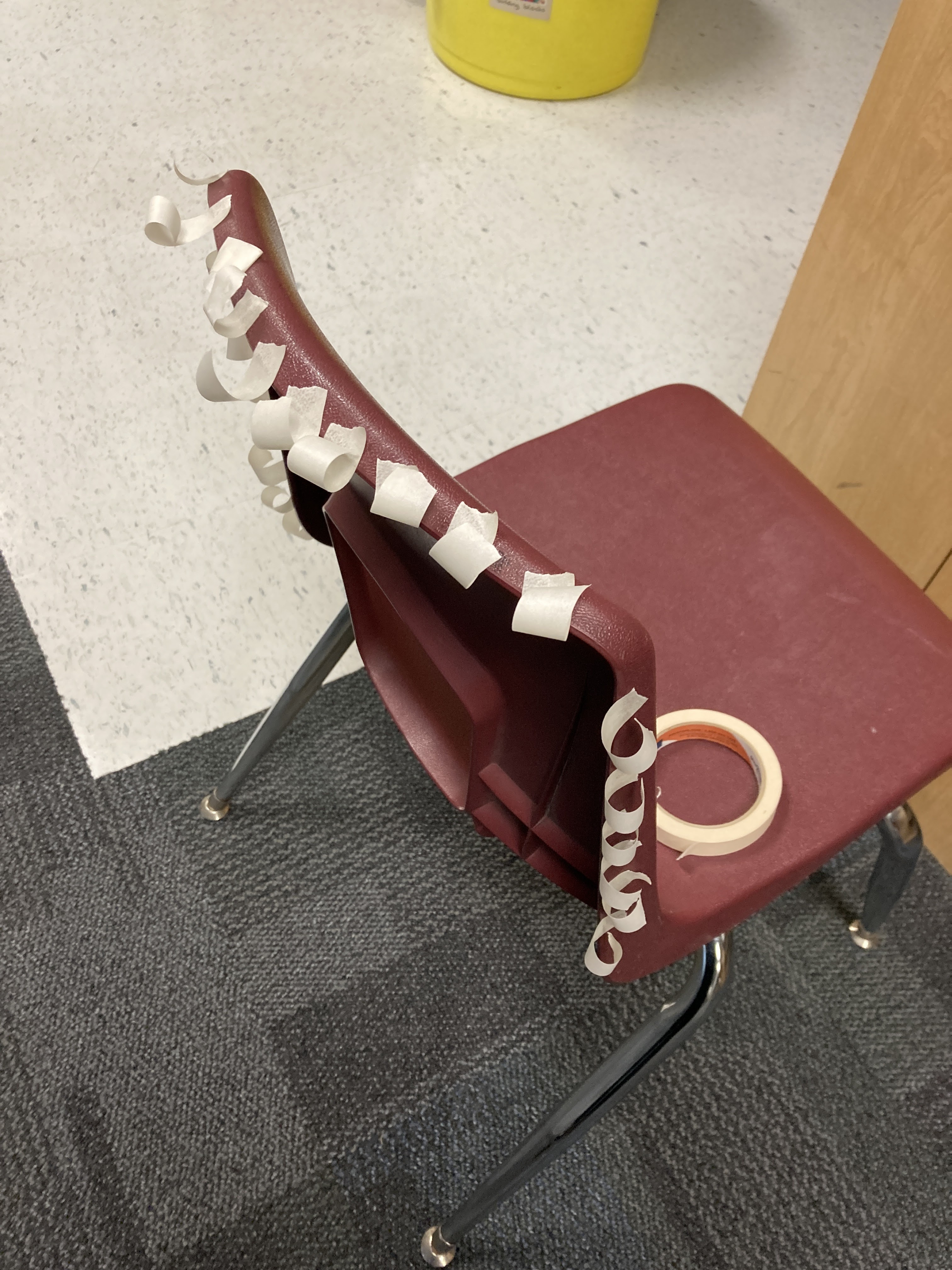
This was an example of learning from the previous class. The first time I tried this, we didn't have time to finish and it wasn't safe to just leave the projects lying out on tables in the library. I talked with Thess Isidro, the ECE, to generate ideas on how to deal with this problem. She recommended collecting the items in paper bags labelled with their names. The bonus was, we could then use the paper bags for hand puppet creations later! I also set up stations so that the students did not have to wait on me for supplies. Tape and strings were all available on chairs and the bins with scissors and potential materials to make the puppet bodies were out and reachable.


I was really pleased with how some of these mini-marionettes turned out! The products hinted at what they understood about how the marionettes worked. 


So I've made some mis-steps. We've had tears, and pick-up mix-ups, and sometimes lessons don't go according to plan. That's okay. Mistakes are part of learning, but I'll keep trying to figure out how to make this work in the school Library Learning Commons.

Monday, October 9, 2023

Go with the Flow

 For a shortened week, it was pretty jam-packed. The AQs that I lead for Queen's University and York University started this week. I hosted the annual Scholastic Book Fair in my library. Also on the calendar was our school's Curriculum Night, Terry Fox Run and the TDSB Teacher Librarian Facilitator Meeting and Planning Session. Did I mention taking my parents to get their haircuts and arranging Thanksgiving dinner? Busy, busy, busy.

Two moments this week reminded me about the importance of flow - both traffic flow and going with the flow.

Last year, the book fair resembled a packed dance club at the hottest night spot; it was so crowded that people could barely move, and even with five staff members helping out, by the end of the night we were all exhausted. This year, the admin team came by to scope out the space and make suggestions on how to improve the situation. I appreciated their interest and concern. My principal recommended a change that actually made a huge difference: create a corridor where shoppers would line up to pay that did not block people still browsing and selecting in the book fair. We moved the cashier location to a spot near my circulation desk and the door to help with this shift. I don't have any photos of the alteration, but it worked well. We only had three staff members monitoring the book fair, and those wonderful colleagues, Connie Chan and Julie Tran, sped things along even more than before by writing and calculating the purchase amounts on sticky notes that the buyers passed to me at the checkout. That meant that I could focus just on collecting the payment and making change when needed. 

I've mentioned frequently about how disruptive and dysregulating the book fair can be. I am now the primary prep provider for the kindergarten classes, and I thought I'd be clever and avoid all the distractions of the book fair by holding my music class on Wednesday in their kindergarten classroom instead of the library. The decision wasn't that smart. I couldn't log into my MusicPlayOnline subscription while in the other class. I improvised my lesson as best as I could, but the students began to get restless, and some of my usual redirection tricks relied on items left in the library. No worries - why not go to the library and use my laptop with my saved password intact? This would have been fine, if my laptop speakers had not suddenly decided to stop working. Having no sound on a music website isn't useful at all. By this time, I was getting a bit frazzled. I was saved by two things: our compassionate Educational Assistant, Joan D'Souza, who saw I was struggling and rearranged her schedule to help me out, and my handy-dandy box of instruments. Although I wasn't feeling like a very competent teacher at the time, I can be a bit creative and think fast on my feet on occasion, so we did some compare and contrast, including a repetitive song phrase I made up on the spot to match one of two instruments (bells or tambourines). It worked so well that I repeated it with the other kindergarten class I saw later that same day. (In case you are curious, the song chants were "This is a tambourine" [ta / tee tee / tee tee / ta = so, so, so, mi, mi, so] and "Bells, bells, bells bells bells" [ta / ta / tee tee / ta = so, mi, so, so, mi]).


Going with the flow isn't easy when the flow is more of a rushing river than a lazy stream. The same goes for traffic flow; managing traffic is better when it isn't like rush hour on the 401. However, life's course never runs smoothly and these tales make for entertaining stories and helpful lessons learned.

Monday, October 2, 2023

Say Hi and Bye to the New Guy

 September and early October are times in the school year that are both full of beginnings and endings. Students meet their new teachers and classmates. Teachers join new schools and get to know new colleagues and communities. However, in late September, school numbers get readjusted. Staffing shifts happen. Buildings gain or lose teachers. It's a rollercoaster ride that people in education often call "ReOrg". Reorganization is a mixed blessing. It was the way I obtained my first full-time permanent contract; yet, it can be awful to upend growing learning communities, like when I had to switch from a Grade 6-7 to a Grade 5-6 assignment and "give up" my Grade 7s

Considering the size of our staff, we have a rather large number of LTOs (long-term occasional) teachers at our site this year, for various reasons. One position that was particularly hard to fill was that of our Special Education Resource Teacher. Thankfully, we found someone willing and able to take the position, and Catherine Wang arrived.

Catherine is a new graduate from the Faculty of Education, but what she may "lack" in terms of experience, she more than made up for with her willingness and enthusiasm. She travelled from downtown to our school in north-east Scarborough via public transit every day, a 90 minute commute one way. I offered to drop her to the nearest station to shorten the trip a bit, so we had the chance to get to know each other a bit more on these drives.

Catherine is eager to learn as much as she can from everyone. She asked questions and observed how the adults interacted with the students. She sought genuine feedback after dealing with students and valued all the advice she was given. One of her greatest talents was the way she quickly forged relationships with all members of the school community. We were so fortunate that she is fluent in Mandarin, so we often called on her to help us with translation issues. After just a few weeks, the parents started asking for Ms. Wang by name for assistance!


I don't have many photos of Ms. Wang, because after her Special Education schedule was established, she was busy supporting students in many classes. This is a shot of her helping one of the kindergarten classes I saw in the library on the second day of school. Catherine is hard-working. She took three separate Additional Qualification courses over the summer to make herself more marketable and improve her skills. She agreed to work on creating the front hall display and took this task seriously, researching welcoming displays and considering equitable representation. She constantly offered to help out in any way she could.

I keep flipping between writing in the present and the past tense, because Catherine is no longer at our school. Our school board has gone on a mass hiring blitz, both this spring and this fall. There were over 200 positions listed a week ago that were permanent contract jobs! This is unprecedented. I was a supply teacher for over a year before I was hired full-time, and I know of many other teachers who spent years working as OTs and LTOs before landing their secure positions. I just peeked on the board website and there are still 24 positions advertised on September 28 with hopes of filling for early October! Golden opportunities like this don't happen every day, so Catherine sent out a flurry of applications. She actually received and conducted 13 interviews for positions over the course of three days. And she was successful! She starts her new, full-time, permanent contract position on Monday October 2.

Catherine oozes gratitude. She sent the staff a lovely email thanking everyone for being so wonderful and supportive. She never failed to thank me every day for dropping her off at the subway, and I'd often find boxes of "thank you Timbits" on my desk from her. She is so appreciative of time she has spent at our school, her fortune in snagging a LTO so quickly after graduation, and all of the kindness she's been shown. She's young enough to be my daughter - in fact, she's just a month older than my eldest - and she may qualify as the "new guy" but she won't stay a "n00b" for long. Her positive attitude and go-getter disposition will take her far. Congratulations Catherine, and all the best in your new teaching job!


Monday, September 25, 2023

What can I do to help?

A blog post in which Diana shares her correspondences, a change in schedule, and admits to hating a beloved children's classic ...

I've had a lot of poignant email and in-person conversations lately. I am honoured that others see me as someone who can help solve problems. Many of these talks fall along similar themes. Be it C through my work email, M in my non-work email from the AQ, M in my DMs, or even C at the grocery store - all of them are reaching out for assistance on explaining aspects of teacher-librarianship to those who aren't in the role, and managing the role itself.

As I told my principal recently, my father used to have a saying: "If you aren't part of the solution, you are part of the problem". (I'll circle back to this later.)

I've been a TL for a long time, which means I know a lot of people and have had many years of dealing with different kinds of people and situations. Here are some things I have done, can do, and will do to make things better.

Collaboration = if you need some examples of what collaboration can look like, feel free to look at this blog from 2021 describing a few types of collaborative teaching experiences 

The Role of the TL = I am considering making some generic (as in, can be used by any school board) slide decks that can be used to explain what a TL does and why this is not a waste of resources and time. If I do this, I'll post them here for people to use. If anyone wants to work with me on this, send me a note.

If you need something on the role of the teacher-librarian right away, you might want to check out a recent ETT Teacher Talk podcast on the School Library Learning Commons. I haven't had a chance to listen to the speakers, but the descriptor sounds like the participants worked hard to capture all the important elements of the job. (Plus, Rabia was one of my Library Part 1 AQ students!)


Visits = If I promise you that I'll come to your school to take a look around and help with planning, physical set up, or programming, know that I am good for it. Remember to email me to book a time.

Scheduling = This is the thing that I can do to help that doesn't fill me with delight but is the best course of action. At my own school, I will relinquish my open collaborative time this year. As my dad's motto rang in my head, "if I'm not part of the solution, I'm part of the problem". This is what I can do right now. I'm disappointed but I am old enough to know that there are cycles. In fact, I wrote in my capping paper for my Masters of Education degree about how, the year after I received Canada's highest honour for school librarianship, (the 2008 Canadian Association of School Libraries / Follett International Teacher-Librarian of the Year) circumstances changed.
In the 2009-2010 school year, the majority of my collaborative teaching time was removed due to declining enrolment at my school and the reduction of required minimum teacher-librarian time board-wide. My teaching position now included being the junior and intermediate special education resource teacher for literacy and numeracy in addition to being the teacher-librarian. My library schedule only held six periods available for collaborative teaching time with class teachers, the lifeblood of a healthy school library program; all the rest of my library time was designated for providing preparation time for class teachers by taking groups for book exchange and teaching isolated library skills instruction for every class in the school. I was very disappointed by this turn of events.  

I lost the teacher-librarian position entirely in 2020-21 when my board eliminated the position in elementary schools because of  the COVID-19 situation and reaction. It's not ideal but I remain hopeful that in the future, there will be a better timetable that will allow for co-planning, co-teaching, and co-assessing. Last year, I was able to be involved with 19 collaborative units, even with getting pulled occasionally to deal with the supply teacher shortage. I remain optimistic that the pendulum will swing back, and I'm willing to take the hit this time.


Some may see this as being too sacrificial. Some may even compare it to the famous picture book, The Giving Tree. This is where I'll shriek "NOOOOOOO!" A major reason for my objection is because I actually despise that book. 

I am not the only one that dislikes this book. Reasons why this book is disliked, as mentioned on a Quora thread, and on a Reddit thread, include the toxic relationship between the tree that constantly gives and the boy that constantly takes, and the exploitation of nature


This image was posted by user "thissucks32" part of the Reddit group r/raisedbyborderlines

By the way, I still have a copy of the actual book in the school library where I work, even though I don't like the main message. The removal of certain titles from school library collections cannot be based on personal preferences. Make sure you read the statement by Canadian School Libraries on book challenges. (I won't write about the criticism the Peel District School Board has faced for its deselection practices. That's worthy of a separate post.) My blog post on deselection from this July describes the actual process.

Oh, and I can't stand The Rainbow Fish either. (This article on Medium sums up most of the objections.) 


This image comes from Kidspot. The original images come from two TikTok accounts labelled in the collage image.

I'll stop here, before you get the idea that I am a crank that hates all famous picture books! Just remember, I'm willing to provide assistance if you need it. Just let me know what I can do to help.

Monday, September 18, 2023

A Funny Thing Happened on the Way to the Library

 I'm teaching a lot of drama this school year. To get into the mood, I've been re-watching old episodes of the improv show, Whose Line Is It Anyways? and enjoying the comic genius of people like Ryan Stiles and Colin Mochrie. Funny enough, one of the games or skits that they play on the show, called "Props", is very similar to a game I'm playing with the students.

We first read Not A Stick to see how the main character can pretend that a stick can be many different things. Then, we sat in a community circle, passed around a stick, and played pretend with some structured conversation. (I think a version of this game is also called "This is a Scarf".) The dialogue goes something like this:

Me: "Who are you?"

Student: [says their name]

Me: "Hey [NAME], nice stick."

Student: "It's not a stick."

Me: "It's not a stick? What is it?"

Student: "It's [says and shows something different]"

I have to tell you that when I played this game with one of our kindergarten classes, you would have thought that they were watching Robin Williams or Catherine O'Hara at their finest. Every time I said "It's NOT a STICK?", the entire class howled with laughter. They thought it was the funniest thing they've ever heard in their entire lives. And then, when I'd say it again for the next person in the circle, they'd crack up laughing anew. No word of a lie, they chortled and giggled and rolled on the floor chuckling loudly like it was the very first time they had ever heard such a witty retort. I was absolutely hilarious. (Before you suggest I abandon teaching for a life on the comedy circuit, check out this article on children's sense of humor from the University of Bristol. I suspect it was a combination of funny faces, funny voices, getting a reaction, and mislabeling.)

Now, it was kind of hard to get them to settle down a bit afterwards, and some of the students were still too shy or hesitant to suggest a different interpretation of the stick, but some did. There were a lot of fishing rods inspired by the book and ninja swords, and a couple of new ideas, but most just loved letting loose. You can see from a few of these photos. These are from the Grade 3-4 students, so they are a bit more advanced in their pantomime, but you can see how it progressed.


Joy is a good thing.

It made me think about the times the students or I have bust a gut laughing out loud.

Toy Store

Students who have had me before for drama class have already begun requesting that we play Toy Store. They love to play pretend. They think it's a hoot to "trick the toy store owner" (aka me in role) and have her perplexed as to why the toy store is in disarray each morning after she locks up, never realizing that the toys are alive and partying after hours. That's what drama is about for young learners. It's not about memorizing lines to recite in a stage performance. The Ontario curriculum says that elementary students will "expand their thinking, solve problems, and develop their ability to express ideas and feelings through aspects of the art form such as contextual or process drama and role play". (page 15)


Early Minecraft Play - We Need a GamingEdus Reunion!

My husband likes to share the story of what it was like listening to my children and to me playing Minecraft together in the early days, alternately screaming in terror and hollering in delight as we experienced this new virtual world. Minecraft used to be such a huge part of my personal and professional life. If you look at the list of presentations I've run on my wiki, you'll notice that from 2012 - 2018, I offered many, many sessions about using Minecraft in the classroom with members of the GamingEdus. The GamingEdus were a group of like-minded educators who believed in the power of video games in education and the positive possibilities of games based learning. We used to have so much fun together. The GamingEdus have crept into my thoughts recently, because one of our core members, Andrew Forgrave, aka Gumby Blockhead, has been helping me migrate all of our old Minecraft accounts to Microsoft before they are locked out for good. 


I even found one of our old business cards out of the blue.


So, what happened to the GamingEdus? Well, Liam O'Donnell moved to the Thames Valley District School Board. Denise Colby became a vice-principal in the Toronto District School Board. Jen Apgar became a vice-principal in the Upper Grand District School Board. Andrew Forgrave retired from the Hastings Prince Edward County District School Board. We still love games but Microsoft's acquisition of Minecraft reduced the pleasure of this specific game for some of us, and we moved on to other priorities and jobs. I hope that we can arrange a get-together in the future so we can reunite and reminisce about those great times we had together.


Conversations with Friends over Food

I couldn't recall a specific example of this, except for a time long ago that my sister and I with some mutual friends (Cathy and Brendan) were sitting around the kitchen table at my parents house. We were eating but we were so overly tired that everything anyone said was inexplicably funny. Thing is, combine good friends with good food and uninterrupted time, and it is likely to lead to lots of laughs. These precious moments will often happen at dinner after a conference, or during the summer over a leisurely lunch. 


I hope you get a chance to laugh lustily and without reservations sometime soon. Laughing has many health benefits, according to this article from the Mayo Clinic.  So, live, laugh and love!

Monday, September 11, 2023

What Works in the First Week

 The first week of school for the 2023-24 school year has come and gone. It was my 27th first week as a paid teacher. I looked at my photo roll to see what memorable moments warranted a picture. My 97 images consisted mostly of:

  • a bit of set-up (of my first loose parts provocation attempt for this year)
  • group photos (taken of every class on the second day of school since the first was too hot and busy) to use in the yearbook
  • kindergarteners in our first library/media class and first dance/drama class together


I've spent a lot of time creating and rejigging schedules and other administrative tasks. There aren't any photos of that.

It's been sweaty and hot - we have air conditioning but it broke - yet we had a very smooth start-up to the new school year. I hope other teachers might agree, despite the terrible weather conditions. To their credit, our principal and caretaker did what they could, arranging technicians to come immediately to fix the AC (which failed on the first attempt), turning off lights, borrowing fans, and encouraging educators to do what they needed (like eliminating strenuous physical activity or spending long periods in direct sunlight) to make it bearable.

There are certain activities, despite my love of novelty, that I use every year in September, because they work and serve a specific purpose successfully.

What do I do in the first week?

1) Play a game that teaches me and others the names of people in the class.

I used to be a Tribes TLC trainer, and one of the strategies or energizers we'd use was called 3 Ball Toss. I never use three balls; I only use a single koosh ball (which doesn't hurt if it hits anyone). Even though I've been at my current school since 2004, I always play some kind of game that practices name acquisition. For the kindergartners, I play Name Fame, followed by Name Train the next week. Even if I know 99% of the students already, I need to review the names now they are in a different class configuration. Plus, the students new to the school need to hear the names of their classmates. 

2) Read aloud short books.

Why short? Kindergarteners don't have a long attention span, and older students aren't used to school routines yet. Short, and usually funny, books are just right. There are so many favourites I have, but I make a point of having the students decide which book I will read, so they see right away that student agency and choice is important in my programming. I loved how a senior kindergarten student told me exactly how we should fairly decide which book to read by placing the book options on tables and then lining up in front of our preferences and then we could see which line had the most. I definitely took several photos of that action. (Some don't know how to line up yet, but most do, and that's okay.)


3) Give some time for students to play or have "free time".

I arrange for some time for students to play so I can listen and observe them. It's also pretty tiring for them to follow directions and postpone doing what they want when to obey the teachers. (I know I napped a few times after school this week, and I'm the one directing things!) I also take photos while they play, to show that I value what they do when they play.


The first few weeks of school are often seen as a "honeymoon" period, where everyone is "feeling each other out" and figuring out what the patterns will be for interacting during the school year. My goal is to continue the focus on student agency and joyful learning, not just in September. I hope this will be a productive and enjoyable year for everyone.

Monday, September 4, 2023

Retired Role Models

 Happy Labour Day - otherwise known as the day before school starts anew.

During the last full week of summer vacation, I celebrated my son's 21st birthday (Happy Birthday Peter!), wrapped up the York University August Teacher Librarianship AQs, attended the TDSB New Teacher-Librarian Unconference and participated in the AML annual Think Tank. I also made some time to visit with two special friends. Both of them live some distance away from me and both of them are retired teachers. Spending time with them was wonderful and valuable in terms of considering my post-teaching next steps.

Melissa Jensen hails from Barrie. She and I crossed paths thanks to OSLA as far back as 2011, possibly even 2008. (Thank you LinkedIn for the date check!) She served on OSLA Council and was OSLA President in 2017 while I was the OSLA Lead Editor from 2006-2018. We presented at the ETFO Summer Academy together in 2016. I stayed at her house when giving a workshop for Simcoe County DSB. 

I reached out to Melissa because 1) I hadn't seen her in a long time, and 2) I needed to consult her about owning a Cavalier King Charles Spaniel. (She has one. I'm considering getting one when I retire but I had to see if my son is allergic.) (Spoiler alert: he IS allergic, so it's back to the planning stage for more hypoallergenic dogs.)

My son, daughter and I spent a delightful Monday afternoon chatting with Melissa and her husband, dining at a tasty local pub, and walking along the waterfront (Lake Simcoe, but more specifically, I think it's Kempenfelt Bay).


Lisa Noble is a Peterborough peeps. We first met face-to-face at ECOO's Bring It Together conference in 2014, although according to my blog, we were in contact much earlier thanks to Twitter. (I joined Twitter in 2009.) We even did a Tumblr inquiry together before our IRL relationship took off. Lisa is one of the big reasons why I go to conferences. She was in KPRDSB and I was in TDSB, so the only opportunities where we could meet were at conferences. I looked back on my blog and I'm constantly quoting Lisa ("breathe" / "let go" / "it's okay to walk away") or making things with her (fabric fidget mazes at BIT 2018) or seeing her make things, like the scarf for Stephen Hurley when he won the 2020 OLA Media Award. We last saw each other in the flesh at the 2020 OLA Super Conference, so it was time to reconnect.

Lisa picked a perfect spot halfway between Toronto and Peterborough - Port Perry, Ontario. We had a Thursday night dinner followed by a pretty stroll along the shores of Lake Scugog.


Melissa, Lisa, and I had engaging conversations during our separate times together. I won't share every detail but it was remarkable how similarly enriching they were. The lessons that I learned from both of them related to retirement is to have a plan AND be prepared to be flexible with that plan. Both Melissa and Lisa left the profession at a slightly different time than they might have anticipated, but it was the right time for them. They both had ideas on how they would spend their time and altered them because circumstances suggested better paths to take. Their post-elementary-school-teaching careers have enough leeway built into them that they are able to enjoy life and not feel like they just replaced one work commitment with another. (Melissa works for Knowledge Hook and Lisa works for Trent University.) They can travel without busting their bank accounts (Melissa is a world traveler like my sister; Lisa explores Ontario in a way that I think my husband might appreciate.) They enjoy time with their spouses and make time for friends. I get the feeling that both of them are not bored and content with how they've crafted their timetables with the right mix of busy and relaxed. They are not stingy with their time and are genuinely happy.

I know I have a lot of time to go before it's my time to retire. I wrote about this last year on my blog when I went to see Boy George in concert. I'm not sure why I was so secretive about my planned window for retirement - I'm thinking it could be in the next 5-8 years, and it's okay if I change those plans to make it earlier or later. That's something I learned from Melissa or Lisa. There's no harm in changing plans. I am grateful that I have friends who have experienced this stage of life a little bit before me, so I can turn to them for positive examples and support. Thank you Lisa and Melissa for giving me permission to share these photos and write about how wonderful you both are!