Monday, June 15, 2026

Library as Party Venue, Library as STEM Task Focus

The school library is a hub of activity. Just this past week, it served two distinct functions that I wanted to elaborate on a bit more in depth.

Library As Party Venue - Volunteer Appreciation Event


On Thursday, June 11, 2026, we hosted our annual celebration to honour our parent and community volunteers. To continue the tradition, we hold the event in the library. There are several reasons why this location makes sense.

1) Our library would be a disaster without our volunteers. Mei and Christine tidy and shelve books faster than our student library helpers can (with their brief 10 minute shifts at recess).

2) The library is bigger than a classroom, but more welcoming an atmosphere than the gym. 

3) One of the main draws of our volunteer event is for people to find their names in the new books dedicated to their efforts that belong to the library.


I really should do new book displays like this more often. People flock to the new titles and I often see students hunkered down, thoroughly engrossed in reading the books. They take special pride in locating books with their names and the names of their loved ones inside. (The picture below is of my daughter, who helped me supervise during the TDSB Heritage Fair.)


I have to make a very special shout-out to our office administrator, Deliah Williams. I was frustrated and exhausted by my attempts to design and complete our 2026 volunteer bookplates. I couldn't find a proper template. I couldn't get the labels to line up correctly. Everything was going wrong. Deliah spent a huge chunk of a morning trouble-shooting and she created a gorgeous book plate. Plus, she entered in all the names of the recipients. Deliah, you are a TREASURE and a LIFESAVER! (I promise we will migrate to a spreadsheet next year to make life easier!)


Library as STEM Task Focus - Coding Robots on Library Maps

This has been a terrific STEM activity that has kept my primary division STEM students engaged and occupied throughout June. It was a lot of work to set up, but it's been worth it.

To wrap up our coding unit, I constructed ten very large maps of the school library. I worked on this just before Kindergarten Orientation and standardized my shapes and distances. The maps aren't to scale, but at least they are consistent with each other. If you recall from a blog post I made in May, the students have trouble documenting their code. I provided some sentence starters and large blank paper for them to record the goal for their Botley or coding mouse, and ample space for them to write it down.


The students have really embraced this task. I love watching them plan with their partners, use the path blocks that came with the coding mice to estimate distances, and revise their work without prompting. 


My only regret is that their work with this specific task won't be reflected on their report cards, but learning is learning, even when it isn't formalized in an official document. The students know the library and became even more adept at connecting the abstract map symbols with the real-life counterparts. 

There's still plenty of things to see, plan, and do before school ends. Stay tune for more reports!

Monday, June 8, 2026

The Evolution of My AI Thoughts

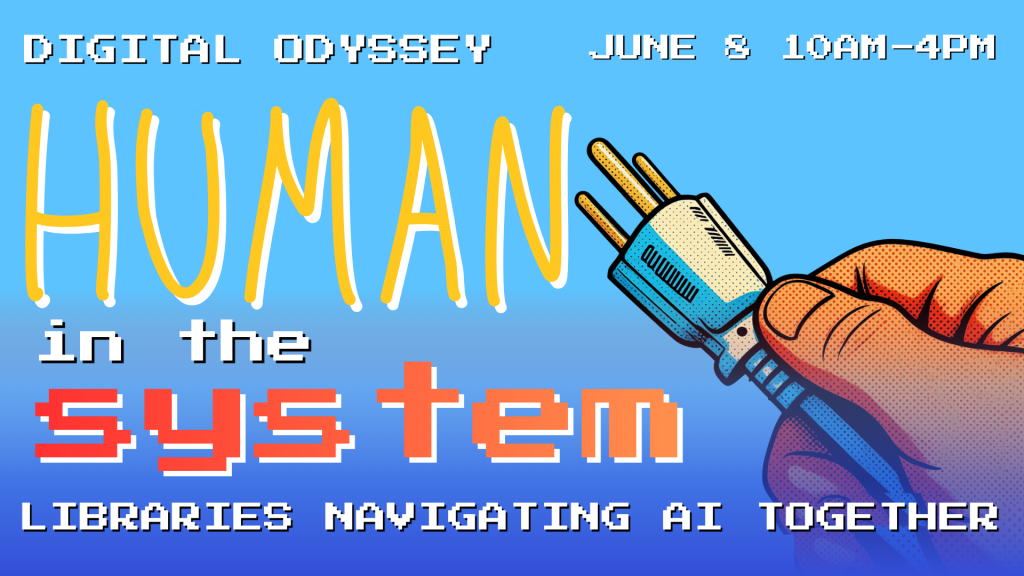
 When this blog goes live on Monday, June 8, it will be the date of the 2026 OLA Digital Odyssey conference. The theme of this year's conference is "Human in the System: Libraries Navigating AI Together"


When I was preparing a couple of talks related to AI for OLA's Digital Odyssey conference and as a guest speaker for AML's Media AQ, I started to wonder how many of these workshops or presentations I've done on Generative AI. I looked at my professional wiki where I record this kind of information, and I made a list. This is current as of June 8, 2026 and just focuses on AI talks.

  • 2023 - Fostering Primary Division Students Critical Exploration of Algorithms (Global Media Education Summit)
  • 2023 - Exploring Algorithms with Primary Students: Magic, Mystery and More! (TDSB Unleashing Learning)
  • 2024 - AI's Not a Bad Guy: Understanding Algorithms (OLA Super Conference)
  • 2024 - Teaching Teachers and Tots the Ins and Outs of Algorithms and AI (IMLRS)
  • 2025 - The Role of AI in Student Research (OLA Super Conference)
  • 2025 - Look Before You Leap: Testing the GenAI Waters in Elementary Schools (OTF Curriculum Forum) (RFTLOI)
  • 2025 - Support Without Substitution: How AI Tools Might Help K-8 Teacher Teaching Teaching Effectively and Ethically (OTF Curriculum Forum) (ECOO ExplorAItion)
  • 2025 - Unpacking Machine Learning (AML)
  • 2025 - Cultivating Critical Minds in a World Influenced by AI (UNESCO)
  • 2025 - Questioning AI: Building Media Literacy and Critical Thinking Skills (ETFO ICT Conference for Women) (ECOO Dream Forward STEAM Ahead)
  • 2026 - CSL Digital Media Toolkit: Smarter Together in the Age of AI
  • 2026 - Developing AI Guides for a School Board and a Country (IMLRS)
I thought it might be interesting to see which presentations became dated quickly, or if there were any ideas I shared back then that have changed or altered. In the end, I decided to make a "listicle".

My Top 3 Favourite AI Talks


#3 = Teaching Teachers and Tots the Ins and Outs of Algorithms and AI


I thought this talk, even though it was shared several years ago, still has relevance. It focused on some of my earliest action research on teaching through and about AI with primary division students. It has a great collection of student quotes and visuals produced by student hands as well as AI. The GenAI image generation tools have improved since 2024. One of the loveliest compliments I've received came after this talk, when someone said "I wish I could be a student in your class". 

#2 = The Role of AI in Student Research


This was a presentation that took a lot of time to prepare but was a lot of fun to deliver. Part of the joy came from presenting with my friend, Kim Davidson, at OLA Super Conference. The audience was filled with friends. I really like how Kim and I looked at GenAI at every stage of the research process and had practical tasks and questions connected to many aspects of inquiry. It's much more clear now what our school board's "supported" AI tools are and which ones to use than when we first developed this talk, so if we ever shared it again, we'd have to update that information, but it was a good one that I will sometimes refer back to myself when planning.


#1 = Questioning AI: Building Media Literacy and Critical Thinking Skills


There are several reasons why I consider this to be one of the best presentations I've given to date on AI. First of all, I had a nice long time to present, so I was able to incorporate activities for the participants to undertake (and I differentiated, so that people didn't feel like they were being forced to use AI against their will). I like how media literacy concepts are fleshed out, equity issues are brought to the forefront instead of being asides, and it ends with practical strategies for critical thinking that can be applied not just to Generative AI but to all media texts. I'm glad that I was able to really hone in on the ETFO AI guideline papers; if educators are going to use AI, they need to do it thoughtfully, with purpose, and in a way that does not demean the profession. In this talk, I had the opportunity to delve into some of my favourite AI subtopics, such as the problematic personification of AI and the distinction between "through" and "about". I was terrified when I gave this talk at the ECOO conference, because some "heavy hitters" that I really respect were in the room - Tim King and Heidi Siwak. I wondered what on earth my workshop could offer them when they are such experts in the field. They seemed to be satisfied, so I consider that a win.


I called this blog "The Evolution of my AI Thoughts". How would I say that my thoughts on AI have changed? I find it ironic that I am sought after by media outlets to provide commentary and lessons on AI, when I think I actually don't use AI that much. I've started to use it more than in the past, but I'm big on citing my use. I'm going to look at my use of Google Gemini at the end of the school year, and try to "make amends to the earth" for the amount of energy and water my AI prompts and queries have done. (This action is inspired by Mariana Spena from DDSB, whom I heard speak at the ECOO conference. Maybe my future post will need to be a list of my favourite AI talks that I've attended as a listener, rather than as a speaker!) There are times when people use it and I question whether it's the right choice. (After all, there are two writers in my family and I strongly believe their work cannot and should not be replaced by AI bots.) AI still makes me feel a bit superior, and I get frustrated by how often AI is embedded in tools where I don't want to use it (such as Blogger, or Gmail). If this is how things have changed from 2023-2026, I wonder what AI will be like in the next three years. Only time will tell. 

Monday, June 1, 2026

Documenting the Documentary Film Making

 Last Monday, on May 25, 2026, my school had the incredible honour of having a TVO film crew come to record footage for an upcoming documentary on media literacy education. It was a lot of work to prepare for their arrival, because many classes were featured and everyone involved needed special permission forms signed. However, it was a very educational experience for the students. I hope that they learned several things about the visit. Here are a few things I hope the students appreciated.

Many People Make Movies

We had a team arrive at our school to collect footage. Everyone had a role to play.

This reminded me of the drawings I commissioned my daughter to create long ago to show the different jobs involved in the film industry. (I'll see if I can find it and include it here in the blog post. ETA - I couldn't find the file in time to share here but if I locate it, I'll add it eventually.)

Jen was the Production Manager. She kept the crew organized. She handled all the bookings and the paperwork. It was Jen that collected all the permission forms. She managed the logistics and schedules.

Kevin was the Producer and Director. He had the vision for what he hoped to see. He instructed the rest of the crew about possible shots and whom to film. Kevin watched the footage and asked questions of me and of the students.


John was the primary camera person. He filmed the video using a huge camera. He'd line up shots and recorded from several different angles using different lenses.


Chris was another camera person. He collected "B roll" footage as well as different angles to complement the ones John collected.


Sanjay was the sound technician. He carried around the long boom microphone and hung it over students when he needed to hear them better. He also wired me up with a body microphone so I could be heard.


Nathan was the assistant. A recent graduate of Seneca and York, Nathan offered help to John and Chris with batteries, wires, lenses and other equipment.

Everyone was important to the process and worked long and hard.


Lots of Time, Lots of Tech

The team from Primitive Entertainment Inc. (the ones filming on behalf of TVO) arrived at 8:10 a.m. and didn't leave until after 5:00 p.m. They had a trolley full of technology. The students were fascinated with the fuzzy cover on the microphone (there to stop rain and wind from interfering with the sound quality), the big lenses (which they had to avoid staring directly into because it ruins the shot), the tripod and term I forgot (half mat?) that held the cameras steady for longer periods of time, and Kevin's viewfinder that showed him what John was shooting. One of my students kept saying "pictures, pictures" when he saw the crew in the hallway.


When the students asked about when the movie would be ready, Kevin explained that it should be finished by next school year. This could be anywhere from September to June, but Kevin and his team had many schools to visit and, if they filmed as long as they did at my school, there would be a lot of footage to sort through and select for the final project.

Filming Doesn't Always Go According to Plan

We had a schedule of classes to see and moments to capture, but sometimes circumstances altered the plans. Sometimes a tangential comment would lead to interesting questions, or something unexpected a student would say would interest the director and have the crew focus elsewhere. We were a bit delayed moving from the library to go to see some of the primary classes and record some of their reading instruction. Big thanks to Sheri Hajiani and Maha Ngo for agreeing to have the crew film them teaching.

Sometimes something would interest the camera people as they filmed extra material to use in between shots, so they'd film in the hall or outside. It caused a bit of a stir, but people needed to understand that close-ups were only of students with forms and outside shots were distant enough to obscure faces, and were primarily just wide-view filler content. The crew was very respectful and were extremely accommodating to the wishes of others in the building. We ran out of time with Room 113 and our own sound malfunctioned on showing a video, so they returned back to the library to "finish up" for an extra ten minutes of filming, and the videographers really seemed to like filming some unscripted interactions between me and the students as they began to write a draft copy of an email to an author. 

I expected that we'd "casually manufacture" a conversation around replacing a library tree book display during the second-last period of the day, (a clear connection to media) but instead, the focus for the time Room 112 was in the library centered on the students serenely reading and borrowing their books, while the director asked them questions about the books they liked to read. The camera man said he captured some great shots of the students blissfully reading with the afternoon sun streaming behind them. Even though Media Key Concept #2 is "Media construct versions of reality", and filming students reading (and asking them questions on camera) wasn't "natural", it was more "authentic" than what we had planned about the library tree. 


During my ESL class first thing in the morning, one of my mischievous students decided to put his name tag (that was originally attached to the props he needed to make his comic on Book Creator) and stick it on my back. I didn't notice until the director asked if I realized I had something on me! 

If/when I share this blog post on www.aml.ca, maybe I'll list all the Media Literacy Key Concepts and how they connected to the day. Let me end by saying it was a great experience. I hope that the footage they collected was useful to the project and that it will advance the cause of media literacy in the province and country.