Note: I'm going to break tradition and create two blog posts for this week, since there's too much content to cram into a single report.
Ontario Library Association Super Conference 2025
Building Bridges - Conference Reflections by Diana Maliszewski
Wednesday, January 29, 2025
8:00 p.m. - Conference Reception and OSLA / CSL Dinner
Summary: Although my conference experience didn't officially begin until Thursday, I drove down to attend a lovely dinner hosted by Wendy Burch Jones to assemble members of the Canadian School Library community together.
So What? Now What?
It was a delightful evening, with good conversations and the chance to renew old friendships and establish new friendships. I was grateful to sit across from Tim King (Ontario) and next to Harold Semenuk (Alberta).
Media Artifacts:


Thursday, January 30, 2025
8:15 a.m. - Let's Talk Tech Toys! STEM Learning in Libraries (Allison Jones, Delia Filipescu, Lindsey Krabbenhoft)
Summary: (copied from online program description)
Libraries everywhere recognize that play is vital to children’s learning. During play children build communication skills, expand their knowledge of the world, and learn to problem solve. STEM play is a valuable experience libraries can offer, especially for families who face barriers and do not have access to enriched play opportunities. Early exposure to STEM toys that spark interest in science and technology inspire today’s children, engaged in play, to become tomorrow’s passionate technologists. Both Greater Victoria Public Library and Vancouver Public Library provide low-barrier, in-branch STEM kits, toys, and programs that explore concepts such as coding, basic electricity, engineering, math and science. In this session, participants will share challenges and successes with STEM play at the library and STEM toy recommendations for kids and teens. Let’s chat about low-barrier models that help families discover new ways for their children to learn!
3 Key Points:
1) Watch your budget, since kids can be rough on supplies. Check out Value Village for ideas, or buy Tobbie (a cheaper robot you can buy at Staples), or simple supplies.
2) Batteries, charging, and cables are big issues for public libraries. Suggestions include charging the item before you lend it out or weighing your kits with a sensitive kitchen scale to determine if anything is missing based on the weight differences.
3) There are many high-tech and low-tech STEM play options. Some places have parents requesting less tech for STEM exploration.
So What? Now What?
I arrived a bit late to the session. I was familiar with some of the items they mentioned, such as dominoes, Make Do, Picasso tiles, Plus Plus, Spheros, Ozobots, coding mice, and the Indigenous-made balancing game. Some items that I wasn't familiar with included Yoto (an e-reader robot), Clixo Creations, Cubelets, and Cubettos. I will need to look into those options. There were a lot of public librarians in attendance, and I was able to reassure them that patrons still like to use Dash robots even though they are becoming more common in schools.
9:15 a.m. - The Role of AI in Student Research (Kim Davidson, Diana Maliszewski)
Summary: (copied from online program description)
AI / LLM programs are either lionized or vilified in education. What if the answer is neither? What if we use teacher-librarians and other school library professionals to accept both the flaws and fortunes of AI? Discover how to use AI tools for enhancing instead of avoiding learning and for critical thinking instead of indiscriminate accepting. Two teacher-librarians with extra experience in media literacy and civic education will lead some lessons on ways to use AI in the inquiry research project at all four stages. The latest school board policies on the use of AI will be shared, analyzed, and compared with the current Ontario Ministry of Education curricula.
3 Key Points:
1) Read the End User License Agreements and consult with your board's AI policy (if it exists) before using any AI tool, to ensure you are okay with the amount of data it takes from you in exchange for the service.
2) Use personally relevant examples, on subjects that the students are intimately familiar with, so that students can be the experts on determining the reliability level of AI tools at the accessing and processing stages of research.
3) Consider what you are evaluating when deciding (or co-deciding with students) what is an acceptable level of involvement for Gen AI in projects.
So What? Now What?
I'm particularly biased toward this session, since I was involved in presenting. This was my friend Kim's first time at Super Conference, and her first time presenting to this crowd. Friendly faces in the front row helped quell Kim's anxiety and it seemed like people enjoyed listening and learned something. We went off script - I had to recognize Tim King in the audience, a cybersecurity expert with an education background who is always getting me to think. He made me realize that my "video that made me speak Mandarin" still collected tons of content, even though I deleted all my accounts and contacts related to the tool. My next step is to make sure I post the slide deck to the OLA Super Conference website.
Media Artifacts:

10:45 a.m. - Can I Ask You a Question? Creating a Culture of Proactive Student Consultation (Courtney Lundrigan, Karen Munro)
Summary: (copied from online program description)
What can you learn from your users by asking only one or two questions? The Engagement and Learning unit at UVic Libraries sought to find out by using a two-question survey repeatedly with different groups. Our approach offered students a low-stakes method of providing feedback. In the process, we found an accessible, sustainable way to collect qualitative user data, which can be especially useful for those who are not assessment specialists. Though we work in an academic library, this approach can be replicated in almost any type of library. Our first year of surveying yielded a rich dataset that has allowed us to further collaborate with library colleagues and generated opportunities to connect with other academic and administrative partners at the university. Our session will share our process and outcomes to date. We will use Liberating Structures to facilitate discussion and reflection in this session.
3 Key Points:
1) Liberating Structures is a way to use strategies that encourage collaboration and shared thinking in different ways (see https://www.liberatingstructures.com/ ) (In fact, my Here's What / So What / Now What structure I use to share my conference reflections is listed as one of the Liberating Structures!)
2) Keep surveys short and simple, with small prizes like a coffee card or printer code top-up (for university students) and accessible ways to collect the data that can even do the transcription for you. (Relevant to university survey takers - by opting out of ethics approval and avoiding all those lengthy consent forms, you change the dynamic of the interaction.)
3) Pay attention to how you word questions; for instance, if you use the word "often", respondents may think you are interested in knowing about how many times a week and specific times, rather than meatier replies. Speaking of words, make sure you capture the responses in the survey participants' own words instead of paraphrasing. Recording "borrowing materials" when the interviewee said "renting equipment" may mean the same thing to you, but recognizing what words they say helps survey takers with next steps.
So What? Now What?
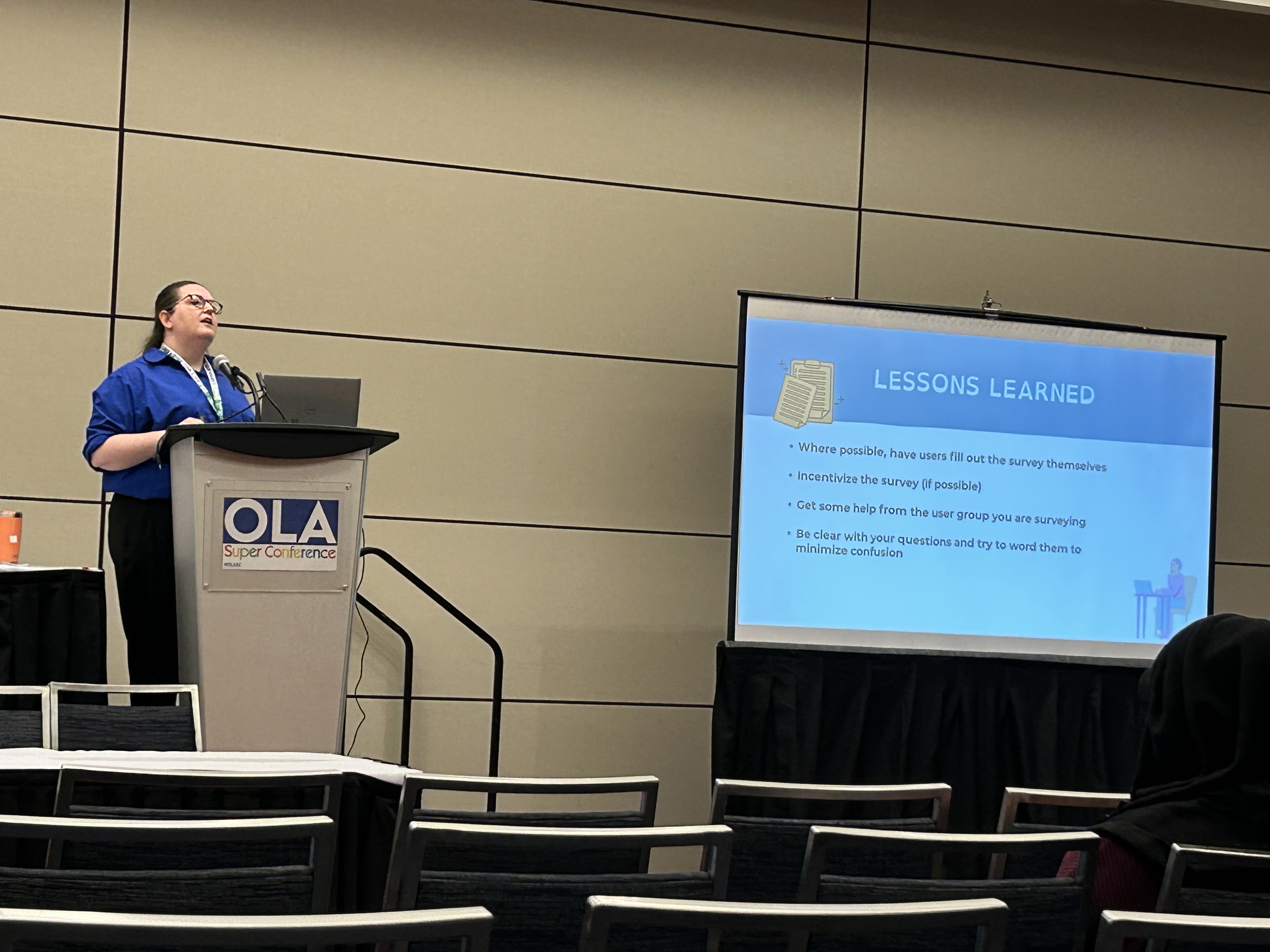
I am big into "through" and "about". I learned a lot about presenting from this talk and through this talk. It was also a particular gift to sit next to the amazing Jennifer Giffen (YRDSB high school TL) and see her in action, naming and noticing all the inclusive and strategic things that Courtney did in her session, from noting how Courtney made her slides with a dyslexia-friendly font, to using ZipCaptions.app, (a Canadian tool!) to caption speakers so she doesn't miss anything when listening to presentations. Courtney is so conscientious about every little thing she says and does in a presentation. I loved how she confirmed with people when she paraphrased or repeated their comment so that words from the audience could be heard by all: "Did I capture that?" When I went to go thank Courtney for the incredible quality of her presentation, she recognized me from when she did work with OSLIP!
Media Artifacts:
12:00 noon - lunch
Summary: In the past, I'd often forget to eat. After a quick tour of the Expo Hall, I crossed the street to grab a jerk chicken sandwich and dine in the speakers lounge with friends Kim Davidson, Leigh Sanger, and Jennifer Brown. It was so nice to sit, rest, and chat.
Media Artifacts:


2:15 p.m. Canadian Copyright Act and Accessible Content: Overview and Best Practices (Alexandra Kohn, Laurie Davison, Victoria Owen)
Summary: (copied from online program description)
The exception in the Copyright Act for persons with perceptual disabilities (section 32) recognizes fundamental human rights in the copyright regime, such as the rights to access works, to education, and to cultural participation. Libraries and other non-profit organizations work hard to ensure that accessible content is made available to users with perceptual disabilities by producing and distributing works in the alternate formats their users need. Understanding and navigating the requirements set forth by the Act is not always easy and confusion about these requirements and fear of making a mistake can represent a major barrier to these organizations in fulfilling their mandate. The presenters have put together a guide to clear up this confusion and provide easy to follow best practices. This presentation will introduce the major copyright issues in alternate format production, provide some context on the creation of the guide and walk the audience through the guidelines.
3 Key Points:
1) 27% of Canadians aged 15+ have some sort of disability (based on 2022 census) so making information accessible is both a human right and an equity issue.
2) There is a large number of items that are not available in accessible formats.
3) 3 main pieces of legislation / sections of the Copyright Act relate to making things more accessible: 32(1) from 1997, 41.16 from 2012 about digital locks, and 32.01 in 2016.
So What? Now What?
I hate leaving in the middle of a session. In fact, when I participated in the OSLA Slam about Super Conference tips and tricks, I said not to try and session hop. Kate Johnson-McGregor advised people to leave if a session isn't meeting their needs. This session was too advanced for me. I didn't understand things being said, and there were a lot of definitions. I snuck out to attend a different workshop. (Thankfully, Susan Ewing, who works in the Professional Library in my school board was there and she understood what was said.)
2:15 p.m. Keeping it Real: Featuring Books with Lived Experiences into Children's and Young Adult Fiction (Carlos Anthony, Liselle Sambury, Julie Thompson, Nadia Hohn, Sade Smith, Sarah Raughley)
Summary: (copied from online program description)
Own voices is a term that came into publishing lexicon after author Corinne Duyvis began using it in September 2015 to refer to books by “authors who openly share the diverse identity of their main characters”. After We Need Diverse Books (WNDB) stopped using the term as it placed “diverse creators in uncomfortable and potentially unsafe situations”as it has been used as a “catchall term”. However, might it be possible that the term still has relevance for Black Canadian authors. What is the insight about their lived experiences that they bring into their work? How can librarians consider their books throughout the year, not just in February? Join us for a conversation with members of Sankofa’s Pen, Black Canadian kidlit creators as they discuss their work and explore issues of authenticity, integrity, and appropriation.
3 Key Points:
1) Liselle Sambury expressed her struggle with finding belonging as a Black girl attending Queen's University (a very white institution) and the hypervisibility vs invisibility she felt in her fantasy book about a secret society and monsters.
2) Carols Anthony said he experienced culture shock when switching from a school with predominantly white students to one with Black students. This exposure to "regular Black" pushed him away from his Guyanese culture and identity but it also made him aware of how police would regularly harass students in the Rexdale neighbourhood, forcing them to carry their school cards to justify their presence in the area.
3) Julie Thompson is a police officer as well as a mother of two boys and an author. In her writing, she deliberately portrays adults who care to combat the stereotypes that Black adults neglect or do harm to their children.
So What? Now What?
This was a good reminder that Black fiction isn't just hardship stories of racism like The Hate U Give, but stories in Black horror, Black fantasy, and other genres. I don't have any real next steps from this session, except to try to read some of the books by these authors.
3:45 p.m. - All-Conference Keynote: Jael Richardson in Conversation with Catherine Hernandez
Summary (copied from online program description)
Thursday's education program will close with a conversation between two Ontario treasures: Jael Richardson, author and Executive Director of the Festival of Literary Diversity (FOLD) will interview best-selling author and screenwriter Catherine Hernandez. Novels Scarborough, The Story of Us, Crosshairs, and Hernandez's latest, Behind You delve into powerful conversations about community and the ways we heal. Discover how real-life events shape novel-writing and how fiction can help readers and writers navigate matters of humanity and social justice in this must-see discussion.
So What? Now What?
I didn't take any notes. I just let the words wash over me. Topics included how the body remembers and reacts to the environment, Hernandez' new book, Behind You, spoke about a time I remember, when a serial rapist and killer was on the loose in Scarborough. It was interesting to see how Hernandez refused to use the killer's name, both in the book and in conversation.
Media Artifacts:


5:00 p.m. - OSLA AGM and Awards Ceremony
Summary: The Ontario School Library Association's annual general meeting is always held at OLA Super Conference. This is also where the awards are distributed.
3 Key Points:
1) The winner of the OSLA Teacher-Librarian of the Year award is Johanna Gibson-Lawler from the Greater Essex County District School Board.
2) The winner of the OSLA Award for Special Achievement is Lynn Goodwin, and the OSLA Administrator of the Year is Rosemary Caruso, both from Halton District School Board.
3) The winner of the OSLA School Library Professional of the Year is the Library Service Team from the Near North District School Board.
So What? Now What?
This was actually a useful meeting. Wendy and Richard (OSLA P and VP) explained the changes to the by-law on council representation so we had an informed vote. It was fascinating that two of the boards that had award winners do not have teacher-librarians anymore, or very few. Johanna's speech taught me that if you are going to cry and need to hold it together, "just clench".
Media Artifacts:


7:00 p.m. - Social Events
Summary: (copied from online program description)
Time to celebrate! It’s the 30th anniversary of the Super Conference and we welcome you to join us at our annual Thursday social night social. Here is where we have in store this year. There is a little bit of something for everyone.
- Behind Door #1: Trivia! A fun interactive trivia night!
- Behind Door #2: Games! A games night featuring board games, puzzles and a space for Dungeons and Dragons. We will have a few games but encourage you to bring your own.
- Behind Door #3: Crafting & Cats! Back by popular demand we have our crafting corner. Why not grab a drink from the bar and bring your knitting, drawing, or crafting? There will be a space for you to sit with others in a low-key environment. Feel free to bring any other craft project with you. We will have lots of crafts for you to do as well! Come meet #EduKnitNight members LIVE! New this year: this room will also feature a viewing of #CatVideoFest!
Just looking to connect with others over a drink? We’ll also have a lounge and bar setup for those looking to relax and chat. Think of a pub with different rooms to hang out in depending on what you like and enjoy.
So What? Now What?
I attended the craft night run by my dear friend, Lisa Noble (assisted by Helen). My friend Sarah got a poem written for her about her by a group called Poesy. We snacked on hors d'oeuvres supplied by OLA. Sarah Wheatley and I left around 9:30 p.m., which is probably the earliest I've ever left OLA Super Conference. However, we didn't get home until 11:00 p.m. because the traffic on the Don Valley Parkway was horrendous!
Media Artifacts:


Friday, January 31, 2025
8:15 a.m. - First Look: CSL Digital Media Literacy Toolkit (Jennifer Casa-Todd, Joseph Jeffery)
Summary: (copied from online program description)
Canadian School Libraries is in the process of building a Digital Media Literacy Toolkit to bring together resources for school library learning commons to assist them with digital media literacy. The toolkit will contain annotated lists of resources, as well as strategies for teaching, good places to start and some background on why its a perfect fit for the school library learning commons. This will also be a chance for you to offer feedback and suggestions ahead of the formal launch. Shape how the toolkit will look - It's for you, so let's make it meet your needs.
So What? Now What?
I attended in order to support Joseph and Jennifer, since I am on the CSL Board now. To be honest, they had it all under control. This made me regret not attending my friend Juli's session, called Signing (in) the Library: Lessons from DHH Student Engagement in the School Library, but I have not yet mastered the skill of being in two places simultaneously.
Media Artifacts:


9:15 a.m. - School Libraries Spotlight: The Love Lettering Project: Making a Place for Placemaking with Lindsay Zier-Vogel
Summary: (copied from online program description)
Author, community-based educator, and creator of the internationally-acclaimed Love Lettering Project, Lindsay Zier-Vogel will share her experience using placemaking and community-building practices in libraries and classrooms across the country. Using her debut picture book, Dear Street, as the basis for engagement, Lindsay will explore the transformative power of writing letters to things we love about where we live, and how this practice can empower students, caregivers, librarians and educators. By reflecting on what works in our communities, we can celebrate and protect the spaces we share, and engage more deeply with our surroundings.
3 Key Points:
1) There's something special about letter writing that is better than just sending an email. Seeing your name in handwriting has power, especially in the handwriting of someone you love. Plus, it is a tactile experience to feel and open, and each letter has a "pause moment" just before it is opened.
2) When Lindsay offered pop-up sessions for people to write love letters to their city, she'd notice either enthusiastic writers or haters. Sometimes, like in student groups, they needed to vent and get the vitriol out before recognizing the good, because students have little to no agency about their city. Writing and hiding and finding the letters shifts your outlook; there's wonder and surprise.
3) Hiding the letters also makes it special. It's an act of "little activism" that includes personal nostalgia.
So What? Now What?
As part of this session, we received paper and envelopes to write letters to the OLA Super Conference and hide them in the Metro Toronto Convention Centre and Intercontinental Toronto Hotel. I helped Wendy distribute OSLA friendship bracelets that Lisa Noble's students made for the occasion, and I had the opportunity to meet and chat with Gabriella from Saskatchewan. (More on her later!)
Media Artifacts:


10:45 a.m. - Digital Media Literacy Skills in the Age of AI (Ken Boyd, Kim Davidson)
Summary: (copied from online program description)
New AI-powered tools have the potential to have a positive impact on students’ learning. At the same time, their ability to make mistakes, produce false and misleading information, and produce artificial content that is indistinguishable from reality has made the problem of finding reliable and trustworthy information online even more difficult. In this session, participants will learn empirically-based digital media literacy strategies that can be used to effectively evaluate any kind of information online, with a focus on content created by AI. Participants will use AI tools to experience how they can produce false, misleading, and biased content, and practice using lateral reading skills to determine whether text, photos, and videos were created by people or by AI. These resources are a new addition to the CTRL-F: Digital Media Literacy programming from CIVIX. All resources are free for educators, and available in both English and French.
3 Key Points:
1) Search Wikipedia for information on sources. Just delete everything but the main part of the website URL and add "wikipedia" to your search and see what it says about the source.
2) If a site does not have a Wikipedia page, use keywords and search for other sources of the claim (e.g. lateral reading).
3) Just because a source is created by AI doesn't mean it's necessarily bad, but we should teach students to prefer sources made by real people, because AI will make things up or confabulate information (e.g. adding information about Harriet Tubman to an article on Mary Ann Shadd Carey).
So What? Now What?
Kim and Ken did a great job presenting to a very full room. My next step is to register for CIVIX and promote some of their material when I present at the OTF Curriculum Forum next week.
Media Artifacts:


12:00 noon - lunch
Summary: I grabbed some lunch from Manchu Wok across the street and ate with Kim and Ken. Others joined us in the speakers lounge. I left to go find my principal, who came to the conference to attend the Expo and support me when I received my award - more on that in my TMC8 reflection post. I returned back to the speakers lounge to make sure that the folks that I was convening for were all set and ready to go.
Media Artifacts:


2:15 p.m. - Inclusive Tales: Augmenting Storytimes with Sensory Activities for Childre and Youth of all Abilities (Heather Kanabe, Katelyn Grader, Emily Bowes)
Summary (copied from online program description)
Partners Telling Tales and Hamilton Public Library together with consulting Occupational Therapist will explore the adaptations tested though the Inclusive Tales Research Project aimed at developing a new model for storytime appropriate for children and youth of all ages and abilities. Strategies used to create universal design for learning are applied to the storytime experience. Responsibilities for the outlined strategies are broken down by the event organizer, presenter, and onsite support. This model helps to create a space set up for success by preparing the physical space and introducing shared norms for operating within the space. It creates entry points for a broad set of learning styles through a set of different age-appropriate sensory engagement activities. Finally, it includes training for presenters and onsite support to provide individualized care for participants. Participants are invited into a space where they can self-select their preferred engagement and benefit from the author reading.
3 Key Points
1) Consider neurodiversity as a natural part of all of us. We are all neuro diverse in some ways. Become aware of your own accessibility needs.
2) One way to practice accessibility is to be clear about expectations: "clear is kind". Establishing "norms" (or "what to expect") about what is acceptable behaviour, and making it more open (e.g. "you don't have to look at the speaker at all times" / "you can move around the room") makes it inviting. If you do activities first, then invite to storytime if they wish (or listen as they do the activities), it means children can stay or go as they please and will be less likely to have a meltdown as they transition from task to task
3) To adjust energy levels, often it means addressing sensory input issues. This can involve many things related to gross motor play, touch, craft, and sound, like having presenters always use the microphone, doing nose checks ("this is loud" / "this is quiet" / "this is the level we will use here right now"), materials on tables or trays, establishing a quiet zone, or providing social stories.
So What? Now What?
The occupational therapist they included was so knowledgeable. I think I want to build a noodle story generator on a wire hanger for use in my school. I also like the idea of hiding ordinary objects in shredded paper and having students find them, or using cookie sheets for the magnetic boards. Maybe it's time to bring back out my StoryTime Bag!
Media Artifacts:


3:45 p.m. - All-Conference Closing Keynote: Carol Off
Summary: (copied from online program description)
We’re all aware of the toxic divisions in our society right now, stirred and amplified by politicians, Big Tech and click-baiting media. But there’s a growing movement that seeks to counter the rage-farmers and the chaos agents. These are people at the grassroots level who want to recover civil society and take back the conversation. While those at the top – seeking power and money – drive wedges between us, bridge-building shows us the path forward.
So What? Now What?
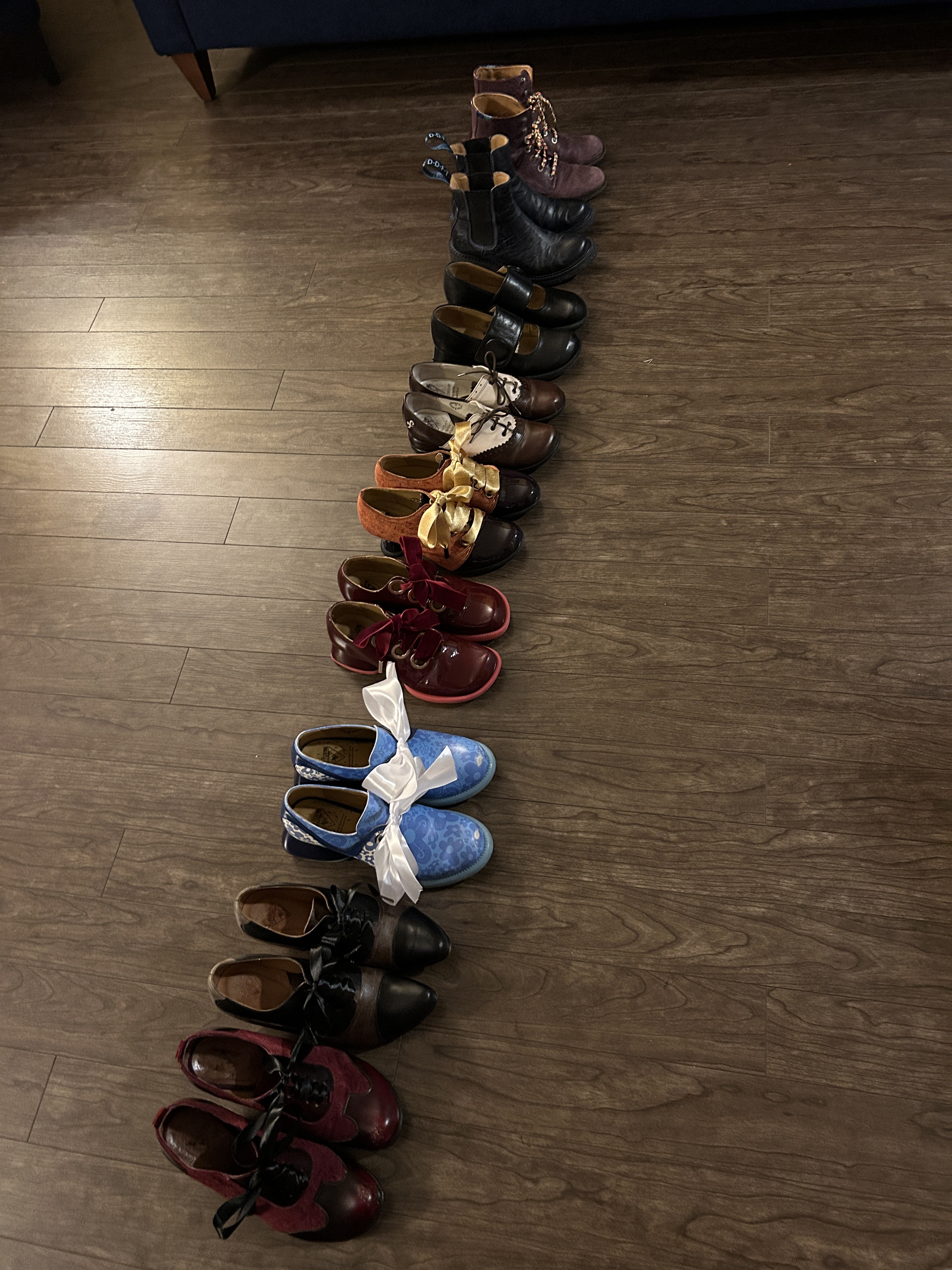
Last year, I went to the Fluevog store instead of the closing keynote. This year, I missed the closing keynote again, but for more noble reasons. I had to get ready for the Treasure Mountain Canada evening session. Moving throughout the MTCC (Metro Toronto Convention Centre) means you can't travel far until you bump into someone you know. I'm sorry I didn't get to spend more time in the Expo Hall (as there were some great authors I would have liked to have visited), and there were sessions I didn't get to see because they were at the same time as others, but I'll share my notes with my other TL friends that may have gone.
Media Artifacts:


But this isn't even the end! Read my next blog post, which reviews my Treasure Mountain 8 experience.