Monday, October 21, 2024

Happy CSLD!

 Today, Monday October 21, 2024, is Canadian School Library Day.

This is a busy time of year. It is also Media Literacy Week (October 21 - 25, 2024), which is near and dear to my heart both as the co-VP of the Association for Media Literacy as well as Canada's representative on UNESCO's Media and Information Literacy Alliance (North America & Europe chapter). I wrote about Media Literacy Week last year at this time on my blog. This time, I'll focus on Canadian School Library Day. 

Canadian School Library Day takes on added significance this year for me because I recently joined Canadian School Libraries, the organization, as an executive board member and as their lead editor for their publication, Canadian School Libraries Journal. I used to be the editor-in-chief for the award winning magazine for the Ontario School Library Association, The Teaching Librarian, from 2006-2018. I guess I'm returning to my volunteer "roots", so to speak. 

When Kim Davidson and I hosted a TDSB Teacher-Librarian Network meeting after school this past week at Banting and Best Public School (thank you Molly for offering your fantastic space!), we mentioned CSLD and brainstormed with the group about ways people could mark the occasion. I shared the idea that I'm running with for this year's event.


Monday will be a book borrowing bonanza! I've made arrangements with the board's library department to turn off my pre-set limit number and encourage students to come during both recesses (or use their library period if it falls on this day) to borrow as many books as they can carry. Usually, the library is open for morning recess only (because I need time to use the bathroom once in a while!). Usually students need a library pass (so that I'm not overwhelmed with an exceptionally large number of students in the space with me as the only supervisor). Both of these safeguards will be suspended for this single day. Have I lost all my senses? Is this a disaster waiting to happen? My friend Kim did point out to me that checking in and shelving these returns is going to be a real chore.


This is where I'm grateful for my newest adult volunteer. She comes in once a week for the afternoon and her job is to shelve books and keep the shelves in order. I won't name her here, because she is rather shy and does not want to advertise that she is doing this for me. However, she's already made such a positive difference - my book return cart isn't overflowing with neglected titles waiting to be returned to their homes on the shelves. It seems that she enjoys contributing to the school's well-being in this way. On Thursday, she brought me flowers from her garden and homemade banana chocolate chip muffins, to thank me. Really, I should be thanking her!


The library is so much more than the books - although they are definitely important. Originally, I was going to write today's blog on "STEM and stickers and swamps", so that I could discuss:

A) how the new STEM Lab (located in the library) is being actively used


B) how consumable items can really motivate students to learn (like my collection of stickers from the Sandylion Sticker Warehouse - even my principal remembers his days in the classroom with these and what a great resource this was for teachers at a great price)


C) how really energizing and delightful my recent co-teaching opportunities have been with the Grade 6s for social studies (where the swamp reference originates), the Grade 5s for science, the Grade 4-5s for social studies and the kindergartens for literary/numeracy/community. 


I'm going to resist writing at length about those three (save a snippet and a photo or two to pique curious minds) for now. I still have reports to write, assessments to complete, culminating projects to design, TMC webinars to rehearse, and TL AQ tasks to mark. The takeaway should be that school libraries are incredible hubs of learning and innovation that need the three pronged protection of strong policy, robust funding and equity of access as critical foundations for their success. Long live school libraries!

Monday, October 14, 2024

GenAI / LLMs in the SLLC

 Happy Thanksgiving to those who celebrate! I am unfortunately under the weather, so today's blog post will be relatively short and sweet. 


How do educators navigate the waters of LLMs (Large Language Models), more popularly known as Generative AI (Artificial Intelligence), in the absence of official guidelines and policies?

This is a difficult question to answer. What's allowed? What's ethical? What should be embraced and what should be avoided? (Heck, even the image that I included with this post wasn't made by me; Bitmoji put it together.)

This coming Wednesday, my friend Kim Davidson and I will be hosting a TDSB Library Network meeting and one of the topics we plan to discuss include AI. There are two recent examples I have that illustrate where we must proceed with caution and/or curiosity. 

Sound-Alike

At the OLA 2024 Super Conference, I attended a keynote session by Avery Swartz. One of the tools that she mentioned gave the ability for an individual to sound as if they were fluent in speaking a different language. I made a note to myself to investigate this particular tool.

I finally got around to exploring it. My first piece of advice comes from the AML - read the EULA (End User License Agreement). Even though these are boring and full of legalese, it is critical to understand what you are agreeing to when you use the software. In this case, the creators would be able to use my voice to train their program. I became a bit nervous about using it but was still fascinated, so I used one of my "junk" emails that isn't linked to almost anything to try it out. After making it, my next conundrum was to determine how to share it "safely". I didn't want it spread without context - which is why you won't see it on my blog. One of the AML key concepts is that audiences negotiate meaning, and I didn't want to give the "wrong impression" to others. I consulted with my administrator, and afterwards with two other teachers with expertise in technology education. They gave me some great advice which I will follow.

An interesting tangent to this story involves my son. He was interested in my process and offered to match my "lip flaps" to the words, so that it would look more realistic. I thanked him for the potential free labour, but I was actually glad to see that my mouth didn't match the sentences, so it was clear it wasn't me. When people upload videos to YouTube now, there is a section where the creator must identify if any parts of the video used "GenAI". I wonder how many people are honest about their use.

Collaborative Inquiry

At the 5th International Media Literacy Research Symposium, I attended a talk by Yonty Friesem, Estrella Luna-Monoz, and Irene Andriopoulou. In my "so what / now what" reflection, I commented that I wanted to replicate their cross-country study within my school board. I asked a few people at my TDSB TL Facilitator meeting and a few people, like Tracey Donaldson, David Hoang, and Dawn Legrow, agreed. Yonty very kindly forwarded us the prompts they used in his initial study and offered to be involved with our version too!

This venture is more about curiosity than caution. There are some tools that we'd be permitted to use with guidance in our schools, especially if they are part of a supervised, guided inquiry with our students. The purpose would be to show how LLMs can both help and hinder the writing process and to involve critical thinking when employing it in school tasks. When does it constitute cheating and when does it count as legitimate assistance? 

The same applies for teacher use. Can teachers use AI for planning, teaching, and/or assessing? If so, how much? How might student privacy be compromised if their work was inputted into a GenAI program for evaluation? We need to have frank conversations, not just about what's possible, but what's prudent.


This applies to teacher researchers too. This week and next week, I'll be part of two webinars, one for BCTLA and one for OSLA, on preparing action research papers for Treasure Mountain Canada 8, the Canadian school library think tank and research symposium. It's very important to "put in the work", as just last year, a researcher with TDSB was fired for using ChatGPT to generate citations that turned out were non-existent. I wouldn't mind having something reliable to check if I formatted my references correctly, as I'm notoriously bad at proper citation (ironic, considering I teach this as part of my TL AQs), but I think I'd rely on people (like my far-away friend Joanie Proske - who will be co-writing a paper with me this year). We shouldn't be ostriches when it comes to LLMs (even though I know it's a myth that ostriches hide their heads in the sand), but we need to go forth with an equal measure of curiosity and caution.

Monday, October 7, 2024

Total Physical Response

 Total Physical Response


On Friday, I completed my ESL Part 2 Additional Qualification course with Queen’s University. The culminating task was to share my inquiry project via a blog post. In the interest of being as authentic as possible, I’m sharing my project on my actual blog!


The Question


My question was “How might I use Total Physical Response to increase comprehension / communication with my MLL students?


Total Physical Response, or TPR for short, is a method of teaching language acquisition using a combination of words and actions. 


I had heard about TPR before but wasn’t sure about how it actually worked. I thought it would suit my particular teaching style. I like to use movements to reinforce foundational terms, such as “media” or “authority”.  I also thought it would be useful because, in my new role as half-time ESL teacher for the primary and junior students at my school, I noticed that I have a lot of students who are at STEP 1 in their English proficiency level. Those students seem to feel more comfortable speaking in Cantonese/Mandarin, because there are many students in the school who share the same language. I will not discourage the use of their home languages, but I still wanted to encourage more attempts at using English. In my AQ, there was much discussion on the “acquisition method” as well as the “learning (direct teaching) method” for language learning. How might TPR fit in?


The Literature Review 


TDSB’s Professional Library department helped me immensely in locating many peer-reviewed academic journal articles and studies connected to TPR. The creator of TPR is James Asher, an American psychologist who focused on young childrens’ linguistic interactions. He stated that young children learned how to speak by watching their parents combine words and actions to reinforce meaning. I read two of Asher’s actual studies (Asher 1966, Asher & Price 1967) and others that employed his methods from Turkey (Bulan & Kasapoglu 2021), Indonesia (Fahrurrozi 2017) and China (Tingting 2018, Rong 2021). The general consensus was that it seemed to benefit the students, although the Turkish study found no difference between using TPR or a more traditional grammar-translation method of instruction. Benefits included social-emotional ones, such as lessening anxiety and raising confidence, while learning.


The Further Questions


Good research often leads to more questions. I wondered if there were a set of specific actions that I had to learn. I considered how I could use TPR with students who were not beginners. How do we go beyond nouns and verbs? Is this TPR approach recommended? 


The Non-Academic Resources


I reached out to my friend, who was an ESL Itinerant teacher. He told me that our school board does not have an official policy related to the use of teaching with TPR (Khan, 2024). I also sought out some practical examples of educators actually using TPR. The ones that helped me were videos like from The Teacher Toolkit, NovaKid Evening Show, and Mooncake English. Seeing it in action helped, so I thought I’d put it into action by trying it out. 


The Action Part of Action Research


I decided to make some videos to demonstrate some of my attempts at using TPR with my students. However, their privacy is very important to me, so I created these videos after school without any students present. (Thanks to my daughter for being the videographer.)


  1. Stop & Go


I used this with some of my earliest-stage ESL students in Grade 5, and believe it or not, they loved it and it was the start of one of my most successful lessons with them so far this year! I noticed that some of the video examples I found on YouTube suggested that we co-create the action together. This is a great idea, but with this particular group, I needed to initiate. Because they need a lot of intensive support, I regularly withdraw them from class. When I took them out and we were walking to the library, I said “Stop” and ceased walking, and put out both of my hands. I found that I needed to do that, because holding up a single hand made them think/say it was the number 5, or ask for a high-five clap! I used “Go” as the word and the paired action was two index fingers pointed in the direction I wanted them to move. We interchanged “stop” and “go” a few times in the hallway, and then I asked them to “Say” (tapping my lower lip with my index finger) it as well. Each of the three students took turns saying “Stop” and “Go” while all of us obeyed the commands. I heaped praise on them and once we finally made it to the library, I gave them each three tickets (see here for my blog post on my ESL Increasing Oral Communication Initiative).


  1. I Like / You Like / We Like To Eat


Confession: when I did this with my Grade 2 ESL students, I didn’t have the physical objects with me. We made our “We Like” rainbow and needed to fill it with writing. In their notebooks, we planned on writing 5 sentences of things we liked and then choosing just one to write a “good copy” sentence on separate paper with pretty Sharpie markers. When I say “We” (not shown in this video), I make a circle-like motion to try and point to myself and the others we are talking about. I use the “thumbs up” action for “like” (even though I know in some cultures, the thumbs-up action can be seen as rude when performed a certain way). When we were brainstorming what we liked, I would confirm if we (as in, the entire group) liked a certain thing by asking, “Do you [point to the person I’m addressing] like [thumbs up] ice cream [miming the licking of an ice cream cone]?” Then I modeled “I [point to myself] like [thumbs up] ice cream [licking an ice cream cone].” The example I’ve recorded here includes an extra action, “eat” (fingers all together going towards mouth, with chewing lip movements if possible).


Even More Questions


As usual, there are still more questions I have. Back in university, I learned ASL (American Sign Language) and was close but never was certified in being Level 1. I wonder how much ASL could (or should) be used in conjunction with TPR. For instance, I know I have actions for “now” (point to my wrist like for a watch and then point down with my index finger in a single thrust)  and “later” (forming my fingers into an L shape and making a arc motion with my wrist and arm) and I think that the “later” sign comes from ASL.  I didn’t include this resource from the British Council for Teaching English but I liked the section on disadvantages. I still wonder how I could use more advanced grammar constructions as part of this approach; the examples provided from this website show more advanced work, but mainly for more advanced single terms (such as “ways of walking”) and I know from my ESL Part 2 AQ that grammar and syntax (things like English verb forms, the way questions are formed using complex verb transformations using auxiliary verbs, pronouns, conjunctions, etc.) can be really difficult for students learning English. 


I’m grateful that I completed this course. Big thanks to my instructor, Laryssa, and my fellow course participants Jennifer, Becky, Meghan and Ashley for their feedback and insightful posts.


Monday, September 30, 2024

Productive Professional Learning

 This past week, I attended two workshops. Often, school- or board-workshops can be dull or unfulfilling, but this was not the case for the two sessions this past week.

Wednesday, September 25, 2024 = TDSB TL Facilitator Orientation

What event would spur me to abandon my book fair in the middle of the big selling spree? That would be the TDSB TL Facilitator Meeting. It is so important to gather in person with other lead teacher librarians to understand the board priorities and plan the sessions we offer to other TLs in TDSB. Our acting Program Coordinator is Deb Haines. Deb did a great job of setting the tone - positive, while at the same time realistic ... purposeful and goal-driven, while at the same time personal with a dash of humor.


We also had a great review of CIVIX's Ctrl-F programs. The best part was hearing from all the other experienced TLs in the room and what they were up to in their spaces. A few of us stayed extra late to cross-reference the lists of new TLs with the new Family of School boundaries, so that we can reach out to the new TLs in our area to invite them to our upcoming meetings. 

Friday, September 27, 2024 = Robotics and STEM in our new STEM Lab


On Friday, we had a PA (Professional Activity) Day. The board gave us guidelines for what could be covered that day, but directed us to provide in-house learning. It was the perfect time to share with the educators in my school the brand new STEM Lab and all the things it has to offer.

This is not false modesty: I "co-facilitated" this workshop with the talented Matthew Malisani, but honestly, I maybe contributed about 5% of the planning for the morning. I added details to two of the 30 pages on the slide deck, I talked a bit during the presentation, and I set up the bulletin board displays in the STEM Lab. Matthew did all the rest. 

The first part of the morning was devoted to robotics. We introduced Dash Robots to the staff. The priority for this learning opportunity was for it to be hands-on. The staff learned the basics of operating the robots and then proceeded to try some challenges, such as knocking over a wall within a maze and using the robot to pop a balloon. Hopefully, we made it clear how differentiated instruction and Universal Design for Learning principles are easily interwoven into activities such as these. We also wanted to emphasize that the STEM Lab and robots are not just for teachers who have STEM in their timetables; it can be integrated into any and all subject areas. (I'm only posting photos without faces on my blog of this PD, since I didn't get permission from everyone to share.)


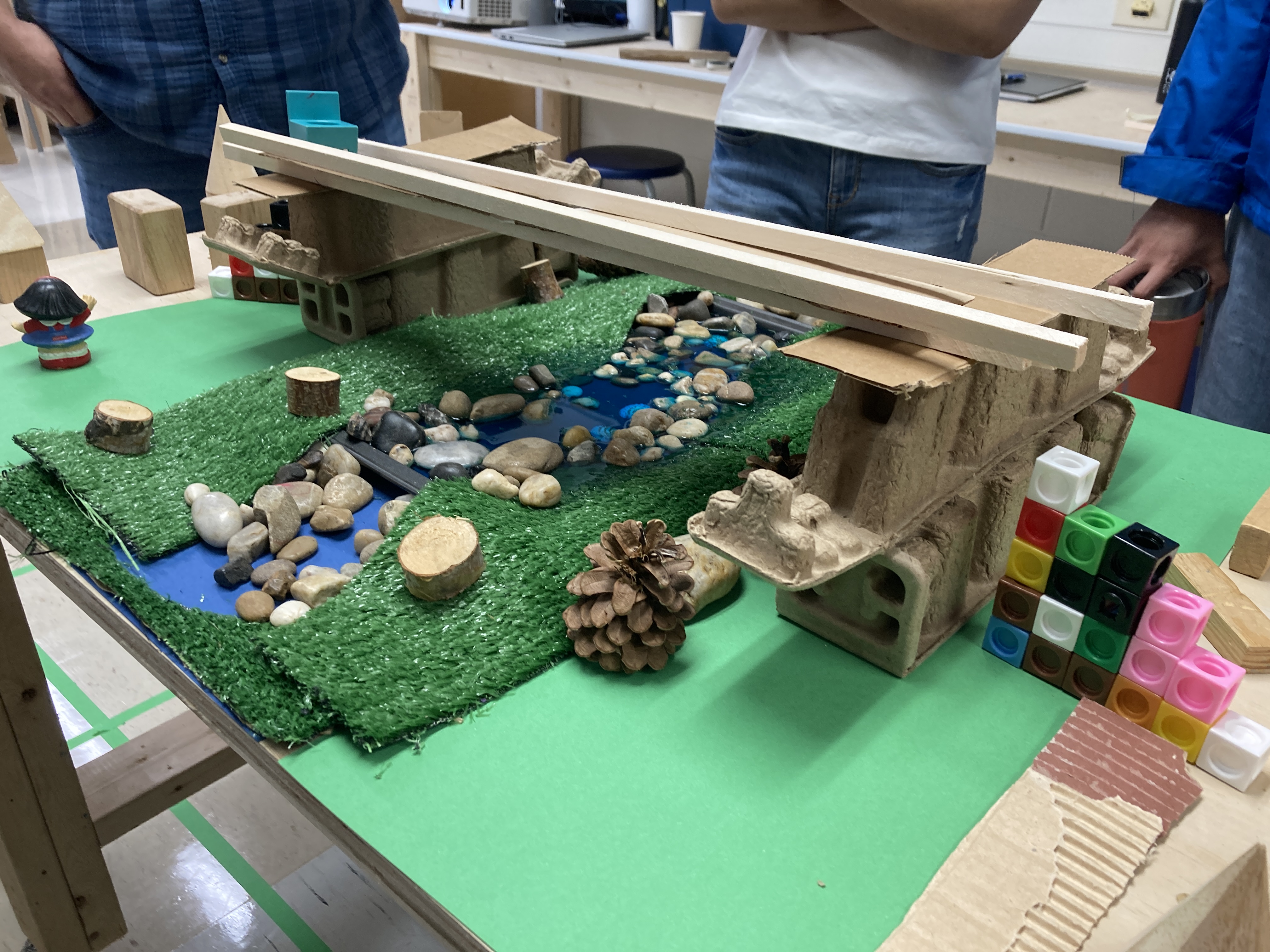
The second part of the morning focused on more low-tech tools. We are so lucky that Matthew is a former Design and Tech teacher. He led us through tasks that introduced tools like hand saws and c-clamps for construction. There were two challenges: first, build a 10 x 10 cm frame using jinx wood, and then, collaboratively build a bridge that humans can use so they don't interfere with turtle habitats but links two cities over a river. The accountable talk was delightful to hear, the varied products were amazing to see, and the level of collaboration was through the roof. People even stayed after the workshop was done so they could finish building their bridges.


People really responded well to the morning's agenda. They said that it was fun, engaging and helpful to know what was available. Some left the session bubbling with ideas about ways to integrate the STEM lab offerings in their upcoming units. Mission accomplished! Thanks to everyone in both the TL and AMPS workshops for their enthusiasm, planning and participation.

Monday, September 23, 2024

How's it going? STEM, ESL and Partnering Update

 I couldn't decide which topic to reflect on this week, so I thought I'd do a general reflection of the past three weeks with three focus points. (Can you believe this is the start of the fourth week of school already?)

STEM

I am teaching two classes of STEM, to both of the Grade 1-2 groups. I'm relatively pleased with how it's progressed so far. We've only had two classes, because of the way our 5-day schedule plays out. 

Our first class began with an anticipation guide, to see what they knew before we began about what STEM / STEAM was all about. I read the fantastic Ashley Spires book, "The Most Magnificent Thing", and then we built with Keva Planks. Our second class officially introduced the STEM acronym and we sorted elements of the Engineering Design Process on the blackboard. Afterwards, we returned to the Keva Planks and had a much more focused challenge: How might you make the tallest possible structure only using 12 Keva Planks?


I took many pictures, to use as observational data. Some of the students used more than 12 planks. Some worked together. Some worked independently. Some used the shelves to support their structures. Some created free-standing structures. I brought out a ruler to measure the builds, and I eventually had to bring out a meter stick, because many of their constructions were taller than 30 cm. I liked looking at how they used the ruler - some just looked at the ruler as a single, non-standard unit of measurement (e.g. "my tower is the same as this ruler"), whereas others looked at the numbers but not the units (e.g. "mine is 26"). 


I think that this coming week, we will look at the pictures I took and comment on the various builds, to tie in with the "improve" portion of the engineer design process. I was happy to see that this activity was doable for all students, regardless of language ability.

ESL

Being the Primary-Junior ESL teacher is new to me this year. I'm still taking my ESL Part 2 AQ to learn the ropes and I attended the TDSB "New to ESL" workshop. Because many of my students are at STEP 1 or 2, I withdraw small groups for direct instruction and support. I still haven't finished my reading and writing assessments yet. I had hoped that the tasks I had planned would be semi-independent, but that's not the case.

I've been really focused on encouraging their conversational English. We played a game I modified from the Tribes TLC energizer "3 Ball Pass" to work on pronouns and for the students to get to know each other. We also worked on a simple collaborative art piece that practiced our color vocabulary: painting huge rainbows that will go on display for Curriculum Night this week. The small groups brainstormed words or phrases that we will type and post with our rainbows in different languages; one example was ["Like a rainbow,] you are ____". 


I also explained an incentive program I'll be using in ESL. I do not want to discourage the use of their home languages, but I don't want them to rely purely on speaking their shared language with the other students in their ESL class. Therefore, I will be giving out tickets when I hear them speaking English or attempting to speak English during certain tasks. After two weeks, we will gather to have a lottery draw; I'll read out the numbers in English and if they have a match, they can win a prize from the prize box. For instance, while the paint was drying on our rainbows, I asked the students to help me look at photos / pictures of other students and then deliver them to the classes for the students to keep. We practiced asking each other "Who is this?" and the possible replies in English: "I don't know" or "That is XXX". We added the question "Whose class are they in?" and sorted the old photos into piles. We then decided on a way to address the teachers in the class with a rehearsed sentence ("Please give these pictures to the students who are in the photos.") Everyone made an attempt at speaking to the teacher. I have to praise my colleagues. They were so patient and encouraging. They thanked them for the delivery and often slowly asked the ESL students for their names. It was an authentic language task, made even sweeter with the potential for a tangible reward later on.

Partnering Units

You can tell I'm old - I still call collaborative planning, teaching, and assessing between the school library and the classroom(s) by the name used in the 1982 document, "Partners in Action". I am beyond excited that I get to have some collaborative teaching time in my schedule this year. If you recall, last year, I had to sacrifice all of my partner time to ensure that our MLLs received enough support from our ESL teacher, who was only allocated 0.5 in our staffing. This year, I have room in my schedule to co-teach and I am delighted. I've already launched a few collaborations.

Grade 6 Social Studies

Nelani Kokularajan is our Grade 6 teacher in the afternoon. She has already begun her social studies unit with a look at treaties. We did our planning over email and decided to use Gather in a way similar to what I did back in 2021 when I had my own class. Having two teachers for this lesson was definitely a benefit. Nelani captured the snippets of conversation we heard as the pre-teens seized land and conquered territory in a virtual world that they had just entered without instruction or direction. These are just some of the photos I took of what we saw going on. I can't wait until next week when we discuss and dissect what went on in that virtual space.


Grade 4-5 Social Studies

Our LTO in the Grade 4-5 welcomed the opportunity to collaborate, but asked if it was at all possible for her to get caught up on her diagnostic assessments. So I supplemented her current packages with some hands-on activities. I promised the Grade 4s that I would bring in the chain mail armor I own and work with them next time. This week, I pulled the Grade 5s aside and we played a game that I purchased while I was on my cruise to Alaska. This game was made by an Indigenous artist from the northwest. We had to balance salmon fry and salmon eggs on the back of the salmon. The students enjoyed the break from the pen and paper tasks. We only just began to discuss how we can determine culturally relevant themes from the game before I had to leave for another class, so I hope to continue that chat later on. 


Grade 5 Science

I am happy that I'll get to work with Brenda Kim again. We did this colossal collaborative lesson with our student teachers back in 2020 that was really impressive. This time, it's just the two of us, but it still looks like it will be rewarding. We used last week to sketch out our plans and this coming week, we'll tackle Expectation E2.5 from the Grade 5 Science curriculum and examine renewable and non-renewable resources of energy. I found this cool kit I bought ages ago that helps students build a solar panel system to collect, store, and use solar energy, so I plan on using it for my portion of the lesson. I wish we had more time to iron out the details, but there's only so much time in the day.


So, things seem to be going quite well considering it's so early in the school year. Of course, many of these plans will take a brief hiatus. The photo below will give a hint why the pause is needed.

Yes, the book fair is back! Wish me luck!

Monday, September 16, 2024

Food Unites Family

 I can't believe we've already had two weeks of school! This week, I attended a pair of events, one personal and one professional, that combined food and family perfectly.

Back to School Staff BBQ

On Friday, we had the most delightful lunch at school. Our wonderful caretaker, Jan-Michael, was the Grill King and coordinated, along with our principal, a Welcome Back BBQ for our staff. Michael personally marinated all the pork skewers himself for days. There was so much food - pork and chicken kebabs, veggie burgers for the vegetarians, green and potato salad, and watermelon and cake for dessert.


Can a school be a family? It sure felt like it at this event. All of our staff members were invited. We had our vision itinerant and social worker attend, as well as a teacher on maternity leave. We even had "extended family" come by - principals from neighbouring schools. They couldn't pass up a free lunch, especially one as delicious as the one served at our school!

I know my school board wants to recapture that "family feeling". This is why TDSB has, once again, renamed its internal organizational structure. No longer are there four learning centers and nearly two dozen learning networks. Now, we are in Ward/Family of Schools 21 in Learning Centre 2. You can see this post explaining the new configurations. Here's a map showing all the groups.


You can't just assemble people, call them a family, and expect the unit to operate like a family. You need to bond over shared experiences (or good food), care about each other, and have some kind of relationship. Easier said than done, but our BBQ really helped to connect us all in a comfortable, casual, social way. 

Visiting Cousins

My first cousin, Julian DeRyck, and his wife Ingrid, live in Arizona. They came up for a wedding this week and so his older sister (Helena) arranged a gathering at her son Mark's house. My husband and I attended and we enjoyed ourselves tremendously. Ingrid hadn't been in Canada for nearly twenty years. 


I remember Uncle Julian and Auntie Ingrid (there's an age gap between us, so often in West Indian culture, one uses the "Uncle" and "Auntie" labels more fluidly) so well. My mom used to like to muss up Julian's hair and Ingrid was such a beautiful bride. My sister and I had our ears pierced at Uncle Julian's house by a family friend, Joey, at the same time that their daughters had their ears pierced. I tried to find a photo of Julian and Ingrid's wedding, but the best I could do was a photo I took of their family at a different wedding from 1991.


I saw first cousins of mine that I also haven't seen for many, many years. Here's a photo I took on Saturday night of me and my first cousin Terrance. (He's 75 and I'm 52. First cousins in large families can have big gaps in ages - we almost look the same age; he looks great!)

It was funny how many family members said I was the striking image of my mother. When Terrance and his older brother Brian saw me, they greeted me with a wink and a "Hi, Gloria!"

Once again, the food was huge in quantity and scrumptious in quality. The location for the gathering was perfect. The weather cooperated so groups mixed and mingled outside and inside. There was no animosity in the air - only great stories and shared laughs. I appreciated hearing my relatives talk about their fond memories of my parents. Someone said my parents were very close to each other, "like batty and po". I know this expression but when I tried to find the exact meaning online, these were the closest definitions I found:

  • be as close as batty and po (or batty and bench) be bosom companions (batty being the Caribbean English folk term for buttocks).


("Wind can't pass between them" - i.e. they are very close.)

We used to have large gatherings like this in the past, but they became fewer and fewer. There are many reasons why they aren't as frequent. Families get bigger, live further away from each other, find it hard to have a location to fit/suit everyone and/or the "glue members" (the ones who seem to tie everyone together) die, leaving no one to arrange these rendezvous. I am thankful that we were able to gather like this, instead of at a funeral. As we departed, the common refrain was "We should do this again sometime."

Actually, it was at both events that everyone kept saying, "We should do this again sometime." True, true.