Monday, November 5, 2018

4 Things I Loved-Hated This Week

This week was a challenging one at school. Some of the challenges stemmed from situations and/or lack of communication. However, some causes of grief were specific "things" that I can also adore. What are these specific things about which I have such ambivalent feelings?

1. My "wobble chairs" and bean bag chairs


Why do I sometimes love them? - Students who struggle with staying still during a lesson really find it helpful to sit and squirm on the wobbly stools that I recently bought with my book fair funds. It can also be an easy way to show students my appreciation for them and their efforts, by offering them one of these "special seats" for a short time. Flexible seating can be a positive thing.

Why do I sometimes hate them? - Students fight over them constantly. I've tried to ensure that everyone has had a turn sitting on these alternates but it's mentally tiring to continually rotate students through. I wanted to get to a stage where we've all gotten the novelty out and then these seats can be for students who really need them, but we're not there yet. One student that I thought would really benefit from using the wobbly stool ended up standing on top of it and jumping off, which meant I had to lock the stools away in my office when his class came to the library. The bean bag chair was a donation from my son, who was dismayed to see that it had paint on it and was the worse for wear. The wobble chairs cost $100 each; I plan to get more to hopefully lessen the arguments, but that's a lot of money to spend!

2. My marbles


Why do I sometimes love them? - I was delighted with how the addition of marbles inspires students to be creative in their play. (See the post a few weeks ago about how students altered their Keva Plank builds to incorporate ramps when I included a marble.) I like how versatile and fun marbles can be. I bought a little book of marble games that I haven't even cracked open yet.

Why do I sometimes hate them? - Marbles are easy to smuggle out of the library, and some of my favourite marbles (that I bought while I was visiting my sister in Calgary last March) have gone missing (and have possibly been stolen). They roll all over the place (including under shelves) and despite having a specific container to live in, marbles get left in boxes and other unsuitable places, which means students often complain there aren't enough marbles available. Then there's a student who pushes things up his nose, so now we have to worry about having things that are small (like marbles and beads) around for him to pilfer and use inappropriately. It's literally and figuratively true that there are days when I've lost my marbles.

3. Lego


Who do I sometimes love them? - This is one of the most popular items in my Library Learning Commons Makerspace. Students of all ages can build anything. I can even include it in my library and media lessons, like I did this past week when I used Lego as "loose parts" and asked students to make different kinds of emojis. Here's just four of the many examples students made.


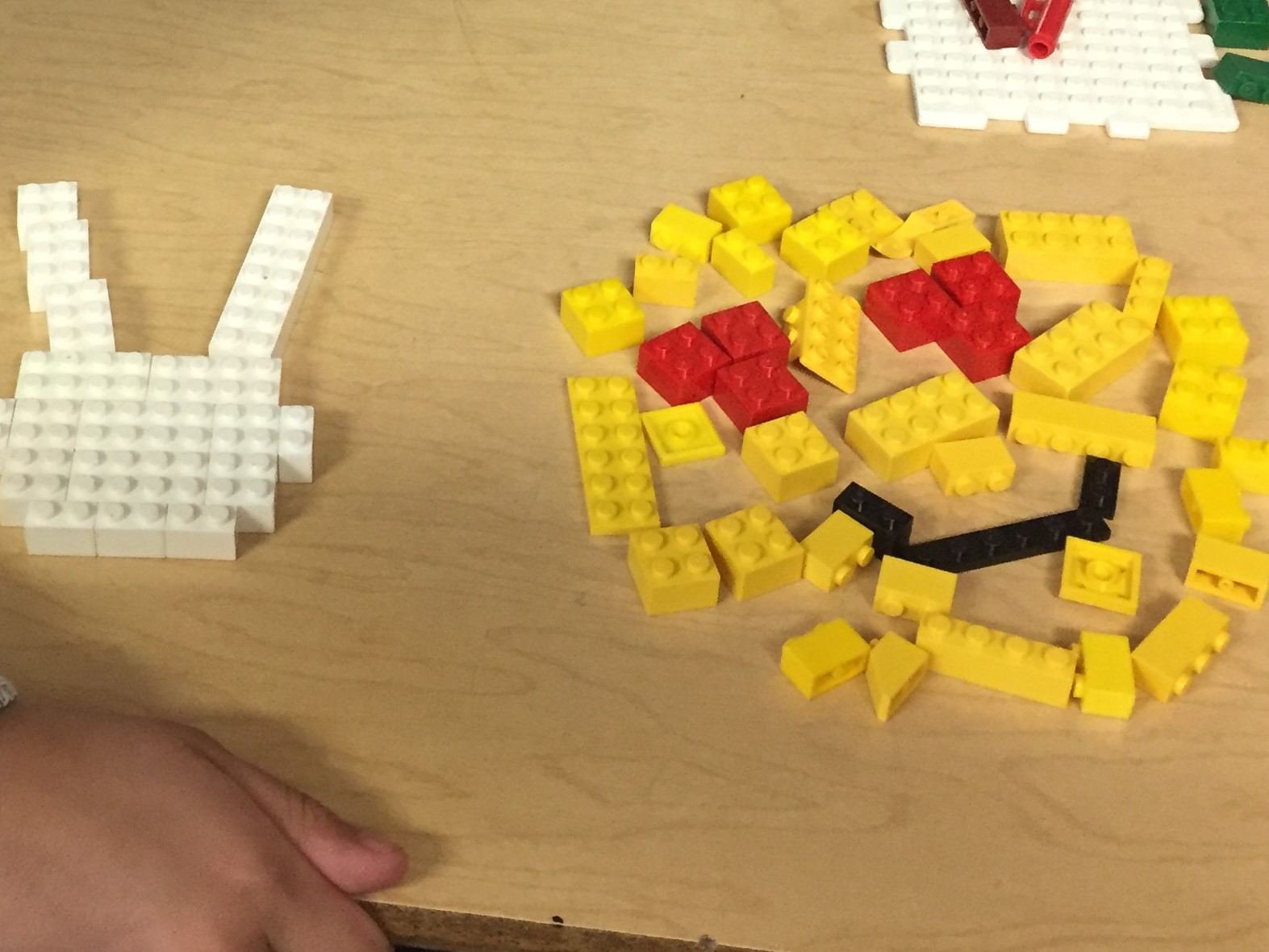


Why do I sometimes hate them? - I allow students to save their Lego creations on the tops of our shelves, but there's a time limit. I put the builds back after a week or two, and the creators are often irate that I've demolished the fruits of their labour, even though I've warned them that we can't preserve them forever and that we can take photos if they want. I find Lego pieces EVERYWHERE in the library, despite my best efforts to keep things tidy and remind students to clean up. With my emoji lesson, I received push back from students who wanted to stack and build what they wanted and not attempt the task at hand.

4. Halloween


Why do I sometimes love it? - As Doug Peterson has noted quite accurately, I adore costumes. I like making costumes, buying costumes and dressing up in costumes. It's fun and creative and playful. I love seeing other people's costumes too. It's a great holiday for taking photos. Plus there's the candy and the chance to see your neighbours as they bring around their children from house to house trick-or-treating.

Why do I sometimes hate it? - Aviva Dunsiger wrote a great blog post about how dys-regulating Halloween can be for some students (and adults). (This isn't her first post on the topic. Check this one out from the self-professed "Halloween Humbug".) Students can be wired and the routine is messed up. Emotions can run high, for students who get afraid of the scary imagery, or students who don't celebrate and feel excluded, or for students who are overly excited about the costumes or the excessive amounts of candy. We tried something new at our school this year, to try and combat the chaos. I'm not sure how successful it was; I really hope we take the opportunity at some point to analyze and discuss the change.

I don't really have any final thoughts on these four items that inspire such mixed emotions. There are positive parts to them, which is why I still continue to keep the Lego, marbles, and flexible seating around. And who knows - maybe "absence makes the heart grow fonder" and my upcoming two days at the ECOO BIT18 conference may rejuvenate me in unexpected ways.


Monday, October 29, 2018

DigCitSummitCA and the learning I choose not to share

On Saturday, October 27, 2018 I attended the Digital Citizenship Summit at OISE-UofT HQ in Toronto. I wasn't an organizer. I wasn't a presenter. I was *just* a participant. It was a pretty liberating experience.


Usually, when I attend a conference, on my blog I list the sessions I attended, a summary of the workshops, three key points and my "so what, now what" next step. I'm not going to do that this time in quite the same way. Why?

A) I did a lot of "session surfing" at this conference, because there were so many talks I wanted to hear and people I wanted to support with my presence at their workshops.

B) Not everything needs to be shared digitally. Some of the conversations that I had were chock-full of learning, but intensely personal and/or private. Consent and confidentiality are crucial concepts. (How's that for a lot of alliteration?) I still want to acknowledge that learning happened, and thank the people that made it happen, but I'm not going to reveal details of what was said. (This fits with Chapter 2 of that book I'm currently reading on documenting learning.)

9:00 - 9:45 am

Sneaking in this pic of T at TT
I was delighted to see how many people I knew as soon as I walked into the space! I didn't even have time to properly take my coat off before I was grabbed for a TDSB group photo! Teresa Allan (my Tinkering Thursday partner from just a few days prior) gave me an adorable "T-bird" that she made by hand. (The T stands for Twitter, Teresa, and tea, since she is my "tea mentor" who taught me how to make wise, healthy tea choices.)

I sat with Chelsea Attwell for the opening remarks, which were led by someone I'm honoured to call my friend, Jennifer Casa-Todd. As part of the whole-group beginning, Andrew McConnell came to give "community wisdom". I'm used to hearing land acknowledgements at the beginning of conferences but this was different. This was the first time I heard someone speak Annishnabek (did I spell this right?) with such a degree of fluency - and Andrew told us that this was his fourth language.

With TDSB friends, new and old (Julie, Larissa, Laura)

9:45 - 10:40

I had planned to attend a gaming session, but it seemed to be more of an introduction to a platform I was already pretty intimately familiar with, so I passed. Instead, I had not one, but two, fantastic conversations. Laura Collins, I want to thank you for your positive nature. Larissa Aradj, I want to thank you for your honesty. I am a privileged educator because I have the opportunity to access both of you virtually and in person and I'm grateful for it. I also squeezed in some time reviewing how to use a MicroBit with kidscodejeunesse and scored a free Bit to try out in my Library MakerSpace!

10:50 - 11:50

Being a session butterfly isn't all it's cracked up to be! I wanted to grab as much information as I could from as many different people, but when you are moving from place to place, all you can hope to achieve are little snippets of ideas. I spent a bit of time first in the session called "Where Does Media Literacy Fit In?" which was a panel with Michelle Solomon, Jane Mitchinson, Matthew Johnson and moderator Carlo Fusco. I heard a couple of good observations around algorithms and echo chambers, but I can't accurately report on the entire experience because I didn't stay long enough. I then popped into "Samaritans on the Digital Road: the OCDSB journey from Digital Citizenship to Digital Integrity". Bill Cocoran, the session lead, made me really think about the purpose of filming good deeds and how much humility and kindness could and should play a part. (Heads up - a friend who wasn't at the conference posted a reply to my tweet and I deleted my reply to her because it sounded too snarky and could have been misinterpreted as mocking the message - a valuable reminder that wry observations or dissenting opinions shared online should be carefully phrased so they don't accidentally offend.) I ended this time slot by visiting Annie Slater, Artemis Manoukas and Katina Papulkas as they concluded their talk on "Digital Citizenship of Staff and Students (and Parents too)".

Selfie with Katina and Annie


11:50 - 1:00

Lunch is still a time to learn! I sat down with a good TL friend who isn't in the GTA, Ruth Gretsinger. Time spent with her is always valuable. We had a great conversation that was wide-ranging in scope and content. Ruth, thanks for sharing all the many things you know and explaining to me things I didn't know.

1:00 - 1:55

I had planned on making this another "butterfly adventure" because I really wanted to hear Julie Millan's talk on "Go Google Yourself: Building an Online Presence" as well as Jennifer Casa-Todd's "Empowering Students to be Digital Leaders". Plans change, and I ended up spending the entire time at Diana Hale's focused discussion on "Integrating Digital Citizenship in Elementary Classrooms". This was because the people in the room - Diana Hale, Jessica Longthorne, Teresa Allan, Matthew Johnson and Carlo Fusco - had so many darn tweetable things to say that I couldn't go! I learned some great new phrases like "empathy trap" and "digital sunset". Literally every person had something wonderful to contribute. I'm going to share Diana Hale's continuum with my staff, since I need to extend my "tendrils of influence" further, now that our school's technology is decentralized and more class-based.


Chatting with Teresa, Jess and Diana


2:05 - 3:00

Being at a conference can be tiring, even if you aren't the one presenting. I took a break to visit the Pop-Up and Playground space on the first floor. I spoke with Tina Zita about some of the cool items she brought with her (including a retro phone receiver that actually plugs into all devices to use as a mic and headset). I then took a "people break" to catch up on the Twitter feed for the event. I snuck/sneaked into Carlo Fusco's session, "Taking Care of Your Digital Identity" for the last fifteen minutes and was able to learn something new even in that brief slot of time.

Check out the "phone"!

Photo with URL for Carlo's presentation
3:10 - 3:30

Our closing keynote was the effervescent, enthusiastic and energetic Olivia Van Ledtje. She's a youth activist and reading enthusiast - and when I say youth, I'm talking a Grade 4 student!

My own networking didn't stop with the end of the conference. I got to "meet" two people that I've known for ages but have never met in person previously. Thank you to Helen deWaard and Julie Johnson for delaying their departure from the conference so we could chat, if only for a little bit.

Diana and Helen

Julie and Diana
Thank you so much to the organizing committee for creating such a fruitful (and affordable) conference. I was reluctant to come, as I have report card comments to complete this weekend, but it was worth it. Thanks also to the people who talked with me, as well as the people I wanted to talk to but ran out of time to do it thoroughly or at all (Natasha Khakoo and Stephen Hurley, I'm looking at you two here!) All of you accelerate my learning!

Monday, October 22, 2018

Always room for improvement -for sleep sacks and library set-up!

Who was it that said "practice makes perfect"? It's not an accurate statement. It'd be more true to say "practice and people's pointers make progress". I have a couple of examples, both in and out of the classroom, to support my thesis.

Ernie in one of the sleep sacks I made

Sleep Sacks

I sew. It's a relatively new skill set for me, begun in earnest in 2016 with some tutelage from my mother, followed by a session offered by the Toronto Parks and Recreation department, first with a supply teacher, and then with my wonderful regular teacher, Natalie. I've made a flapper costume for myself, tails and ears for the animals in our school musical, as well as a replica of the outfit Joy wears in the movie, Inside Out. I've hemmed my daughter's prom dress, and attempted to make pajama pants.

My latest sewing project has been sleep sacks for my skinny pig. I used to buy them from someone online for $15 each. My vet told me that I needed to change Ernie's sleep sacks daily so that he would not get another foot infection - he likes to urinate and defecate where he sleeps, which becomes detrimental to his health when he sits in it for too long. I realized that I needed to try my hand at making these sleep sacks, so I would have enough to use. I consulted with Cathy, the lady who sold me my sewing machine, and owns a sewing store. I brought her one of the sacks I had purchased, which had been bitten through, to expose all the different layers. She instructed me on what each type of fabric was (cotton, batting, and a kind of fleece) and showed me the measurements to cut, how to stitch each square together, combine the squares, and sew everything together at the bottom and top. When I went to Fabricland to purchase the materials, which I got for a great deal, Patrine, the salesperson asked me what I was doing. She suggested that I sew all three layers together at once, to avoid having to make a fat connecting stitch at the bottom. I tried out both ways, and each had its drawbacks and benefits. One major snag to both methods was that the material was so bulky that it was hard to fit under the foot of my sewing machine. Still, I was able to manufacture six bags.

Six bags made, photo taken September 12, 2018

I signed up for the fall session of the Toronto Parks and Rec Sewing Class and I brought a couple of bags to stitch. Natalie had some fantastic advice for me.
  • stitch the cotton and batting together, and then afterwards stitch the fleece layer on - that way, if I confused the sides, I'd only have one layer to redo
  • use a different type of sewing foot - she switched my regular metal one for a see-through plastic foot that did not get caught in the batting
  • alter the stitch length, stitch width and something else (at a 4 setting instead of a 1) for bigger stitches to accommodate the fatter material
  • snip the ends of the fleece so when it's combined with the other bags, it won't bunch up at the corners
Natalie shows me how the new foot won't get stuck

Snipping edges to make it fit easier (Oct. 13/18)
I got so excited about these improvements to my process that I purchased more fabric to make more bags. My new bags were much better - but they weren't perfect. There were still gaps where the fleece folded over for a ridge opening. One of my fellow students who has been taking class for longer than I have (and whose name, for the life of me, I cannot recall but will add in later) came to look at what I was doing. She had additional suggestions - instead of sewing the fabric all the way up to the top, she said to stop where the batting and cotton ended, and then flip the remaining edges the other way to sew closed. Then, add a tuck and hem for a neater finished look. When I flippantly said that the skinny pig would not care what the edge would look like, R wisely replied that it's better to try to do our best with any project, even if we'd be the only ones to appreciate the effort.

Me flipping the material to sew the ends

No more large gap/hole in the sides

Tucked edge under and then stitched it

The newest bags, made Oct.20/18

So I took Natalie and R's advice and made seven more sleep sacks. They are way better - but they still aren't perfect. I can sometimes see the sewed-together-inner-layers peeking out of the inside of the bag. I'm going to put a hold on making any more bags for now, but I must say making several in a row definitely helped my technique. I've made sixteen sacks so far, including one I sent to a teacher-librarian colleague.

All but 2 of the bags I've made so far

Side, closer view - can you see the gaps & inside lining peeking out?


Library Set-Up and Routines

I have been a teacher-librarian for my entire career (which is 22 years and counting). You'd think that I'd have circulation routines and layouts mastered, but it's never perfect. I have several new teacher-librarians that I'm mentoring this year. One of them came to visit my library before school began. We were chatting about signage and I was reflecting critically (and a bit negatively) on my current shelf signage set-up and shelf labels. I liked how I use old textbooks wrapped in bright paper as section markers (an idea I borrowed from another TL) but disliked my messy and inaccurate tape labels that indicated what specific section of books were on that shelf. He offered a recommendation - why not try Velcro strips? That way, if I weeded or reorganized a section, I could simply rip off the old one and replace it with a new one. Simple, affordable, and brilliant!

I didn't want to make new labels until I had continued my never-ending weeding of the collection. (Pssst - here's a job secret - libraries need to be constantly weeded. I try to pick one section each year and slowly make my way through it.) I shared my plan with my adult volunteer, the amazing Mrs. Pat McNaughton (mother of another teacher-librarian, Kim Davidson). She liked the idea, and had one of her own. The dual language section was getting crowded and cramped. It didn't need weeding as much as it needed a different space. We talked and chose part of the periodicals area, which itself needs serious revamping. 

I also talked with Mrs. McNaughton about something new I'm trying but am struggling with implementing. In the past, when students forgot their library books, they'd be sent back to class to fetch their agendas and receive a "reminder stamp" to encourage them to bring back their books. Why not make bringing agendas just a regular part of the library routine, and increase the positive communication between the school library and home by providing a "thumbs up stamp" to indicate when students have done a great job of returning their books on time? This shift in routine has been bumpy. I'm transferring responsibility to the students by trying to have different groups of students a) check in the books, b) check the status of their classmates and stamp the agendas, and c) check out the books, but depending on the age and ability of the students, this goes slowly or with mistakes. Agendas are sometimes left or lost in the library. My library helpers, who work at recesses and at lunch, are trying to lessen the load by collecting books to check in during their shifts beforehand so the younger students have less to do. It goes more efficiently when Mrs. McNaughton is around to supervise the circulation desk and I can teach the lesson, but I can't monopolize Mrs. McNaughton's time, since I share her with her daughter (and adorable grandson, Henry).  

Generalized Lessons Learned

1) Things will never be perfect. Hubby and I talked about the difference between improvement and change (a common rally cry on election signs we see). I'm going to keep trying to improve and not change for change's sake. At some point I'm going to need to move onto other things that need my attention and accept my efforts as a constant work in progress. 

2) Getting multiple opportunities to try things helps a lot. I've made sixteen bags and still haven't gotten it to the point where I'm 100% satisfied. I guess that's true with sports or music too.

3) "How it's always been done" isn't always how it has to remain. This is great if it's working well, but what might one tweak do to make it even better?

4) Keep the celebration intact while still seeing where improvements can be made. I will try not to get discouraged that the sleep sacks aren't exactly to my specifications, or that the agendas aren't completed within the first 15 minutes of the 40 minute period. That's what makes revising and editing writing sometimes a chore - we forget to congratulate ourselves on what's been accomplished so far and focus instead on the many items that need correcting.

5) Getting advice from others really helps a lot. They provide different perspectives that can revitalize a project or process. I don't always have to accept every piece of advice provided, but listening to different points of view won't do any harm. 


Monday, October 15, 2018

Short Week, Tough Week, Unsolved Challenges

Why is it that shortened weeks seem tougher to complete? You'd think the opposite would be true. I had four days to rest, rejuvenate, socialize and satiate my appetite. (Thank you Jen S for the fudge!) However, not everyone enjoys the extra days at home and the transition back can be difficult. When I contemplate the past week and what stood out, it's specific students and certain behaviours that are sticking in my mind. I can't go into details, because I have to protect the privacy of my students. This is a list of the issues I've struggled with these past four (which felt like eight) days:
  • overhearing a conversation and making the phone call that every educator dreads [Tuesday]
  • being at a loss for words at a soaked classroom that felt like it happened in a blink of an eye (and where did all that hand sanitizer go?) [Tuesday]
  • preventing a student from self-destructive conduct and unusual, unsafe ways of dealing with frustration [Wednesday]
  • inviting a new teacher-librarian to my space and having her see a lesson bomb, as well as what might be considered "shaky class management" [Thursday]
  • witnessing students try to by-pass the library visit limits and not telling the truth initially when asked [Wednesday and Friday]
  • listening to outright defiance when asked to do reasonable (but maybe unpleasant) tasks [Thursday and Friday]
  • getting yelled at and kicked by a student because he didn't live up to the end of his part of an agreement [Friday]
I've been reading A Guide to Documenting Learning by Silvia Rosenthal Tolisano and Janet A. Hale (only Chapter 1 so far, because I'm trying to read it slowly and digest the messages thoroughly). I was pleased to accidentally discover that I already did the Chapter 1 Action Step because the post from two weeks ago as well as last week's post were actually examples of turning "documenting OF learning" snapshots into "documenting FOR learning" artifacts. It has also confirmed that this blog is my own "documenting AS learning" because it is a metacognitive process. There's strategic preparation involved ("what was memorable? what's on my mind? what do I need to puzzle out?") and it helps me immediately ("Aha! As I wrote it out, I can see the situation and possible next moves more clearly!") and over time ("So that's what I was thinking before, and yeah, I can see why X must change or Y must stay the same") and now I like getting comments or suggestions because it's easy for sharing and obtaining feedback (which wasn't my original purpose for blogging but has become a valued part of it). (The underlined words part of the key words from page 11 which describes "documenting as learning". The one part this blog doesn't fulfill in this description is that it isn't completed while it is happening, as least, not when the incidents themselves are happening.)

But this blog, this documenting, ... me - I don't have any answers to these current dilemmas. I want to fix things but things can't always be remedied quickly or completely. I've read Stuart Shanker's Calm, Alert and Learning and I realize that some of our students are disregulated in many of the domains. I remember that I cannot control students but I can control my reaction to students (and that varies - sometimes I react calmly and professionally, but not always). I'm grateful to our SNA, Stephanie Paterson, because I can talk to her and the conversation always moves away from venting ("Can you believe what that student did?") to problem solving or what Renee Keberer likes to reframe as solution-finding ("So what can we put in place that will lessen these outbursts and ease transitions for those students?"). Our specialist teacher PLC will focus on helping our students self-regulation skills, and I have a ton of new books to read (like the Minds Up handbook and Lost at School, a book Stephanie highly recommended.)

Back to Guide to Documenting Learning and these particular students swimming in my head. Tolisano and Hale tell me to "keep the sharing short [and] be conscious of privacy concerns" (page 21). A few pages back, they list samples of documenting learning purposes, asking if the documenting action:
- supports growth?
- moves learning forward?
- tells a story about the learning?
- gives learners a voice?
- causes ownership of one's learning?
- creates opportunities for feedback?
- encourages reflection and metacognition?
- makes meaningful connections to future learning?
- supports collection through curation?
- encourages community communication?
- embraces communication with a global audience?
- creates professional learning opportunities?
I despaired that today's blog post couldn't move the learning forward and was unable to engender community communication (since I can't go into detail with a wider audience). Yet, the act of writing them down in that list, thankfully, refocused me and told me that documenting via this post of my struggles (and the students' struggles) doesn't require that it meet all twelve possible purposes. By showing I'm not perfect (something I'm still surprised that others think of me) and wrestling with these situations, I guess I am taking ownership of this problem and am determined to try finding solutions.

Before you think my entire week was a complete disaster, (and three brutal Cross-Fit sessions didn't help to improve my frame of mind, I gotta say) let me end it on some positive notes.

1) The students are still enjoying the Keva planks and working together with incorporating marbles or trying to extend their structures as far off a table as possible. They are the ones that tell me that I must take photos of what they've made. (Great beginnings for a documenting learning mindset, I suspect - I don't know, I haven't gotten that far in the book.)  The Larkspur Library Learning Commons liked my tweet/post about the Keva plank challenge and have been sharing their own experiments with the challenge.


2) Ernie the skinny pig inspired soft voices, nurturing actions (like kindergarteners feeding him lettuce leaves) and great inquiry questions. One class were so calm and careful that I had them hold Ernie in his sleep sack while I cleaned his cage. They were delighted that they were given this privilege and really treated him with gentle kindness. I had never been confident about allowing this sort of responsibility with such a young group of learners before. (They were between 8-9 years old.)


3) I saw Jennifer Orr's blog post and was inspired by it. When I was writing a "good tattle" note in a Grade 4 girl's agenda, she told me that I should write one like it in some of her classmates' agendas too, and recommended someone and the reason. My heart melted!


4) "Miss Landra", our orientation and mobility teacher with the Vision Department, taught me a whole lot about how maps differ for people who are blind. She modified a library assignment I had for the student she works with, and the two of them explained to me how the assignment was completed and why the map has the structure and features it contained.


5) Our Grade 3-4 teacher, and I (with the amazing Stephanie Paterson) are working on a collaborative unit that incorporates science, language, and visual arts. I appreciate that this teacher values "Library Partners" time and was willing to shift her schedule to make it work. When we first explained the project to the students, many didn't understand (and this was confirmed when we did "exit tickets" with the students). The teacher [name removed upon request] and I talked, and we re-did the lesson, based on the students' feedback to us. It went so much better, and the students now have a better understanding of what they will do and how they can accomplish it.

I hope next week will have more examples like the ones closer to the end of the post and less of the examples listed at the beginning of the post. Truth is, we handle what we are given, like it or not. My hope is that my actions help lead to the positive instead of the negative.

Monday, October 8, 2018

Ped Doc

Ped Doc - my friend Denise Colby's short hand phrase for pedagogical documentation - is a
process for making. pedagogical (or other) work visible and subject to dialogue, interpretation, contestation and transformation.” ( Dahlberg, 2007)
The Ontario Ministry of Education put out a good monograph in their Capacity Building Series about pedagogical documentation, found at http://www.edu.gov.on.ca/eng/literacynumeracy/inspire/research/CBS_Pedagogical.pdf

This past week, I took a ton of photos as different student groups from varied classes explored the Keva planks I had out in my Library Learning Commons.  These photos and videos help tell an abbreviated story about what students were doing, how their plans changed, and gives a glimpse into their thinking at the time. I promise, I *actually* do things other than build with Keva planks in the library!

Sample 1: Grade 8s After School 
On Thursday, October 4, I experienced some technical difficulties with loading Minecraft on my school Mac computers (after running it without any major problems since 2012). The club members present decided while they were waiting to build a tower that was taller than they were, and mimic one of the builds they saw on a Keva plank card that came with my new set of 200 planks.


Sample 2: Kindergartens After Teamwork Read-aloud
Aviva Dunsiger responded to last week's blog post with many great questions. I was motivated by two of them in particular.
How might the addition of another materials (e.g., LEGO or a different kind of block with the Keva blocks) change the building?
How do the reduced group sizes help with this kind of parallel play? 
I decided to read a non-fiction book about teamwork to the kindergarten classes, and then give a limited amount of planks (only 20 per pair) to build whatever they wanted. Then, after a few minutes (and inspired by someone's initial build) I gave each pair a single marble. It was neat to see how the structures morphed into different creations and how they were inspired by their classmates to alter their designs. The photos here are just a very quick peek at what happened after the marble was introduced.

2A) Room K2 - A pair built a well-supported ramp, and another pair tried using their breath to move the marble on their structure. One pair started with parallel play but then gravitated towards each other to share their planks so they'd have more.


2B) Room K1 - One team decided to use the library shelf to make a tall structure. Many kept their original structures and then explored how the marble could be incorporated into it.


2C) Room 110 - Structures changed from flat roads, to roads with walls on the side, to slanted roads with walls on the side (tilted with more planks or with other found materials like the "black border" we use to keep a safe distance from the rocking chair). Purposes other than rolling were also explored, such as balancing on the top of a structure, or propelling out of a hole like a cannon. The last picture I took was inspired by a comment by the ECE in another class, who marveled about the way students figured out how to carry many planks. I wouldn't have thought to document this had it not been for Thess Isidro's comment. These two students chose to put planks in their pockets to carry them around!


Sample 3: Grade 3s during free time
The Grade 3s finished their media task during class time very quickly and so I gave them the opportunity to build what they wanted with whom they wanted. Some went to the Lego area but many went to the Keva planks. They made many different things. They insisted I take photos of what they built, especially because they couldn't keep the structures around after the period ended.


Sample 4: Junior students sewing
I should have taken a photo of how they initially tried to pin cloth together! Some of the students were keen to make things with fabric at recess in our makerspace. After seeing how they pinned, I realized they needed a bit of direct instruction. After learning how to attach fabric together with pins, some students got a chance to stitch the material together. This is a Grade 4 boy sewing a square to make a bag.


My new (and typical post-conference-workshop) question is, "so what?" What do I do with these photos, other than share them with the classroom teachers, who will share them with the parents? Well, I was working on my Annual Learning Plan and the major project that I've been working on for 8 years has finally come to fruition (publishing my research on readers choice awards programs in a peer-reviewed academic journal). I needed a new focus, other than my ongoing one on supporting our ELL students and providing assessment feedback in a timely fashion. I'll be doing some work on mentoring, but I've also committed to reading A Guide to Documenting Learning by Silvia Rosenthal Tolisano and Janet A. Hale as part of my professional learning this year. I also signed up for a TDSB online course on loose parts. I'm excited to see how my own use of "ped doc" can expand, grow, and become more effective.