
This was my first time attending an IBBY (International Board of Books for Young People) event. There was so much to report that I have to split the blog post into two sections. Apologies that my Monday musings came on a Tuesday! Big thanks to CSL for giving me and my co-presenter a grant that helped reduce the costs of registration.
40th IBBY World Congress (2026)
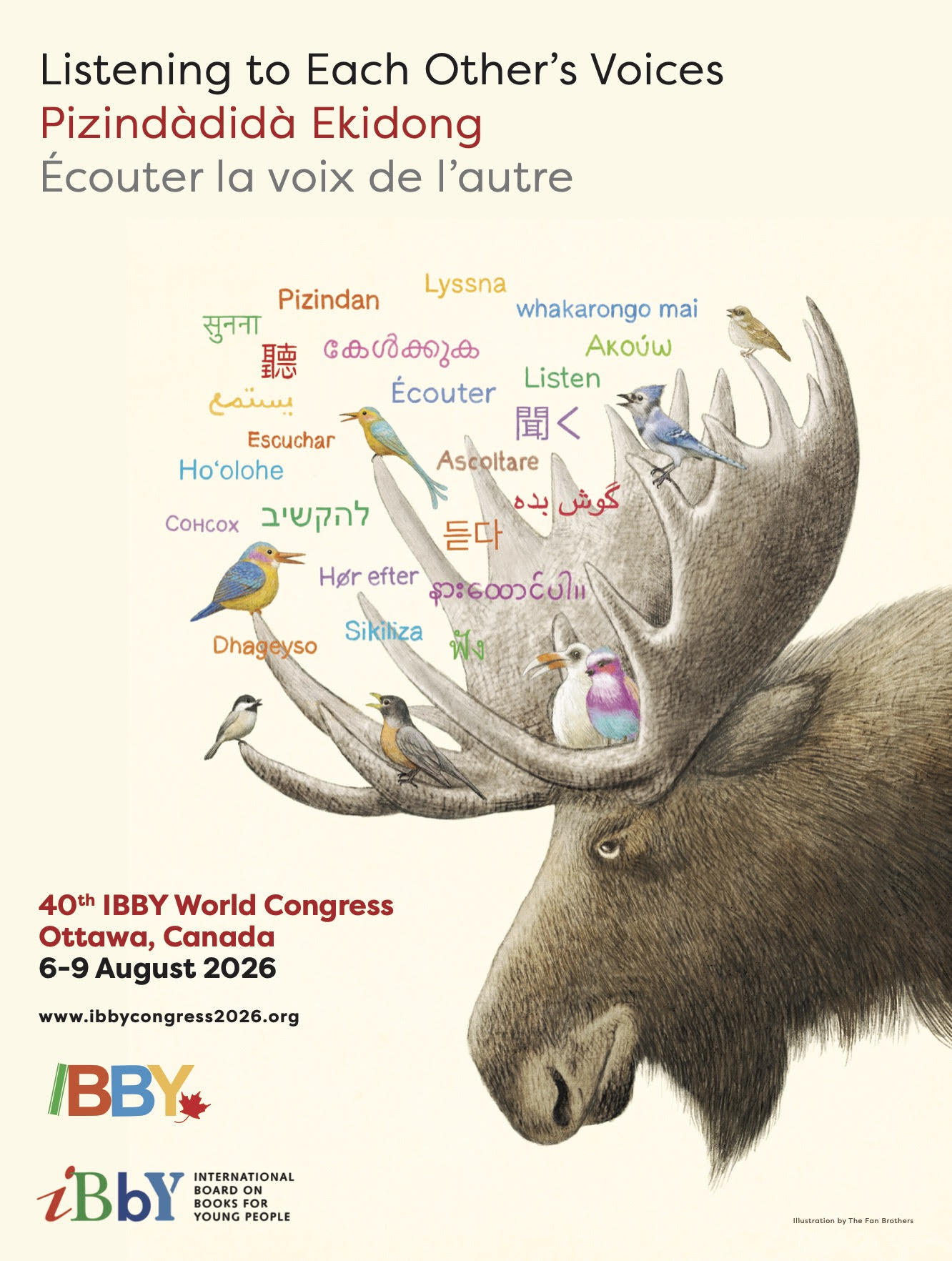
August 6-9, 2026
Conference Reflections by Diana Maliszewski
Part 1 of 2 Posts - Reports on Thursday & Friday
Thursday, August 6, 2026
6:00 a.m. - Sunrise Ceremony
Summary: (taken from program) Led by Elder Barry Sarazin,
the Sunrise Ceremony will take
place at 6:00 a.m. on August 6
at the Residence Quad.
During the ceremony,
participants are invited to
gather in a circle for prayer,
songs, and a smudge, which
involves the burning of sacred
medicines. Tobacco will be
offered and placed on the
ground as a way of giving
thanks to the Creator.
In a traditional ceremonial
context, women typically
wear long skirts. Women
are encouraged to wear
long skirts, if they are able,
however, it is not mandatory
for this event.
So What? Now What?
This was very early in the morning for me, so I wasn't at my most alert state. Also, the circle was four-people deep and Elder Barry (naturally) wasn't using a microphone, so I wasn't able to follow what he was saying. However, seeing the smoke from the pipe, hearing the drum (and the geese that dramatically flew overhead, honking their welcome) and feeling the tobacco in my hand that I used as an act of gratitude to the earth made for a serene tone and start to the conference.
Media Artifacts


8:00 a.m. - Opening Ceremonies
Jay Odjick
Summary: (taken from program) In the opening and closing
ceremonies, we will highlight
diverse voices from across
Canada (that will include
some familiar faces from the
Congress welcome video).
These voices reflect the
richness and expansiveness of
the conversations we hope will
unfold throughout Congress.
3 Key Points:
1) Ottawa means trading place, so it makes it a suitable setting for this World Congress, where representatives from 60 countries can gather and share. Ottawa's mayor Mark Sutcliffe proclaimed August 6, 2026 "Children's Literature Day" in Ottawa to recognize the importance of this gathering; it is the very first time that IBBY Canada is the host.
2) Jay shared several facts about Canada, including that the Algonquin term for poutine translates as "heart explosion".
3) Although we have made a lot of progress (such as the collaboration between Jay and Robert Munsch for their picture books, Blackflies as well as Bears for Breakfast) there is still a lot of work to do. Jay told a story about an interview he did when promoting the Bears book and how the interviewer reacted when he talked about eating bear. We also need to build the infrastructure for the Indigenous writing community and find new ways to listen.
Media Artifacts


Monica Ittusardjuat
Summary: (taken from program) At the
Opening Ceremonies, Monica
will share the story Lighting the
Qulliq (Inhabit Media, 2019), a
wordless picture book showing a
grandmother and granddaughter
from long ago lighting a qulliq,
an Inuit lamp that provides light
and warmth to the Earth.
Media Artifacts


Senator Kristopher Wells, PhD
Summary: (taken from program) At
the Opening Ceremonies, Senator
Wells will provide a spotlight talk
addressing this year’s theme of
Gender, Sex, and Sexuality in
children’s literature. As part of
the 40th IBBY World Congress, a
catalogue and exhibition titled
Reading with Pride: Stories for
Everyone will launch. Reading
with Pride features over 300
2SLGBTQ+ children’s picture
books, originally collected by
Senator Wells and expanded
through a call to Canadian
publishers.
3 Key Points:
1) Book bans are not about protection. They are about control and it's an attempt to control memory.
2) Translating texts is an act of cultural bridge building.
3) The hope is to move from defense to flourishing, and expanding possibilities.
So What? Now What?
Dr. Wells is from Alberta, which is significant for a couple of reasons; the majority of book challenges happen in Alberta, and to help support the school libraries and public libraries under siege in Alberta, Canadian School Libraries has chosen to hold the next Treasure Mountain Canada (TMC) think tank and school library research symposium in Edmonton. Our immediate next step was to invite the senator to attend TMC9. He's usually able to free up the weekends, so fingers crossed, he might be a guest!
Media Artifacts:


11:00 a.m. - Keynote
Sharing Stories: The Power of
Picture Books to Transcend by Sydney Smith
Summary: (taken from program) Sydney Smith’s picture books
have received wide critical
acclaim in Canada and abroad,
having been translated into
more than 20 languages and
garnered many honours. He
has twice won the Governor
General’s Literary Award for
Young People’s Literature—
Illustrated Books: Sidewalk
Flowers in 2015 and Small in
the City in 2019. Four thousand
copies of the former title were
distributed to Syrian refugee
families in Canada through a
special project with IBBY Canada
and the Department of Canadian
Heritage. In 2024, Sydney won
the Hans Christian Andersen
Award for Illustration—the first
time a Canadian has won the
prestigious prize in its nearly 70-
year history. He lives in Halifax.
3 Key Points:
1) Winning the Hans Christian Andersen Award impacted him immensely, but not always for the better. He say he felt pressure to now be "the expert" in his field, despite the fact that working on each book feels like it's his very first book. Internally, he felt confused and conflicted because of the expectations and reputation and what it meant to "be worthy". He says that insecure artists like himself never believe it when people say they like his books. Despite the fact that in picture books, the words and art work in tandem, illustrators often feel like the "plus one" or residual twin.
2) Picture books borrow from many text forms such as film, poetry, comics, yet picture books are unique in that they are made to be shared, to bring people together, to be spoken out loud through the voice of someone trusted, with lent words. It is the readers that have the "true ultimate power" (another creator told him that the magic is within the mind of the child, and as Sydney says, without imagination, a picture book is just paper, ink, thread and glue).
3) After an ocean drawing activity, Sydney said that each one of us carries our own oceans, our own perspectives, and that's good. He used to think that he had to take out the locality for global success, but he no longer believe this; stories are "housed in particularity" and are vessels that carry the heart of a story. They echo universal themes and share emotional landscapes. We know each other through the stories we share.
So What? Now What?
Sydney led the audience through an exercise where he had us listen to a recording of an ocean, then had us draw it and share our drawings with our seatmates. It was nice to meet new people and "share our oceans". I related to the feeling of being "an imposter" despite winning awards. I will have to look to see how many Sydney Smith books we have in our library and add more!
Media Artifacts


2:00 p.m. - (Parallel Sessions) Hear the Future: Listening to Young Voices to Reimagine Children's Media for a Sustainable World
Summary: This was a panel discussion, featuring Jan Beaver (Anishinaabe Elder), Lisa M. Lyons Johnston (Global Publishing Consultant,) and Janis Nostbakken filling in for Annabel Slaight (ClearWater Futures Foundation)
3 Key Points:
1) Jan describes working at Firgrove P.S. in the Jane-Finch area of TDSB, with 30 kids in a Grade 5 classroom with varying abilities but the shared attitude that they were incapable of writing stories. She shared her cultural beliefs that everything is alive and that stones are the entities that remember all the stories of the past within them. While at an outdoor education centre, she had the students collect "story stones" at night (but first asking permission of the stone to take it and offering something in return) it helped release the stories for the children.
2) Janis describes how Annabel and the Clearwater Futures Foundation works with children and aims to have them be part of every stage of the process, not just at the end as a survey participant. Before they launched Chirp, Chickadee, and Owl magazines, they had a Grade 3 class make their own magazines as an exciting experiment, to see what was required in their planned nature magazines and the big answer to this was emotional connection. Future Chicken, the mascot of the Clearwater Futures Foundation, was invented by children who said they wanted to see how the actions they take today could make a positive impact in the future. It's more important to have students involved right at the start because it's more fun, authentic, and leads to revelations; consult and involve kids from the get-go to make better media.
3) Lisa spoke about the CitizenKid collection of books from KidsCan Press, with 26 books that operate with a United Nations Sustainable Development Goals lens. She says that production teams that have helped them make films and videos create a "virtuous circle" as it moves from one platform or media type to another. It's beneficial on another level too; at the KidsScreen event, Future Chicken was identified/voted as one of the top 5 IPs (intellectual properties) with the most potential. She mentioned the famous moment when 5 years olds interviewed the Canadian Prime Minister (Pierre Trudeau) and how the simple but powerful questions led to great insights; by offering many media tools, kids have access to different forms of expression. She encouraged us to go to where the children are on their platforms, to "follow kids into the future".
So What? Now What?
I was intrigued and buoyed by Lisa's references in her talk to media literacy, so I went to talk to her after the panel discussion. She comes by her media literacy knowledge honestly; her husband David is the president and CEO of the McLuhan Foundation!
One of the activities we did as part of the panel was select a stone to take home as our story stone and decorate it. Jan said we needed to spend time with our story stone, so that is one of my next steps.
Media Artifacts:


4:00 p.m. - IBBY iRead Outstanding Reading Promotion Award
Summary: (taken from program) The IBBY-iRead Outstanding
Reading Promoter Award
was established by the
Shenzhen iRead Foundation
and IBBY to encourage a real
commitment to the cause of
reading promotion in the hope
of spreading this dedication
to others around the globe.
Every two years, IBBY invites
nominations from the IBBY
sections that recognize
outstanding individuals who
are working to promote the
expansion and development
of children’s reading. From the
nominations the IBBY-iRead
Award Jury will select two
winners.
2 Key Points: (taken from program)
1) Kirsten Boie is a renowned
German author and a dedicated
champion for sustainable reading
promotion who has advocated
for equal access to reading
education for over 20 years.
Born in Hamburg in 1950, she
believes that access to literature
is essential for self-realization
and participation in society.
Her work focuses on creating
literature that meets the specific
needs of children, ensuring
that reading remains a viable
path for every young person in
Germany and abroad. Over her
career, Kirsten Boie has written
more than 100 books, many of
which serve as readers for first
and primary schools. Beyond her
creative work, she has published
numerous essays and delivered
talks on literacy to raise public
awareness and mobilize political
attention for the cause. She
actively participates in literacy
support programmes and backs
campaigns as a patron through
her Möwenweg Foundation. Her
commitment extends to Eswatini,
Africa, where she advocates for
children’s rights to read in their
native language.
Through her foundation, she
established the BOOKCRAZY
campaign as part of the
“Litsemba” project, a childcare
programme supporting 3,000 to
4,000 orphans and children living
in extreme poverty across 104
Neighbourhood Carepoints. In
addition to providing books, she
holds workshops for local authors
and supports various community
projects designed to strengthen
the children’s living environment.
Her extensive networking and
sustained advocacy have made
her a pivotal figure in connecting
resources to those who need
them most.
2) Namita Susan Jacob is an
educator and expert in disability
inclusion with over 35 years of
experience improving learning
access for people with disabilities.
As the Program Director of
Chetana Trust in Chennai, a
not-for-profit organization,
she develops locally relevant,
evidence-based solutions focused
on child development, health,
and inclusive education. Her
work places a strong emphasis
on supporting individuals
who are visually impaired,
deaf, or deafblind through an
interdisciplinary approach that
integrates design, education,
health, and technology. Under
her leadership, Chetana Trust
launched several impactful
initiatives, including the
Accessible Reading Materials
(ARM) Library, which promotes
reading and play through
community-created inclusive
content. During the pandemic,
the library expanded its reach
globally to over 100 countries and
received the ABC International
Excellence Award in 2023.
Susan also initiated the
“I Count” project to address
the overlooked visual needs of
children with multiple disabilities.
She has likewise spearheaded
the development of assistive
technologies such as Aditi, a noncontact switch, and Tactograph, a low-cost tactile graphic tool.
She has worked extensively
across Asia and the MENA
region, helping to build services
in communities, hospitals, and
schools. Holding a PhD from
UC Berkeley and San Francisco
State University, she is widely
published and continues to apply
her expertise to create practical,
inclusive solutions that ensure
equal access to education and
reading for all.
Media Artifacts:


6:00 p.m. - Celebrating Indigenous Voices Dinner
Summary: (taken from program) The Celebrating Indigenous
Voices evening will feature
the launch of the IBBYUNESCO Collection for Books
in Indigenous and Endangered
Languages by members of
the International Selection
committee Colette Poitras,
Johan Sandberg McGuinne
and Ben Bowen, a reading by
Sámi author Moa Backe Åstot,
and a reading by the winner of
Celebrating Young Indigenous
Voices contest, Yekaronyohs.
The evening will also feature
a very special conversation
between Nancy Cooper and
David A. Robertson and Ben
Bowen, CEO of the Indigenous
Literacy Foundation
(Australia), 2024 Astrid
Lindgren Memorial Award
Laureates.
So What? Now What?
It was a lovely evening, although I was exhausted by the end of the night. Yekaronyohs' reading was delightful and I loved how her sister held her hand as she read, to lend her support and courage. We ate a meal that focused on Indigenous ingredients (we had bison and beef stew, bannock, salmon and local vegetables). We got along very well with members of our table, especially Samina Mishra from India (who we convinced to store her formal gear in our room so she could wear her sari to the next night's gala) and Kavita Singh Kale, also from India, who generously gifted me one of her wordless picture books and autographed it for me! My next step is to read this book at some point to my students. The event was held at the Canadian Museum of History, and Cathy Fowler (my co-presenter and roommate) commented on the presence of all the totem poles unceremoniously seized from the original West Coast owners. A Sami singer performed as well and Cathy was captivated by the haunting melodic sound. We also learned some Metis jigging.
Media Artifacts:


Friday, August 7, 2026
8:00 a.m. - (Parallel Sessions) Listening to Voices from Queer Romance, Fantasy, and Fairy Tales
Under the Sea: Exploring Mermaids’ Queer Voices
and Subtext in Middle-Grade Literature by Samuel Hinds
Summary: Sam discussed the symbolism of mermaids and focused on two media texts (The Magic Fish from 2020 and Luca from 2021) as ways to understand queerness
3 Key Points:
1) Reading mermaids as connected to queer culture is not a stretch. The earliest merpeople were from Mesopotamia and the fertility goddess in question had eunuch priestesses; the famous story of The Little Mermaid has connected both trans individuals and unrequited "unnatural" love because of the author ("monstrous but not a monster").
2) The Magic Fish is very clearly about a gay son's journey. In the graphic novel, Tien's mother reads him a revised ending of The Little Mermaid and is a flip to the classic queer story because Tien gets to talk about queerness on his terms. Luca was not meant to be a queer text but queer audiences see the ideas of acceptance, identity, and outing as relatable [Diana adds that it's like Media Literacy Key Concept #3 - audiences negotiate meaning]. Both protagonists are navigating the world while trying to keep their identities, and that fitting it can come at the cost of sacrificing communication.
3) Both Luca and Tien get happy endings. Mermaid or sea creature stories such as these may be ways that middle school students, especially in areas where overtly queer literature may be frowned on, can explore some themes safely.
So What? Now What?
Sam might write something on this for Canadian School Libraries Journal. We exchanged information to keep in touch.
Media Artifacts


Listening through Love: Fanfiction Aesthetics and
the Reimagining of Gender in Contemporary YA Romance by Monika Wozniak
Summary: Monika talked about how fan fiction listens to the audience and what they want/need. Her analysis focused on two titles (Ali Hazelwood's The Love Hypothesis 2021 and Casey McQuiston's Red White and Royal Blue 2019).
3 Key Points:
1) Fan fiction is a participatory culture, but Monika says it's more of a listening culture, because it listens to readers desires, emotional needs, and voices. With desires, if fills gaps for representation, rewrites unsatisfactory endings and gives readers the stories they want to hear. For emotional needs, it relies on certain tropes such as hurt/comfort, enemies to lovers, found families, mutual pining, and slow burns. For voices, this is shown in stories developed through dialogue, via comments beta readers, and feedback.
2) The two books she looked at follow the same fanfic patterns. The Hazelwood took began life as a Star Wars fan fic, as a "ReyLo" (Rei and Kylo Ren) "shipping". It isn't necessary to know about ReyLo, although the Star Wars shared fan culture adds layers. (The McQuiston novel makes Han Solo and Leia references.) Romantic fiction like this keeps the emotional needs and even recognizes invisible issues such as sexism in STEM fields.
3) Fan fiction changes the relationship between the text and reader, making it more responsive, with possibly less friction between the two. For instance, due to JK Rowling's transphobic actions, many fan fictions have erased any allusions to Harry Potter in their work.
So What? Now What?
I wonder if having students write fan fiction of their own (age appropriate, of course, but featuring characters they are already familiar with) would increase their engagement with writing?
Media Artifacts:


“Diversity Assures Resilience”: Cultivating Queer
Arts of Noticing—and Listening—with Picture books by Kit Forrester
Summary: Kit talked about queer ecologies and how picture books, by their nature of communicating via words and pictures, get us to pay closer attention to what's happening in a story.
3 Key Points:
1) Picture books get us to look around rather than ahead, enhancing the power of visual storytelling. Picture books are multimodal texts. Even when stories end in traditional ways, they get us to consider possibilities. She mentioned classics such as The Odd Egg by Emily Gravett, Are You My Mother? and Blueberries for Sal.
2) In the book The Fog, the bird is watching the person who is watching it. The binoculars are scientific, analytical, and usually part of the colonizer, white observer's tool for oppression but in this text the binoculars are seen in a different way, as subversive.
3) Another example is The Barnabas Project, where ideas such as perfect vs imperfect, beautiful vs ugly, creative collaboration, collective care, and alternative kinship all are expressed.
So What? Now What?
I never thought about some of these books in this way before.
Media Artifacts:


9:35 a.m. (Parallel Sessions) Immigrant Experiences: Belonging and Identity
Transnational Narrative and Poetic Justice in Children’s
Novels by Asian Diaspora Authors in the West by Fengxia Tan
Summary: Fengxia Tan described the narrative strategies used in Asian diaspora literature, where writers carry historical memory and individual cross-cultural expression.
3 Key Points:
1) We all belong to more than one story and identity is complex. Her work focused on Chinese, Korean, and Filipino writers who went abroad. This kind of literature cultivates "compassionate spectators".
2) The three narrative strategies she listed were a) nested narratives and historical truths, b) metaphorical rhetoric and identity reconstruction, and c) food symbolism and community solidarity.
3) Stories can "repair broken dignity" and transforms young readers' perspectives through poetic justice. These kinds of stories aren't just "minority narratives"; they are essential for all children to assist with global understanding.
So What? Now What?
We received Chinese fortune treats (from China, as opposed to their immigrant offspring, the fortune cookie) and I was intrigued by the difference. I wonder if my students are familiar with both kinds.
Media Artifacts:


Shaping Identity through Memory in Iranian
Diaspora Children’s Picture books by Maryam Mohammadkhan
Summary: Maryam examined four picture books to compare the layers of cultural history and memory embedded in the narratives.
3 Key Points:
1) The four books she looked at were published between 2018-2024 by authors Rashin Kheiriyeh, Naseem Hrab, Nahid Kazemi and Sahar Golshan/Shiva Delsooz, who all had different levels of distance from the homeland. She says that children's books are never just about the stories and mentioned Saffron Ice Cream by Homi Bhabha from 1994 as an example of how identity is produced in the "third space", neither in the culture of origin, nor in the host culture, but in between where meanings are negotiated and translated. For instance, in both The Sour Cherry Tree and So Loud, there is a language barrier and linguistic gap between the protagonists and their relatives, so memories are inherited. Hrab's Tree book has a page with Persian that she (and Western readers) cannot decipher but shows her grandfather was a celebrated poet back home.
2) A lot of elements aren't accurate but are there to make the Iran-ness recognizable to the Western reader (e.g. wearing a chador inside your own house).
3) The four conclusions were that a) some books produce a hybrid identity via the third space, b) other books reproduce simplified consumable images of Iran for Western readership, c) the third space is not automatic and must be actively constructed, and d) books don't all do the same thing.
So What? Now What?
Naseem was "there but not there" at the conference (in the welcome video by IBBY Canada and then through her books). I'll have to make sure I keep inviting her to be a guest speaker at my York U TL AQs.
Media Artifacts


From Looked-At to Heard: Voice, Power, and
Immigration Narratives in YA Fiction by Aleksandra Strelcova
Summary: Aleksandra has developed her own version of the hero's journey model, but about how in literature teens move into adulthood and the influence of power on the process.
3 Key Points:
1) Some crossings are too difficult to make alone, not over water but over adolescence. The protagonist of the book she focused on juggled many difficult circumstances (dead mother, alcoholic father, abusive relative) in addition to being an immigrant and so "double othering" happens as a teen and immigrant, so it is challenging for him to find his own voice to create an adult identity.
2) Power can oppress or liberate. Protagonists can resist, conform, or exclude. In YA, teens learn to monitor themselves based on the adult gaze, as they have adult responsibilities without adult power
3) When the main character of the book she examined (All My Rage) goes to prison, he finds himself by obtaining a mentor in prison. It moves from a private voice to public voice to consequential voice.
So What? Now What?
Aleksandra and I got to know each other on the bus ride to the Indigenous Voices dinner the night before. I will cheer her from the sidelines as she finishes her dissertation. I thought it was clever how Aleksandra incorporated photos from dinner the night before into her presentation.
Media Artifacts


11:00 a.m. - Keynote
Children's Literature as a Welcoming Space for World Languages by Hasmig Chahinian
Summary: (taken from program) Hasmig Chahinian is responsible
for IBBY France at the National
Centre for Children’s Literature
at the French National Library.
She has been a member of IBBY’s
executive committee for many
years, taking on various roles, and
is currently serving as treasurer.
With her Armenian, Lebanese,
and French heritage, Hasmig has
a strong interest in multicultural
identity and languages; she runs
training courses and publishes
articles on the subject. Her
doctoral thesis focused on the
relationship between Armenian
children’s reading and the
formation of their identity.
Hasmig founded the Kotot
publishing house to offer quality
books in Armenian for children.
3 Key Points:
1) In Lebanon, there was no language hierarchy. She spoke Armenian but also Lebanese and French. In Lebanese schools, they learned all those languages plus Arabic. When Armenians had to flee the Armenian Genocide in 1915, maintaining and passing on their language became of utmost importance, but Armenian texts for children in the past were all just focused on folk tales and the trauma of exile. It was trying because she wanted to read books she loved but felt it her duty to read in Armenian. When in France, it was very clear that there was a language hierarchy. If you wanted to fit in, you spoke French fluently and this impacted Armenian identity, in that Armenian identity in France isn't linked to language use but there's a sense of loss when language is not passed down. This led her to her PhD and to eventually publishing Armenian picture books that children would want to read.
2) Language is never neutral. Our accents reveal who we are. The United Nations Convention on the Rights of the Child (singed by 196 states, except for the US) is the most adopted human rights treaty and it respects a child's language in Article 29. France has started to change its monolith linguistic status; in 2021 France's linguistic diversity was finally recognized including regional languages and dialects, including French Sign Language and immigrants from French territories.
3) Reading is the best way to learn a language, because you get more variety in vocabulary as well as the grammar and syntax. A child's brain needs variety in texts in their own language to develop language skills. World languages (a term that should replace "foreign languages") deserve a place in libraries. If librarians struggle with choosing quality books in languages they don't speak, they can turn to the IBBY network, which has a treasure trove of experts to consult. Do bilingual readings with community members or parents so students get used to hearing other languages. Familiarize kids with libraries.
So What? Now What?
I remember struggling to find books in Roma (not Romanian) for some of my students. I turned to AI but it sounds like a better path would be to look at IBBY book recommendations. I will check it out, both for the dominant languages in my school as well as lesser represented ones. Hasmig even said to send an email to IBBY if you can't find a children's book in a language you need. Hasmigh also mentioned open source library management software they use in migrant camps. I should mention that to my contact in remote Northern Ontario who was trying to create a school library on her reserve school.
Media Artifacts


1:30 p.m. - Keynote
Black Ink: Exploring the Power and Potential of Lit-Hop by Khodi Dill
Summary: (taken from program) Khodi Dill is an author, antiracism educator, spoken
word artist, and emcee from
Saskatoon. His work focuses on
themes of social justice, Black
identity, hip-hop, and joy. Well known for his picture books
Welcome to the Cypher and Little
Black Lives Matter, his latest
publication is a nonfiction book
for young adults titled stay up:
racism, resistance, and reclaiming
Black freedom (Annick Press).
For more on Khodi, visit
thegreygriot.com or follow
@KhodiDill on social media.
3 Key Points:
1) Hip hop is a legitimate form of poetry and literature. Hip hop is culture. Ebonics is a black manner of speaking. Khodi grew up in Moose Jaw, Saskatchewan and was the only black kid in his school; he says that the desire to be white seeped into his psyche and so he rejected cultural markers. He wanted to "speak properly" and not like his side of the family from the Bahamas. This changed and he hungrily searched out music at a time when it was difficult to locate, as it wasn't being played on the radio.
2) Khodi explained the differences between many terms for the audience. For instance, a cypher is a circle of rappers gathered to share freestyle rhymes, and is not the same as a rap battle. Slam poetry does not equal spoken word poetry. Outsiders see it as highly competitive and full of "one-upping" but this isn't accurate. (Even the use of the word "uppity" is a way of denigrating Black confidence.) At the world level of poetry slams, the winner is determined by five random audience members. Spoken word poetry has links between the old and the new, like Shakespeare. There's a rap genius website that helps people uncover all the layers of meaning. Marginalized communities use spoken word to express social justice issues.
3) There are so many elements and benefits in hip hop or rap, like improv skills, presence, collaboration, expression, intuition, joy and rhythm. Gatekeeping hip hop is the suppression of counter-narratives. Rap (rhythmic accentuated poetry) contains sophisticated meters (iambs - 2 syllables, 1 stressed 1 unstressed) - Shakespeare wrote in iambic pentameters but DRake raps in dactylic hexameters (6 groups of 3 syllables). Despite the hegemony and privileging of the written word over the oral, businesses profit from ebonics (like using the "habitual be", or dropping the "er" and "ing" endings, like in McDonald's slogan "I'm lovin' it").
So What? Now What?
I loved it when Khodi said that "ebonics is both the medium AND the message" - someone in AML needs to write or co-write about that important connection. Khodi ended his talk by sharing his poem "Blackcent". I will need to find that Rap Genius website and read a bit to educate myself more. I need to encourage teachers to include more spoken word poetry in their poetry units.
Media Artifacts


2:35 p.m. - (Parallel Sessions) Migrants, Wordless Picture Books and the Lampedusa Project
A Very Powerful Silence by Deborah Soria
Summary: Lampedusa is an island in between Africa and Europe where many migrants come. It's a very dangerous way to cross into Europe and many die in the attempt. Deborah described the project, an international initiative where wordless books are gathered and provided to migrant children on this island.
3 Key Points:
1) This is a political project that disrupts structure. With "Silent Books Final Destination Lampedusa", countries or publishers donated two copies of a wordless book (one to be kept in Rome for study and one to send to the island for children to read). This project took a while to establish (the library has been open since 2007) because there's a need to befriend the community there. 43 countries have sent books.
2) The project also now works with cemeteries on the island, giving tombstones to acknowledge the existence of people who didn't make it.
3) Borders should be where stories are shared. Deborah encouraged us to the fill out the form if we know about any silent books. Check out http://noborderbooks.org/en
So What? Now What?
I was perturbed when the first question Deborah received during the Q&A was criticizing the term "silent book" or "wordless book". The person said that when they hosted the touring exhibit, they relabeled it "visual narrative". I had the good fortune to chat briefly with Deborah on Saturday and we both agreed that this term did not convey what it is. I wish there was a way that we could send wordless books to some of those poor children who have been incarcerated in American ICE seizure camps.
Media Artifacts


Listening to Silence: Building Bridges to Understanding
with the IBBY Silent Books Collection by Jared S. Crossley and Lisa Pinkerton
Summary: These two researchers from The Ohio State University examined all the IBBY Honour List wordless books from 2013-2023 to examine their themes.
3 Key Points:
1) The theoretical frameworks they used were a) reader response theory (that reading is transactional and offers multiple meanings) and b) visual semiotics and iconography (visuals convey meaning).
2) They acknowledge that, as white Americans, they probably missed many cultural layers and meanings, but that still, the collection was infused with healing and hope. The universal nature of childhood makes stories accessible.
3) The four main themes they identified in the books were i) connections (friendship / across space and time / healing / human-animal), ii) relationships with the natural world (reciprocity / leaving a mark / rejuvenation / finding beauty), iii) perspectives (agency / adaptations / impact what we see / foster engagement) and iv) imagination and play (mundane to adventurous / chasing your dreams / even animals play / playing with imaginary friends)
So What? Now What?
I need to buy me some more wordless books!
Media Artifacts


The Narrative Aesthetics and Cross-Cultural
Characteristics of Wordless Picture Books by Qingzhi Zhu
Summary: This "young researcher" (as moderator Mingzhou Zhang described him) shared how wordless picture books worked and worked on creating a draft of his own to illustrate the possibilities.
3 Key Points:
1) There are four categories he determined exist in wordless picture books. (See the photo for the information.)
2) Visual art is autonomous. There's active cognition in co-creation. Silence is not empty.
3) Style constructs believability, such as in the book Zoom where you constantly reevaluate scale. Materiality shapes the emotional tone, such as in the book The Snowman. See the photos for slides describing the pacing, page turns, and book designs.
So What? Now What?
By this point of the congress, at the end of the second day, my fingers were hurting from taking so many notes! Qingzhi Zhu's book draft looks absolutely amazing and I hope he publishes it. I would buy it for sure! I had a chance to speak to him at the Saturday BBQ and compliment him on his work. He was very gracious.
Media Artifacts


4:00 p.m. - IBBY Asahi Reading Promotion Awards
Summary: (taken from program) The IBBY-Asahi Reading
Promotion Award is given
biennially to one group or
institution whose outstanding
activities are judged to be
making a lasting contribution
to reading promotion
programs for children and
young people. The Award
was established in 1986 and
is sponsored by the Asahi
Shimbun media group.
Nominations are submitted
by the IBBY sections and may
include reading promotion
projects from any part of the
world. ... Honouring the 2026 IBBY-Asahi Reading Promotions Award winner: LINKS Philippines Hooked on Books Program.
1 Key Point (taken from program)
1) Deeply aligned with IBBY’s
mission, LINKS Philippines
Hooked on Books Program offers
a unique model that integrates
literacy with creativity, civic
engagement, and financial
literacy. By combining Filipino authored storybooks with
storytelling, theatre, and values based workshops, the programme
provides disadvantaged children
with culturally relevant literature,
transforming reading into a joyful,
empowering experience that
fosters empathy, imagination,
and civic responsibility. Since
its 2017 launch, LINKS has
established 25 libraries,
reaching over 21,600 children
and training more than 1,000
educators and volunteers. Its
inclusive approach serves entire
communities—children, parents,
teachers, and volunteers—
exemplifying IBBY’s values of
human development through
books. Supported by a diverse
coalition of local governments,
schools, donors, and nonprofits,
the programme employs a
shared-responsibility model
that ensures cost-effectiveness,
community ownership, and
long-term sustainability.
Already replicated in various
communities and embedded
into public policy, LINKS offers a
low-cost, high-impact framework
adaptable to diverse settings,
particularly where book access
is limited. The jury believes
this award will consolidate the
project’s expansion, reinforcing a
collaborative approach essential
for its future growth and lasting impact.
So What? Now What?
I only stayed for a portion of this presentation. I learned from the previous night that I needed a bit more time to get ready for the evening gala and to make sure I didn't miss the shuttle buses to the Canadian Museum of History.
Media Artifacts


6:00 p.m. - Hans Christian Andersen Awards and Dinner
Summary: (taken from program) Given every other year by
IBBY, the IBBY Hans Christian
Andersen Award is the highest
international recognition given
to a writer and an illustrator,
whose complete works
have made an important
and lasting contribution to
children’s literature.
Nominations for the Andersen
Award are made by the
Sections of IBBY. The Award
recipients are selected by a
distinguished international
jury of children’s literature
specialists.
The 2026 Hans Christian
Andersen Award is generously
sponsored by Nami Island Inc. ... Celebrating the 2026 Hans Christian Andersen Awards winners: author Michael Rosen (United Kingdom) and
illustrator Cai Gao (China).
2 Key Points (taken from program)
1) Michael Rosen was raised in
a household where laughter,
Yiddish phrases, and storytelling
shaped his voice. After studying
English at Oxford University, he
became a teacher and published
his debut poetry collection, Mind
Your Own Business (1974). He has
since written over 200 books
for children and adults, often
collaborating with illustrators like
Quentin Blake, Tony Ross, and
Helen Oxenbury. His work thrives
when performed, and his YouTube
readings have drawn millions,
turning poems into shared, joyful
experiences. He writes in the
language children know, using
rhythm, humour, and honesty.
He also confronts hard truths:
Michael Rosen’s Sad Book (2004)
responds to the death of his
son; The Missing (2020) and On
the Move (2024) explore family
history, war, and migration, never
shying from complexity. Beyond
writing, Rosen is a professor
of children’s literature at
Goldsmiths, University of London. In awarding the 2026 Hans
Christian Andersen Award for
writing, the jury writes:
Michael Rosen’s body of work
demonstrates an extraordinary
ability to speak to children
with honesty, humour,
intelligence, and respect. His
writing reflects the rhythms
of children’s language and
thought, combining playfulness
with emotional depth and
social awareness. Across poetry,
novels, and non-fiction, his work
invites children into literature,
encourages empathy, and opens
space for discussion about
history, family, loss, identity,
and society. His work shows that
literature for children can be
playful and profound at the same
time. Through his extensive and
influential body of work, Michael
Rosen has made a lasting
and significant contribution
to children’s literature
internationally
2) Cai Gao grew up immersed in
preindustrial traditions, her
grandmother’s nursery rhymes
sparking a lifelong passion for
oral and visual narrative. Denied
university education, she taught
herself to draw while working
as a poster painter and primary
school teacher. Her debut picture
book The Beautiful Garden (1980)
won immediate acclaim. She
has remained devoted to picture
books, creating over 40 titles
that reflect her deep affirmation
of life, resilience, and wonder. Her
style is richly versatile, blending
Western textures, Chinese
folk art’s vigour, and classical
painting’s elegance. In Ba’oer
(1994) she uses dense colour
and decentred perspectives to
evoke folk art to portray a boy’s
courage against darkness. Her
recent works—How I Came to Be
Me (2016) and What Would It Be
Like Without…(2024)—celebrate
innocence, curiosity, and the
wisdom of seeing the world anew.
Among her many accolades, she
received the BIB Grand Prize in 1994. In awarding the 2026 Hans
Christian Andersen Award for
illustration, the jury writes:
Cai Gao’s work demonstrates
outstanding artistic quality
and a unique visual language
that expands the possibilities
of illustration for children. Her
illustrations combine technical
mastery with creativity,
sensitivity, and innovation. Her
work moves between tradition
and modernity, creating
images that are visually
striking, emotionally resonant,
and meaningful for young
readers. Through her use of
colour, composition, and visual
storytelling, she creates books
that invite children to explore,
imagine, and interpret the
world visually. Her body of work
represents a significant and
lasting contribution to the art of
children’s books.
So What? Now What?
Dinner was lovely. We didn't get a table photo together this time but Cathy and I had lovely conversations with fellow Canadians, Croatians, and Lithuanians. In fact, I convinced the IBBY Lithuania President to cancel her train ticket (and that of a colleague) and ride back to Toronto with me after the conference! The speeches were lovely. Cai Gao's daughter translated for her. I must say, however, that it was another long night. We didn't get back to our Carleton University dorm rooms until after 11:00 p.m.
Media Artifacts


No comments:
Post a Comment